Search filter
95 results found
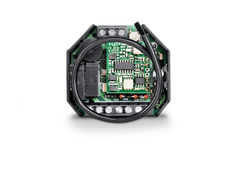
WRM-230
Receiving module for activating window drives with 230 V DC
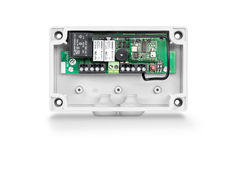
WRM-230B
Receiving module for activating window drives with 230 V DC
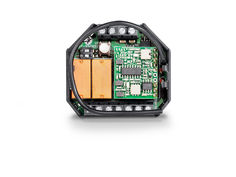
WRM-24
Receiving module for activating automatic doors and window drives with 24 V DC

Guide rail 2-leaf
The correct and, even more so, reliable closing sequence of the door closer system is especially important for double leaf doors.

Combined detector
One thing is certain: automatic sliding doors must open early, as soon as people want to access the door. At the same time, the sliding door must not touch people while it is opening and closing.
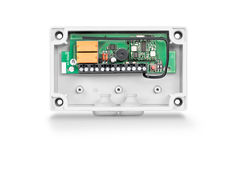
WRM-24B
Receiving module for activating automatic doors and window drives with 24 V DC
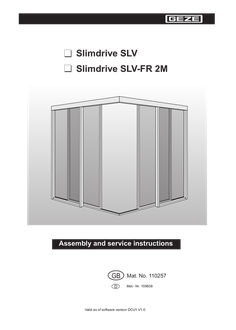
… Learning Air lock or vestibule 20 20 21 22 … • The electrical and mechanical installation has now been completed. • The motor, controller, transformer, accumulator and locking device are mounted and connected. • The controller has not yet been initialised with the "Learn" function. • A display program switch is connected. • The toothed belt locking device (optional) must be locked (interlocking cog completely engages in the toothed belt). Procedure Only use display program switch DCU1 (Mat. No. 103940)! … Start-up Danger of electric shock! Only allow an electrician to connect and disconnect the electrical system (230 V). Implement mains supply and earthed wire check according to VDE 0100 part 610. Connecting cable 1. Disconnect the system from the 230 V mains network. 2. Carry out cable routing in an orderly manner in accordance with terminal connection diagram: Use cable take-up in the end pieces and cable holders. Cut out breaks in the side panel if necessary. 3. Make connections to the controls according to the connection diagram. • If flexible cables are used, attach insulated wire-end ferrules. • The accumulator must be completed charged. 4. Remove cables from sliding path of leaves and driver before startup and secure with cable ties. Starting Learn function 1. Insert the display program switch in the controller. 2. Clear out detection field of all sensors. Danger of crushing! Door leaves move, all the locking devices on the door are deactivated. Move away from the door path. Danger of injury by opened drive! Hair, clothing, cables etc. can be pulled in by rotating parts! When working on open drive, be cautious of rotating parts. 3. Connect system to 230 V mains network. The controller jumps to the Learn function with initial start-up (see Chapter … ) and the display program switch shows LE. Next, is displayed for a controller DCU1 ( = standard door) or for a controller DCU1-2M ( = escape door), and a version number, e.g. 14 for version 1, revision 4. If the controller was already in operation, Learning mode is started by selecting LE in the Service menu, Chapter … . To perform the Learn function correctly, the door leaves must be closed. 4. Close the door leaves. 5. Press key: – Door leaves open and close again. – Run parameters are determined and saved. Learn program proceeds as described in Chapter … ). – Door leaves open and close. When the program selector shows LE or Au, the Learn program has been completed and the door is ready for operation. Check the function 1. Switch system off. 2. Switch system on again. 3. Set display program switch to automatic: The self-test will run automatically. 4. Check function of modules and periphery: – Safety sensor close (SIS): When light barrier/light curtain is interrupted, door may not close following actuation. Door closes slowly after … ) in the Service mode to check whether the controller has learned all the connected modules/safety devices. – Check locking function and reset locking position if necessary (Chapter … minutes, then the controller returns to the normal operating mode. Exceptions: in the Learning mode, in the Diagnostic mode and with motor isolated. Operating Service mode The Service mode starts with the first function in the first menu (function ). The Service mode consists of four menus which are divided into individual functions. Different settings are possible within the functions. The door leaves open and close after each change. IIn the Service mode the door maintains the current operating state and opens and closes accordingly. Exception: Settings and . The keys of the display program switch are assigned as follows in the Service mode: Button Description Go to previous function/setting or increase value Go to next function/setting or decrease value Confirm function and switch to the settings/Accept setting and return to the current menu X Cancel and return to first menu ( function) For the list of menu functions, see terminal connection diagram. 20 … Learning Close door leaves before learning. The door calculates its running parameters by using the Learn function in the Service mode. The display program switch displays the following steps: Display Description Possible settings LO L1 L3 L2 L8 L4 L6 Start — Checking the rotary transducer — Opening width — Toothed belt locking device — Friction — Door leaf mass — Reduced opening width Position the door in the desired position. Press button: The setting is adopted. - or Automatic acceptance after 30 seconds: L7 EL End Adopt setting Error in learning (see Chapter … ) Learning a reduced position for escape doors (DCU1-2M) A reduced opening width can also be learned in the context of the Learn program. To learn a reduced opening size, the operator must submit the escape route width specified for the escape route in writing.Only when this document has been submitted is it permitted to learn a reduced opening width. The set reduced opening width must be at least as large as the specified escape route width. A copy of the document must be included with the service or test log.. The reduced opening width may not be smaller than 30% of the opening width. The control will not learn a smaller reduced position. 1. Before starting the learn program, install a jumper on the control between terminals … and 6. Begin learning. 2. When is displayed at the display program switch, move the door until the desired position for the reduced opening width is reached. 3. Press button Door position is accepted. 4. Press button The Learn program is ended. 5. Remove the jumper between terminal … again. 21 Check: 1. Switch over to the "Automatic" program. 2. Move door into “Winter” operational mode by simultaneously pressing the keys and . 3. Check position of reduced opening width with a tape measure by actuation or with “reduced continuous open". Cancelling Learning mode Press the service key and the closing time key at the same time. … Maintenance The prescribed maintenance work on Slimdrive SLV and Slimdrive SLV-FR 2M is to be carried out by properly trained personnel at least once a year or when the service display on the program selector display lights up (see figure below). 1. Keep the test documents up-to-date and make them available. 2. In the menu item of the second Service menu, bring up the number of openings ( hours ( ) and the number of self-tests ( ) and record these in the maintenance log. ), the operating After completing the maintenance work always carry out the Learn function for the door (see Chapter … 15 L Learning
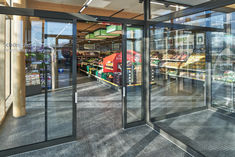
Guide: How to find the ideal GEZE presence detector
… Learn more about the GEZE 338 sensor strip GC 335: Sensor strip with high safety standard for the protection of automatic swing doors and revolving doors Suitable for interior and exterior doors with normal ground conditions Fulfils a high safety standard of protection for main and secondary closing edges Max. installation height 2,500 mm Angle of inclination and scanning range can be adjusted mechanically Learn more about the GEZE 335 sensor strip GEZE Slimdrive EMD IS with GC 342 laser scanner in the experimenta in Heilbronn. © Jürgen Pollak / GEZE GmbH GC 342: Laser scanner for the protection of automatic doors and windows with integrated object and wall blanking Suitable for interior and exterior doors Compact and space-saving For door leaf widths up to 1,600 mm Max. installation height 3,850 mm, depending on the door width High stability, even on difficult door situations and ground conditions Use on doors with continuous vertical pull handle Protection of the main and secondary closing edges on automated windows Learn more about the GC 342 laser scanner GC 342+: Laser scanner for the protection of automatic swing doors with integrated object and wall blanking Suitable for interior and exterior doors Compact and space-saving For door leaf widths up to 1,600 mm Max. installation height 3,850 mm, depending on the door width High stability, even on difficult door situations and ground conditions Added safety: Four laser curtains prevent the door from closing if someone is under the door frame Use on doors with continuous vertical pull handle Virtual push button for activation via the active infrared detector (function only possible if GC 342+ is directly connected to the door drive) Learn more about the GC 342+ laser scanner Automatic linear sliding door system in escape and rescue routes © Robert Sprang / GEZE GmbH GC 339+: Safety sensor for automatic swing, revolving, and curved sliding doors, as well as for windows Suitable for interior and exterior doors Protects the secondary closing edge on automatic sliding doors without a protective leaf, or the main and secondary closing edges on automated windows. Installation height up to 3,500 mm With ten adjustable active infrared detector configurations Learn more about the GC 339+ safety sensor GC 341: Safety sensor for automatic doors Suitable for interior and exterior doors Protects the secondary closing edge on automatic sliding doors without a protective leaf Installation height up to 3,500 mm With four adjustable active infrared detector configurations Convenient commissioning via DIP switch Learn more about the GC 341 safety sensor The GC 363 combined detector is a radar movement detector with infrared light curtain. It fulfils the stipulations for activation and protection of automatic sliding doors. © Lorenz Frey / GEZE GmbH GC 339+: Combined detector for the activation and protection of automatic sliding doors with ten adjustable light curtain configurations Suitable for interior and exterior doors With ten adjustable active infrared detector configurations Installation height up to 3,500 mm All settings can be changed via remote control The combination of activation and protection in one device reduces installation work Learn more about the GC 339+ combined detector GC 365: Combined detector for the activation and protection of automatic sliding doors with four adjustable light curtain configurations Suitable for interior and exterior doors Installation height up to 3,500 mm With … adjustable active infrared detector configurations Covers a larger area of the ground, meaning fewer sensors are required overall Look back function secures the area between the door leaves during the hold-open time All settings can be conveniently made by DIP switch The combination of activation and protection in one device reduces installation work Learn more about the GC 365 combined detector We support you in your planning Customised solutions from GEZE Can't find the right solution for your needs among our standard options? Let our experts help you create a solution from our product range. Give us a call on: GEZE hotline +49-7152-203-0 Architects’ Hotline You can obtain detailed information and advice about our products and their use from our project consultants via our GEZE architects' hotline from Monday to Thursday from 9:00 am to 4:00 pm and on Friday from 9:00 am to 3:00 pm. Give us a call on +49-7152-203-112 Related topics Topics | Automatic doors | Hygiene Automatic doors Automatic doors make everyday life easier. Not only are they convenient, they save energy too. They facilitate barrier-free access and passage, while meeting the most stringent of safety demands. Read more Topics | Energy efficiency | Security | Sustainability | Smart Building | Building automation Building automation Increased comfort, efficiency and safety: digital control and automation technologies make buildings into 'smart buildings'. Read more Access and security | Topics | Security Building security Comprehensive GEZE security solutions and GEZE access control elements ensure optimal protection for people and goods. Read more
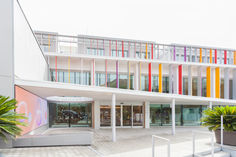
How healing architecture works at the SJD hospital
… LEARN MORE ABOUT OUR SOLUTIONS FOR HEALTH CARE What is healing architecture? The goal of healing architecture is to promote health and well-being through building design. By taking scientific insights into account along with the needs of all building users, healing architecture is intended to support patients’ healing process, improve well-being for personnel and family members, and at the same time improve the effectiveness of medical care. LEARN MORE ABOUT HEALING ARCHITECTURE Accessible and secure access to the PCCB oncology centre ECdrive technology ensures comfortable passing through and creative freedom in the outpatient wards. © Pau Esculies / GEZE Iberia Automatic sliding doors in many areas of the PCCB paediatric hospital were equipped with ECdrive or Slimdrive SL NT drives. These allow for accessible and non-contact movement throughout the hospital, making them the right choice for hygiene reasons as well – especially in sensitive areas like the PCCB oncology centre in Barcelona. The hospital selected the ECdrive for the entrance area. The automatic linear sliding door system easily integrates into the building design, thanks to its low height and clear style. It impresses with low maintenance requirements and a long service life even in high-traffic areas, making it the perfect choice for large health care centres like the Sant Joan de Déu. GC 307+ non-contact push button enables hygienic activation of automatic doors. © Pau Esculies / GEZE Iberia Hermetic sealing thanks to hygienic doors The heart of the new centre, where the operating rooms, X-ray rooms, and specialised area for immunocompromised patients are located, is equipped with highly hygienic doors and the Powerdrive PL-HT automatic linear sliding door system, specially created for large and heavy doors in areas with increased hygiene requirements. They are accessible, low-contact and easy to clean, making them an excellent choice for highly sensitive areas. A hermetic seal is created by lowering and pressing the door leaf against the frame structure. In addition, a full circumferential sealing system with sealing corners reduces the air permeability of the closed sliding door system. LEARN MORE ABOUT HYGIENIC DOORS Hygienic and accessible door opening thanks to radar movement detectors In areas with high hygiene requirements, the GC 307+ non-contact proximity switch also makes it possible to activate automatic doors without actually touching them. The radar movement detector detects persons and objects within a detection area of 10 to 60 cm, allowing the doors to be opened effortlessly, hygienically, d accessibly. In addition, the scanning ranges are adjustable to optimally adapt the sensors to the prevailing ambient conditions and user needs, so doors do not open unnecessarily each time someone passes by, for instance. LEARN MORE ABOUT RADAR MOVEMENT DETECTORS Note Instead of the Powerdrive PL-HT, GEZE now offers the MCRdrive, a new sliding door system that scores highly with a range of advantages, especially for hygienically sensitive areas of application. More about the GEZE MCRdrive Safety and discretion despite an open design inside Multiple factors play a role in the design inside the oncology centre: here as well, ensuring a barrier-free environment is a key priority. The indoor climate, hygiene, and the energy efficiency of the building are also relevant factors. The powerful Powerturn swing door drive is used in corridors and rooms where heavy fire protection doors need to be moved. It is particularly well-suited for large and heavy door leaves, and allows for large opening widths as well, like those needed in hospital operation. Additional advantages of the Powerturn for the hospital: To ensure smooth and safe operation depending on applicable needs and usage areas, the opening and closing speeds, as well as the closing force are individually adjustable from EN4-7. The low energy function ensures doors open and close at reduced speeds, so that they fulfil the highest safety requirements. Motorised support for manual door opening via the servo function is an advantage in particular for users with restricted mobility. Obstacle detection stops the opening or closing process once an obstacle is detected, to avoid potential accidents and damage. Good to know: the Powerturn F/R can be installed for escape and rescue routes at required locations. LEARN MORE ABOUT EMERGENCY EXIT PROTECTION GEZE delivered a large number of automatic drive solutions for multiple areas of the SJD Paediatric Cancer Centre Barcelona. In addition, the company helped create smart access points without architectural barriers, and even air tight solutions in areas with specific hygiene requirements. By doing so, GEZE helped improve quality and safety for all patients and employees of the hospital. Birgit Zondler, Managing Director of GEZE Iberia Key Facts SJD Paediatric Cancer Centre Barcelona – Designed by the architectural firm PINEARQ, under the leadership of Alberto de Pineda – The PCCB building is 14,000 square metres in size – It is directly connected with the Sant Joan de Déu hospital – The paediatric oncology centre covers five floors – 70 % of the area is used to provide medical care, and 30 % is used for research and development – The health centre has a total of 37 single rooms,
Building renovation in historically preserved buildings: the Betonhaus Poznań
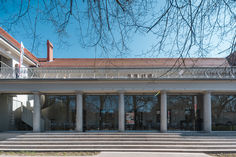
… LEARN MORE ABOUT GEZE SERVICES Customised solution without compromise: GEZE MSW glass sliding wall system The large glass elements of the customised sliding door system can be opened or closed depending on the weather. © Fotografia Maciej Lulko / GEZE Polska One of GEZE’s key USPs was use of the movable glass partition wall system MSW with specially developed running gears, which ensured safe and reliable operation despite the unusual height and structural requirements. The GEZE manual sliding wall system uniquely combines flexibility, aesthetic integration and functionality – all essential factors in transforming the historic industrial building into a modern, multifunctional space. The flexibility of the solution was decisive: the product can be adapted precisely to almost any architectural space – including the special conditions of the historic Betonhaus. This ability to seamlessly integrate the system into a non-standardised structure without compromising on functionality or design was key to the customer's decision to work with GEZE, and continues to be a strong selling point for future projects. Currently, the Petit Paris restaurant is located in this area of the Betonhaus. The restaurant not only benefits from the inviting character and charming view of the park provided by the open façade, but can also use the terrace regardless of the weather and season. Daria Kuttene, owner of Petit Paris, highlights the high functionality, flexibility and seamless integration of the GEZE MSW glass sliding wall system as key factors in creating an open, inviting space that enhances the restaurant's atmosphere all year round. Thanks to the glass wall system, we can easily connect the interior of the restaurant to the terrace. Guests feel like they are sitting right in the middle of the park – whatever the weather. Daria Kuttene, owner of Petit Paris The advantages of the MSW movable glass partition wall Architectural adaptability: The manual sliding wall system creates open, modular spaces that reflect the architectural vision of the Betonhaus – the building’s industrial character is retained, yet it remains flexible for modern uses (e.g. retail, hospitality or cultural functions). Maximum transparency with minimal intervention: Frameless, fully glazed sliding panels preserve the visual integrity of the original concrete structure while providing a modern, open feel and natural light. Flexible room design: The manual sliding wall system allows the room to be easily reconfigured according to the desired usage: it can be closed to create intimate spaces or opened completely to connect interior areas with exterior areas or connect building sections. Efficient manual operation: Simple operation thanks to intelligent guidance systems and smooth opening/closing mechanisms allows the room to be reconfigured frequently without technical barriers for users. Customisable storage options: Storage recesses integrated into to the building structure provide a clean and discreet way to store the infill panels when the system is open – essential to maintaining the minimalist aesthetics of the revitalised space. LEARN MORE ABOUT ROOM PARTITIONING GEZE MSW: Customised sliding door system for modern, open and flexible room design The guide rails of the system allow for safe operation of the manual sliding wall system. © Fotografia Maciej Lulko / GEZE Polska Special solutions were implemented for the Betonhaus to ensure both functionality and aesthetics: three of the infill panels in the manual sliding wall system were designed to serve as entrance doors. When the partition wall system is opened or closed, these integrated door assemblies move together with the rest of the system, maintaining a seamless appearance while providing easy and functional access to the building. This solution was specially tailored to the client's desire for optimum usability without compromising the architectural coherence of the façade. Challenging statics: powerful special solutions for the Betonhaus As the building was very old and no detailed support documentation was available, a customised static reinforcement system was developed to ensure sufficient load-bearing capacity. In close cooperation with a structural engineer from SQT Inżynieria w Budownictwie and an architect from JEMS Architekci, a reinforced steel substructure was designed to reinforce the existing ceiling. This customised solution was essential to ensure the structural integrity of the building, particularly given the unknown load-bearing capacity of the original structure. The reinforcement enabled the new manual sliding wall system to be installed securely while preserving the historic character of the building. The challenge of historical preservation: between safety and aesthetics Throughout the project, ongoing consultation with the conservation officer was essential. Their approval was required for each phase of the reconstruction to ensure that the historical value of the building was preserved while incorporating modern elements such as accessibility and fire protection . Another challenge was the presence of historical architectural elements that could not be moved or altered, such as the columns. To get around this, additional side guide rails had to be designed, which made it possible to install the sliding wall system without touching or damaging these protected parts of the building. One reason why the solution was accepted by the conservation officer was that, despite its impressive size, the GEZE MSW system is visually unobtrusive. It blends harmoniously into the historic architecture and preserves the original aesthetics of the room. Thanks to this customised combination of intelligent technology and subtle design, the room has been modernised in a way that meets the requirements of the historic preservation authorities, while also satisfying structural and aesthetic requirements. Betonhaus Poznań The Betonhaus, made of reinforced concrete, was built in 1910 over a six month period as an exhibition pavilion. It opened in May 1911 as part of the East German Exhibition for Industry, Crafts and Agriculture. It was originally used as a "hunting lodge" where imperial trophies were displayed. Over time, the hall has had various purposes, including housing university departments and serving as a music pavilion. The house is particularly impressive due to its ornately decorated barrel vault. GEZE Services at a glance Planning Process Implementation Installation Product trainings Acceptance Maintenance Planning Process Implementation Installation Product trainings Acceptance Maintenance GEZE provided the client with comprehensive support during the planning phase, supplying all the necessary CAD drawings for the manual sliding wall system. These technical drawings formed an important basis for the structural engineer and architects’ work, and enabled the partition wall system to be integrated precisely into the building design. Thanks to GEZE's detailed and project-specific documentation, the planning team was able to ensure optimal coordination between the architectural concept, the structural requirements and the functional expectations. LEARN MORE ABOUT PLANNING GEZE actively supported all parties involved in the project through close cooperation on site and via remote access. GEZE specialists on site and in the office worked hand in hand with architects, engineers and installation teams to ensure smooth communication, efficient problem solving and seamless integration of the manual sliding wall system at every stage. This proactive approach helped to keep the schedule on track, resolve technical challenges and align system implementation with the overall vision of the project. GEZE supported the implementation process by working closely with the contractor throughout the installation and ensuring correct alignment with system specifications and functional requirements. Installation of the manual sliding wall system was handled by an external contractor. However, GEZE provided technical support throughout the process to ensure proper assembly and configuration. GEZE conducted on-site training for the plant's operating personnel. As the manual sliding wall system is a custom-made product, selected personnel were instructed in how to open and close the system correctly and safely. Only trained persons are authorised to operate the system. LEARN MORE ABOUT GEZE TRAINING GEZE supported the acceptance process by ensuring that the system was properly configured and functional prior to handover. There were no complaints or problems from the installation company, confirming the quality and conformity of the system. GEZE offers a system maintenance service and is available for ongoing support as required to ensure the long-term reliability and performance of the solution. LEARN MORE ABOUT GEZE SERVICES Products used MSW all-glass MSW Comfort Movable all-glass partition wall system for shop partitions and flexible room design Go to product MSW with fine-framed panels MSW sliding panel - fine-framed Basic element of a movable fine-framed glass partitioning wall Go to product MSW with fine-framed panels MSW double-action door - fine-framed Closure element for movable fine-framed glass partitioning walls Go to product Related topics Topics | Building renovation Building renovation You can increase the comfort, the security and the energy efficiency of your existing properties through building renovation works. GEZE supports you in this with the right products. Read more Public buildings | References | Accessibility | safety Renovating a protected historical building at Mannheim Palace The building renovation of Mannheim Palace meets modern standards for fire protection, accessibility and energy efficiency. Find out why Gassert chose GEZE door systems for this project. Read more