Search filter
39 results found
Gripping and cleaning scissors (FPS)
For fanlight openers for additional protection of bottom-hung leaves
… carbon as well as other elements depending on the desired characteristics. Components made of steel are formed by stamping or other types of mechanical processing. 1) This product/article/at least one partial article contains substances listed in the ECHA candidate list (date: … Comparability Basically, a comparison or an evaluation of EPD data is only possible if all the data sets to be compared were created according to EN 15804 and the building context, respectively the product-specific characteristics of performance, are taken into account. ecoinvent v3.8 (system model: cut-off by classification) has been used as the background database. 4. LCA: Scenarios and additional technical information Characteristic product properties of biogenic carbon Information on the biogenic carbon content at factory gate Note: … kg of biogenic carbon is equivalent to 44/12 kg of CO2. Name Biogenic carbon content in product Biogenic carbon content in accompanying packaging Value Unit kg
… carbon as well as other elements depending on the desired characteristics. Components made of steel are formed by stamping or other types of mechanical processing. Zamak is an alloy with a base metal of zinc and alloying elements of aluminium, magnesium, and copper. Components … Comparability Basically, a comparison or an evaluation of EPD data is only possible if all the data sets to be compared were created according to EN 15804 and the building context, respectively the product-specific characteristics of performance, are taken into account. ecoinvent v3.8 (system model: cut-off by classification) has been used as the background database. 4. LCA: Scenarios and additional technical information Characteristic product properties of biogenic carbon Note: … kg of biogenic carbon is equivalent to 44/12 kg of CO2. Information on the biogenic carbon content at factory gate Name Value Unit kg Biogenic carbon content in product … C Biogenic carbon content in accompanying kg
… carbon as well as other elements depending on the desired characteristics. Components made of steel are formed by stamping or other types of mechanical processing. Brass is an alloy of zinc and copper. Components made of brass are made by extrusion, forging, die-casting or other types of mechanical processing. Nickel silver is an alloy of copper, nickel, and zinc. Components made of nickel silver are formed by stamping or other types of mechanical processing. Bronze is an alloy consisting primarily of copper, commonly with tin and often with the addition of other metals and sometimes non-metals. Components can be bronze-coated for decorative reasons and for providing sliding and dry running properties. 1) This product/article/at least one partial article contains substances listed in the ECHA candidate list (date: … Comparability Basically, a comparison or an evaluation of EPD data is only possible if all the data sets to be compared were created according to EN 15804 and the building context, respectively the product-specific characteristics of performance, are taken into account. ecoinvent v3.8 (system model: cut-off by classification) has been used as the background database. 4. LCA: Scenarios and additional technical information Characteristic product properties of biogenic carbon Information on biogenic carbon content at factory gate Note: … kg of biogenic carbon is equivalent to 44/12 kg of CO2. Name Biogenic carbon content in product Biogenic carbon content in accompanying packaging Value Unit kg
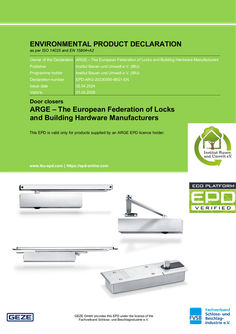
… carbon as well as other elements depending on the desired characteristics. Components made of steel are formed by stamping or other types of mechanical processing. Aluminium is a non-ferrous metal produced from bauxite by the Bayer process. Components made of aluminium are manufactured by extrusion or other types of mechanical processing. Zamak is an alloy with a base metal of zinc and alloying elements of aluminium, magnesium, and copper. Components made of Zamak are die-cast. ABS (acrylonitrile butadiene styrene) is a terpolymer polymer made by polymerizing styrene and acrylonitrile in the presence of polybutadiene. Components made of ABS are made by injection moulding or other thermal forming processes. Brass is an alloy of zinc and copper. Components made of brass are made by extrusion, forging, die-casting or other types of mechanical processing. Nylon 66 is a polymer, in particular polyamide. It is formed by the polycondensation of hexamethylenediamine and adipic acid in equal parts. Components made of Nylon 66 are formed by injection moulding or other thermal forming processes. PP (polypropylene) is a thermoplastic polymer produced from propylene by a polymerisation process. Components made of PP are formed by injection moulding or other thermal forming processes. Rubber (synthetic) is an elastomer synthesised by the polymerisation of petroleum byproducts. Components made of rubber are formed by injection moulding or other thermal forming processes. Acetal, or polyoxymethylene (POM), is produced by polymerisation of anhydrous formaldehyde. Components made of Acetal are formed by injection moulding or other thermal forming processes. PEHD (polyethylene high-density) is a thermoplastic polymer produced from the monomer ethylene. Components made of PEHD are formed by injection moulding or other thermal forming processes. 1) This product/article/at least one partial article contains substances listed in the ECHA candidate list (date: … Comparability Basically, a comparison or an evaluation of EPD data is only possible if all the data sets to be compared were created according to EN 15804 and the building context, respectively the product-specific characteristics of performance, are taken into account. ecoinvent v3.8 (system model: cut-off by classification) has been used as the background database. 4. LCA: Scenarios and additional technical information Characteristic product properties of biogenic carbon The following information is the basis of the declared modules within the LCA in this EPD. Information on the biogenic carbon content at factory gate Note: … kg of biogenic carbon is equivalent to 44/12 kg of CO2. Transport to the building site (A4) Name Litres of fuel Transport distance Capacity utilisation (including empty runs) Name Biogenic carbon content in product Biogenic carbon content in accompanying packaging
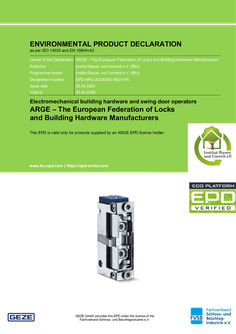
… carbon as well as other elements depending on the desired characteristics. Components made of steel are formed by stamping or other types of mechanical processing. Stainless steel is produced by combining iron with chromium as well as other elements depending on the desired characteristics. Components made of steel are formed by stamping or other types of mechanical processing. Zamak is an alloy with a base metal of zinc and alloying elements of aluminium, magnesium, and copper. Components made of Zamak are die-cast. Motor, PCB are electronic components, which include copper wiring, etched copper sheets on non-conductive substrates, resistors, transistors, etc. ABS (acrylonitrile butadiene styrene) is a terpolymer polymer made by polymerizing styrene and acrylonitrile in the presence of polybutadiene. Components made of ABS are made by injection moulding or other thermal forming processes. Acetal, or polyoxymethylene (POM), is produced by polymerisation of anhydrous formaldehyde. Components made of Acetal are formed by injection moulding or other thermal … Comparability Basically, a comparison or an evaluation of EPD data is only possible if all the data sets to be compared were created according to EN 15804 and the building context, respectively the product-specific characteristics of performance, are taken into account. ecoinvent v3.8 (system model: cut-off by classification) has been used as the background database. Environmental Product Declaration - ARGE – The European Federation of Locks and Building Hardware Manufacturers - Electromechanical building hardware and swing door operators 4. LCA: Scenarios and additional technical information Characteristic product properties of biogenic carbon Information on the biogenic carbon content at factory gate Note: … kg of biogenic carbon is equivalent to 44/12 kg of CO2. Name Value Unit kg … C Biogenic carbon content in product Biogenic carbon content in accompanying packaging The following information is the basis of the declared modules within the LCA in this EPD. Transport to the building site (A4) Name Litres of fuel Transport distance Capacity utilisation (including empty runs) Installation into the building (A5) Name Material loss Value Unit
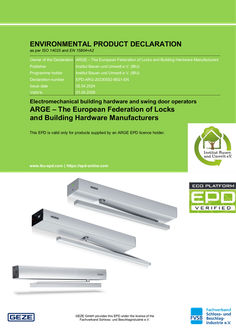
… carbon as well as other elements depending on the desired characteristics. Components made of steel are formed by stamping or other types of mechanical processing. Stainless steel is produced by combining iron with chromium as well as other elements depending on the desired characteristics. Components made of steel are formed by stamping or other types of mechanical processing. Zamak is an alloy with a base metal of zinc and alloying elements of aluminium, magnesium, and copper. Components made of Zamak are die-cast. Motor, PCB are electronic components, which include copper wiring, etched copper sheets on non-conductive substrates, resistors, transistors, etc. ABS (acrylonitrile butadiene styrene) is a terpolymer polymer made by polymerizing styrene and acrylonitrile in the presence of polybutadiene. Components made of ABS are made by injection moulding or other thermal forming processes. Acetal, or polyoxymethylene (POM), is produced by polymerisation of anhydrous formaldehyde. Components made of Acetal are formed by injection moulding or other thermal … Comparability Basically, a comparison or an evaluation of EPD data is only possible if all the data sets to be compared were created according to EN 15804 and the building context, respectively the product-specific characteristics of performance, are taken into account. ecoinvent v3.8 (system model: cut-off by classification) has been used as the background database. Environmental Product Declaration - ARGE – The European Federation of Locks and Building Hardware Manufacturers - Electromechanical building hardware and swing door operators 4. LCA: Scenarios and additional technical information Characteristic product properties of biogenic carbon Information on the biogenic carbon content at factory gate Note: … kg of biogenic carbon is equivalent to 44/12 kg of CO2. Name Value Unit kg … C Biogenic carbon content in product Biogenic carbon content in accompanying packaging The following information is the basis of the declared modules within the LCA in this EPD. Transport to the building site (A4) Name Litres of fuel Transport distance Capacity utilisation (including empty runs) Installation into the building (A5) Name Material loss Value Unit
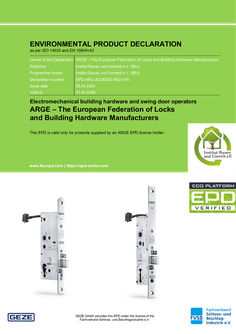
… carbon as well as other elements depending on the desired characteristics. Components made of steel are formed by stamping or other types of mechanical processing. Stainless steel is produced by combining iron with chromium as well as other elements depending on the desired characteristics. Components made of steel are formed by stamping or other types of mechanical processing. Zamak is an alloy with a base metal of zinc and alloying elements of aluminium, magnesium, and copper. Components made of Zamak are die-cast. Motor, PCB are electronic components, which include copper wiring, etched copper sheets on non-conductive substrates, resistors, transistors, etc. ABS (acrylonitrile butadiene styrene) is a terpolymer polymer made by polymerizing styrene and acrylonitrile in the presence of polybutadiene. Components made of ABS are made by injection moulding or other thermal forming processes. Acetal, or polyoxymethylene (POM), is produced by polymerisation of anhydrous formaldehyde. Components made of Acetal are formed by injection moulding or other thermal … Comparability Basically, a comparison or an evaluation of EPD data is only possible if all the data sets to be compared were created according to EN 15804 and the building context, respectively the product-specific characteristics of performance, are taken into account. ecoinvent v3.8 (system model: cut-off by classification) has been used as the background database. Environmental Product Declaration - ARGE – The European Federation of Locks and Building Hardware Manufacturers - Electromechanical building hardware and swing door operators 4. LCA: Scenarios and additional technical information Characteristic product properties of biogenic carbon Information on the biogenic carbon content at factory gate Note: … kg of biogenic carbon is equivalent to 44/12 kg of CO2. Name Value Unit kg … C Biogenic carbon content in product Biogenic carbon content in accompanying packaging The following information is the basis of the declared modules within the LCA in this EPD. Transport to the building site (A4) Name Litres of fuel Transport distance Capacity utilisation (including empty runs) Installation into the building (A5) Name Material loss Value Unit

Smoke and heat extraction system (SHEV) save lives in case of a fire
… carbon monoxide (CO). Concentrations of this gas rises rapidly during a fire. Inhaling carbon monoxide leads to headaches, symptoms of poisoning, unconsciousness, and ultimately death. Smoke-free escape and rescue routes thanks to SHEV Toxic fumes must be removed from the building as quickly as possible. Smoke extractors are installed to provide natural smoke extraction. SHEV smoke ventilation systems can be activated automatically (via smoke detectors) or manually (via SHEV buttons). They open ventilation openings like SHEV windows or fanlights . These draw fumes and heat energy away from the building. Escape routes remain smoke-free and fire-fighters are able to intervene quickly, precisely where they are needed. LEARN MORE ABOUT EMERGENCY EXIT PROTECTION Effective smoke extraction requires air inlet openings Smoke and heat extraction systems are dependent on smoke being extracted from above a supply of fresh air from below. These air inlet openings support fire-fighting measures Air inlet systems provide: increasing thermal drive, resulting in fumes being drawn more quickly through SHEV windows or openings in the roof (chimney effect), creating a low-smoke layer along the bottom part of the room to provide a clear view of escape and rescue routes, reducing the amount of fumes and explosive smouldering gases as a result of cleaner combustion, reducing the heat, enabling fire-fighters to get closer to the fire. GO TO GEZE AIR INLET SYSTEMS Tips for planning and assembly of smoke and heat extraction system air-Inlet doors This is how effective smoke and heat extraction works in the event of a fire: GEZE expert Dr. Dominik Landerer explains the central role of air inlets for effective smoke and heat extraction systems (SHEV) in buildings and provides practical tips for planning and implementing SHEV air-Inlet doors. MORE ABOUT SMOKE AND HEAT EXTRACTION SYSTEM AIR-INLET DOORS Smoke vent, heat extraction, smoke and heat extraction systems and pressure ventilation systems Smoke extraction (NRA, NRWG, MRA) Heat extraction Smoke and heat extraction systems Pressure ventilation systems Smoke extraction (NRA, NRWG, MRA) Heat extraction Smoke and heat extraction systems Pressure ventilation systems A smoke vent is part of preventative fire suppression and ensures smoke extraction in case of a fire. The objective is a stable layer of air with little smoke near the floor so that escape and rescue routes can be used safely. An open smoke extraction also carries away heat from the fire. This means that the load-bearing behaviour of load-bearing or separating construction components is extended considerably. For this reason, the terms smoke extraction and smoke ventilation are often used synonymously. Smoke extraction is designated as natural smoke extraction if it works via natural thermal lift, without additional ventilation drives (such as ventilators). Natural smoke and heat extraction system (NSHEV) include, for instance, windows, skylights, ventilation blinds that open automatically in case of a fire and help dissipate smoke and hot gases out of a building. In accordance with DIN EN 12101-2, a natural NSHEV is a natural smoke and heat extraction system designed for installation in buildings as part of a smoke ventilation system. A natural SHEV consists of a window and its associated components (profiles, seals, door fittings), the infill (e.g. glass, panels), and the drive system with its associated components (drive, consoles, fittings). A mechanical smoke extraction (MRA) works with a motorised drive, such as with smoke extraction fans. Smoke can be removed either with or without ventilation ducts. Materials in wall or roof areas are described as heat extraction (WA) if they melt at higher temperatures or destroy themselves in the process. Openings created in this way enable heat from the fire to escape from the burning room. The energy drawn from the room on fire is now not available to further heat load-bearing or divisional construction components, for example. As a result, these construction components reach their critical temperature at a later point in time. Heat extraction thus extends the load-bearing behaviour of such components. Heat extraction generally becomes effective when the fire has taken hold for some time. Fumes are also drawn out via the openings. But this is too late in terms of protecting people and fighting the fire. S0 heat extraction is not the same thing as smoke extraction! The term automatic opening vent and the technical systems that performs this function are both abbreviated with AOV. Natural automatic opening vent (AOV) consist of the following: the AOV smoke vent, e.g. windows, fanlights, skylights in roof, each with drive system the control and power supply (AOV panel) the triggering element (such as smoke detectors, AOV system button) the fresh air supply (e.g. via open windows or doors) smoke screens if needed (to divide up larger rooms) Safety stairwells are required in pressure ventilation systems: according to the Model Building Code (MBO Sec. 33), a safety stairwell must be designed so that fire and smoke cannot get inside. Pressure ventilation systems and smoke protection pressure systems ensure they remain free from smoke. Functions of SHEV Smoke and heat extraction systems (SHEV) serve primarily as preventive fire protection to safeguard people. They also have additional functions, however: Protecting people keeping smoke out of rescue routes Environmental protection reducing environmental damage Property protection maintaining the building structure Active rescue Minimising damage caused by fire extinguishing activities Fire-fighting support Passive rescue Minimum use of extinguishing agents Ventilation of the fire Localisation of the fire Minimisation of the thermal load Smoke and heat extraction SHEV enables escape, rescue, and fire-fighting measures. © GEZE GmbH Smoke and heat extraction Without SHEV, toxic fumes and heat will remain in the building. © GEZE GmbH GEZE electric SHEV and ventilation systems brochure You can download our brochure on SHEV and ventilation systems here: GEZE ELECTRIC SHEV AND VENTILATION SYSTEMS (PDF |

Automated door, window and safety systems for sustainable buildings
… carbon footprint Intelligent building automation can improve not only energy efficiency , but indoor air quality as well. This is because smart window systems that are networked with the building management system enable automated, natural ventilation. Windows open and close at set times or in certain situations, such as in case of wind, rain, and solar radiation, or when indoor and outdoor temperatures reach a certain level. Automated night-time cooling is also possible, ensuring a good indoor climate at the beginning of the day. This also allows supplementary climate control technology like the heating and cooling systems to be used in a more targeted and efficient way. This results in energy and cost savings for sustainable building climate control. More about natural ventilation Comprehensive service from GEZE across all service phases Christian Roßmeier, Business Manager Markets & Technology at GEZE. © GEZE GmbH “On average, architects receive change requests for windows and doors in 20 percent of cases. Usually, this is due to insufficient or poor planning. Because of this, automation experts from the manufacturer side should be involved in the planning early on. We support architects throughout all service phases, from design to specialist door planning with full or partial project management, to the pre-commissioning inspection and construction site coordination. This approach allows us to optimally implement building and application-specific requirements and the needs of building owners and operators right from the outset” says Christian Roßmeier, Business Manager Markets & Technology at GEZE. We support architects throughout all service phases, from design to specialist door planning with full or partial project management, to the pre-commissioning inspection and construction site coordination. Christian Roßmeier, Business Manager Markets & Technology Efficient networking solutions with the BACnet open standard Networking solutions from GEZE are designed to offer our customers the best possible integration and interoperability with all automated subsections of a building. This is where the new, modular connectivity platform myGEZE Control comes into play: the establishment of the BACnet open communication standard has made it possible to provide a uniform, manufacturer-independent standard for data exchange between the components of a building management system. This allows different devices for controlling lights, safety, fire alarm technology, and heating, ventilation and air conditioning systems to be centrally integrated, controlled and monitored. “In contrast to other manufacturers, we have been using the open BACnet standard for years, and can deliver the entire integration solution with project management. This is a unique selling principle for our company. Other, provider-specific solutions on the market generally require a large amount of work to integrate into the higher-ranking building management system, or need to be managed in parallel” says Christian Roßmeier. In contrast to other manufacturers, we have been using the open BACnet standard for years, and can deliver the entire integration solution with project management. This is a unique selling principle for our company. Christian Roßmeier, Business Manager Markets & Technology The advantages of the new platform include automated processes in the building and central monitoring, which makes using the system more convenient and safe. In addition, it helps ensure all building operations processes are optimised. Outages and faults in door systems are reliably reported and quickly forwarded to service technicians. This means malfunctions relevant to building safety and operation can be corrected early, as well as maintained or repaired in a more targeted fashion. This boosts the longevity of the product and ensures better sustainability. Depending on the solution used, important functions such as the reliable closure of doors or windows can be centrally monitored after the end of business hours and triggered as needed, even via mobile applications. Learn more about the connectivity platform myGEZE Control Building automation with myGEZE Control offers these added values Scenarios involving access-restricted areas, accessibility, fire protection or emergency exit protection can be implemented easily. Sustainable, highly energy-efficient buildings can be created with intelligent control and networking of windows and doors. Smart window systems networked via myGEZE Control allow for automated, natural ventilation to improve comfort for users. Continuous monitoring of the building and interventions to optimise building processes are possible at any time, including remotely. Thanks to standardised BACnet project management, system integration is completely independent of service providers. The solution can be integrated easily into all common building management, physical security management or CAFM systems. myGEZE Control is a scalable solution and can grow with the requirements of a building. Every building has its own individual requirements. And the people who spend time in these buildings everyday have different needs. myGEZE Control elevates building automation to an all new level. Optimally designed around your requirements. For more comfort, efficiency, and sustainability. Learn more about myGEZE Control For personalised advising, please call us at +49-7152-203-0 . Related topics Topics | Energy efficiency | Sustainability Energy efficiency in buildings Energy efficiency is of major significance for architects, planners and users. Because a large proportion of the total consumption of end-use energy costs is accounted for by buildings. GEZE provides energy-saving and sustainable solutions for door, window and safety technology. Read more Topics | Energy efficiency | Security | Sustainability | Smart Building | Building automation Building automation Increased comfort, efficiency and safety: digital control and automation technologies make buildings into 'smart buildings'. Read more Topics | Energy efficiency | Sustainability | Green Building Green building GEZE believes in sustainable building. Our products meet DGNB and LEED criteria, some of the most important certificates for the sustainability of a building. Read more