Search filter
13 results found
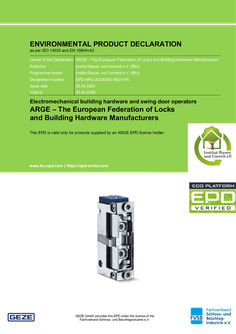
ENVIRONMENTAL PRODUCT DECLARATION as per ISO 14025 and EN 15804+A2 Owner of the Declaration ARGE – The European Federation of Locks and Building Hardware Manufacturers Publisher Institut Bauen und Umwelt e.V. (IBU) Programme holder Institut Bauen und Umwelt e.V. (IBU) Declaration number EPD-ARG-20230552-IBG1-EN Issue date … .2024 Valid to … .2029 Electromechanical building hardware and swing door operators ARGE – The European Federation of Locks and Building Hardware Manufacturers This EPD is valid only for products supplied by an ARGE EPD licence holder. www.ibu-epd.com | https://epd-online.com GEZE GmbH provides this EPD under the license of the Fachverband Schloss- und Beschlagindustrie e.V. 1. General Information ARGE – The European Federation of Locks and Building Hardware Manufacturers Electromechanical building hardware and swing door operators IBU – Institut Bauen und Umwelt e.V. Hegelplatz … 10117 Berlin Germany Declaration number ARGE – The European Federation of Locks and Building Hardware Manufacturers Offerstraße 12 42551 Velbert Germany Declared product / declared unit EPD-ARG-20230552-IBG1-EN … kg of electromechanical building hardware or swing door operator This declaration is based on the product category rules: Scope: Building Hardware products, … .2021 (PCR checked and approved by the SVR) This ARGE EPD covers electromechanical building hardware and swing door operators used to control access on doors or gates, or enable door or window opening and closing, as well as holding open of a door or window by means of electrical impulse. Several products of this product group have been assessed in separate LCA; from these LCA the worst values per indicator and module are declared as worst-case assumption. It can therefore be used to cover all electromechanical access control devices for doors and gates, as well as devices for opening, hold open and closing of doors, gates and windows manufactured in Europe by ARGE member companies. The owner of the declaration shall be liable for the underlying information and evidence; the IBU shall not be liable with respect to manufacturer information, life cycle assessment data and evidences. Programme holder Issue date … .2024 Valid to … .2029 Owner of the declaration The EPD was created according to the specifications of EN 15804+A2. In the following, the standard will be simplified as EN 15804. Verification The standard EN 15804 serves as the core PCR Independent verification of the declaration and data according to ISO 14025:2011 Dipl.-Ing. Hans Peters (Chairman of Institut Bauen und Umwelt e.V.) Florian Pronold (Managing Director Institut Bauen und Umwelt e.V.) … internally X externally Dr. Matthew Fishwick, (Independent verifier) Environmental Product Declaration - ARGE – The European Federation of Locks and Building Hardware Manufacturers - Electromechanical building hardware and swing door operators 2. Product … Product description/Product definition This ARGE EPD covers electromechanical building hardware and swing door operators used to control access on doors or gates, or enable opening, holding open and closing of a door or window, designed to potentially being integrated into access control systems, building security and/or automation systems, etc. There are … principal versions of such electromechanical hardware devices: - battery-powered - with external power supply For certain products covered by this EPD the placing on the market in the European Union/European Free Trade Association (EU/EFTA) (with the exception of Switzerland) has to be compliant with Regulation (EU) No. 305/2011 (CPR). These products need a declaration of performance taking into consideration EN 14846:2008 Building hardware – Locks and latches – Electromechanically operated locks and striking plates – Requirements and test methods and the CE-marking. In addition to such products requiring a CE-marking under EN 14846 all of the following products require a CE-marking as for placing in the European Union/European Free Trade Association (EU/EFTA) (with the exception of Switzerland) other legal provisions apply: • Electromechanically operated locks and striking plates, if no CE-marking is required under EN 14846:2008. • Mechatronic cylinders: EN 15684:2020, Building hardware - Mechatronic cylinders - Requirements and test methods. • Mechatronic padlocks: EN 16864:2017, Building hardware - Mechatronic padlocks - Requirements and test methods. • Mechatronic door furniture: EN 16867:2020+A1:2021, Building hardware - Mechatronic door furniture Requirements and test methods. • Electrically controlled exit systems for use on escape routes: EN 13637:2015, Building hardware - Electrically controlled exit systems for use on escape routes Requirements and test methods. • Electrically powered hold-open devices for swing doors: EN 1155:1997+A1:2002+AC:2006, Building hardware Electrically powered hold-open devices for swing doors Requirements and test methods. These other legal provisions which might apply for the electromechanical building hardware devices are: • Directive (EU) No. 2014/35 (Low Voltage Directive (LVD)) • Directive (EU) No. 2014/30 (Electromagnetic Compatibility (EMC) Directive) • Directive (EU) No. 2014/53 (Radio Equipment Directive (RED)) • Directive (EU) No. 2011/65 (Directive on the restriction of the use of certain hazardous substances in electrical and electronic equipment (RoHS Directive)) • Directive (EU) No. 2006/42 (Machinery Directive) The respective CE-marking takes into account the proof of conformity with the relevant harmonised standard(s) based on these legal provisions or with the legal provision itself. For the application and use the respective national provisions apply. These products are designed to be integrated into or installed on door, gate and window assemblies consisting of various materials and used for various applications. They may be used for either interior or exterior doors, gates or windows, in accordance with manufacturer's instructions. … Technical Data Ideally, products should comply with a suitable technical specification. EN 14846:2008, Building hardware – Locks and latches – Electromechanically operated locks and striking plates – Requirements and test methods is an example of such a specification and some products will comply with it. Performance data of such products in accordance with the declaration of performance with respect to its essential characteristics according to this standard. Performance data of other products in respect to its characteristics in accordance with the relevant technical provision (no CE-marking). … Delivery status The products are sold by unit. Deliveries of individual items are possible but are an exception. Standard deliveries comprise a larger quantity of electromechanical building hardware devices, as they are marketed as "B2B" products and not to end-users. … Base materials/Ancillary materials Composition of product analysed for this EPD: The values given in the table below are for the product analysed for this EPD: Name Value Steel … Stainless steel … Zamak … Motor … PCB … ABS … Acetal … Neodymium … Unit % % % % % % % % Steel is produced by combining iron with carbon as well as other elements depending on the desired characteristics. Components made of steel are formed by stamping or other types of mechanical processing. Stainless steel is produced by combining iron with chromium as well as other elements depending on the desired characteristics. Components made of steel are formed by stamping or other types of mechanical processing. Zamak is an alloy with a base metal of zinc and alloying elements of aluminium, magnesium, and copper. Components made of Zamak are die-cast. Motor, PCB are electronic components, which include copper wiring, etched copper sheets on non-conductive substrates, resistors, transistors, etc. ABS (acrylonitrile butadiene styrene) is a terpolymer polymer made by polymerizing styrene and acrylonitrile in the presence of polybutadiene. Components made of ABS are made by injection moulding or other thermal forming processes. Acetal, or polyoxymethylene (POM), is produced by polymerisation of anhydrous formaldehyde. Components made of Acetal are formed by injection moulding or other thermal … Application … Environmental Product Declaration - ARGE – The European Federation of Locks and Building Hardware Manufacturers - Electromechanical building hardware and swing door operators forming processes. disposal (including recycling). Neodymium is a chemical element and Neodymium alloys, used in high quality permanent magnets, consist of pure neodymium, iron, and boron. … Condition of use Once installed, the products shall require no servicing during their expected service lives. There shall be no consumption of water linked to their use, and they shall not cause any emissions. Battery (in case of battery-powered electromechanical devices): AA 1.5V Lithium or similar. 1) This product/article/at least one partial article contains substances listed in the ECHA candidate list (date: … .2023) exceeding … percentage by mass: Certain components may contain small amounts of lead (CAS no. 7439-92-1) as an alloying element. 2) This product/article/at least one partial article contains other cancerogenic, mutagenic, reprotoxic (CMR) substances in categories 1A or 1B which are not on the ECHA candidate list, exceeding … percentage by mass: no. 3) Biocide products were added to this construction product or it has been treated with biocide products (this then concerns a treated product as defined by the (EU) Ordinance on Biocide Products No. 528/2012): no. … Manufacture The manufacture of an electromechanical building hardware device usually follows a 3-step process: 1. Manufacture of the components: this step may include surface treatment in the factory or by external contractors. 2. Pre-assembly of modules (in the factory). 3. Final assembly (in the factory). … Environment and health during manufacturing Regular measurements of air quality and noise levels are carried out by the manufacturers, the ARGE member companies. The results shall be within the mandatory safety levels. In areas where employees are exposed to chemical products, the required protective clothing and technical protective devices shall be provided. Regular health checks are mandatory for employees in production facilities. … Product processing/Installation The installation of the product may vary depending on the type of door, gate or window and the specific situation, but the products shall not require energy consumption for installation. … Packaging Normally, each individual product is packed in paper or cardboard. These individual products are then packed in a cardboard box and stacked on wooden pallets for transport to the customer. … Environment and health during use No environmental damage or health risks are to be expected during normal conditions of use. … Reference service life A reference service life according to ISO 15686 cannot be declared. The typical service life is 10 years under normal working conditions. The service life is not limited due to mechanical obsolescence but due to outdated electronic components/software. It is required that installation, as well as maintenance of the product, must be done in line with instructions provided by the manufacturer. … Extraordinary effects Fire Certain products are suitable for use on fire resisting and/or smoke control door/window sets according to e.g., one of the classes A, B, N in EN 12209. Specific needs on fire resistance are addressed by individual manufacturers. Water The declared product is intended to be used in buildings under normal conditions (indoor or outdoor). It shall not emit hazardous substances in the event of flooding. Mechanical destruction Mechanical destruction of the declared product shall not materially alter its composition or have any adverse effect on the environment. … Re-use phase Removal of electromechanical building hardware (for re-use or recycling) shall have no adverse effect on the environment. … Disposal Electromechanical building hardware components should be recycled wherever possible, providing that there is no adverse effect on the environment. The waste code in accordance with the European Waste Code is 17 04 07. … Further information Details of all types and variants can be found on the manufacturers' websites. The respective website addresses are available at https://arge.org. Waste from product packaging is collected separately for waste 3. LCA: Calculation rules … Declared Unit The declared unit for all products covered by ARGE EPD is … kg (of product). Since individual products will rarely weigh exactly … kg it is necessary to establish the exact weight of the product then use this as a correction factor to determine the true values for … kg of product in the tables (Section 5). Declared unit Name Declared unit Mass of assessed products Raw density Value … - … Unit kg kg kg/m3 … System boundary Type of the EPD: "cradle to gate with options, with modules C1 – C4, and module D (A1-A3, C1-C3, D and additional modules)" The analysis of the product life cycle includes the production … Environmental Product Declaration - ARGE – The European Federation of Locks and Building Hardware Manufacturers - Electromechanical building hardware and swing door operators and transport of the raw materials, manufacture of the product and the packaging materials which are declared in modules A1A3. Losses during production are considered as waste and are sent for recycling. No recycling processes are taken into account except transport and electricity consumption for grinding the metals. When recycled metals are used as raw material only their transformation process is taken into account and not the extraction of the raw material. A4 module represents the transport of the finished electromechanical building hardware or swing door operator to the installation site. There is no waste associated with the installation of the product. The A5 module therefore represents only the disposal of the product packaging. Two alternatives are declared for the power supply: • B6_1: replacement of the battery every … years (for battery-powered devices) • B6_2: energy consumption from the grid (for gridconnected devices) The End-of-Life (EoL) stages are also considered. The transportation to the EoL disposal site is taken into account in module C2. Module C4 covers the disposal of the electromechanical building hardware or swing door operator. Module C3 covers the recycling of the individual elements according to European averages, with the remaining waste divided between incineration and landfill. Such a mixed scenario is declared due to the complex material mix of the product and the dependency of the EoL-route on the EoL-route of the product the electromechanical building hardware or swing door operator has been integrated into. In practice, the end of life has been modelled as follows: • when a material is sent for recycling, generic transport and electric consumption of a shredder is taken into account (corresponding to the process 'Grinding, metals'). Only then, is the material considered to have attained the 'end of waste' state. • each type of waste is modelled as a transport to the treatment site with a distance of 30 km. Parts sent for recycling include electricity consumption (grinding) and a flow ('Materials for recycling, unspecified'). … Estimates and assumptions The LCA data of the declared product had been calculated by the production data from one ARGE member company. This company had been chosen by ARGE as being representative by means of its production processes and its market share. The product is chosen to be as representative as possible. In addition, data were used from another manufacturer to consider battery-powered devices in order to complete the LCA results. … Cut-off criteria The cut-off criteria considered are 1% of renewable and nonrenewable primary energy usage and 1% of the total mass of that unit process. The total neglected input flows per module amount to a maximum of 5% of energy usage and mass. For this study, all input and output flows have been considered at 100%, including raw materials as per the product composition provided by the manufacturer and packaging of raw materials as well as the final product. Energy and water consumptions have also been considered at 100% according to the data provided. With the approach chosen, no significant environmental impacts are known to have been cut off. … Background data For life cycle modelling of the considered product, all relevant background datasets are taken from ecoinvent v3.8 (system model: cut-off by classification). … Data quality The objective of this evaluation is to evaluate the environmental impacts generated by the products throughout their entire life cycles. To this end, ISO 14040, ISO 14044 and EN 15804 have been met regarding the quality of data on the following different criteria: Time: The life cycle inventory data used come from: • Data collected specifically for this study on the ARGE member company's manufacturing site. Datasets are based on 1-year averaged data (time period: January 2013 to December 2013 considered representative for 2022). • In the absence of collected data, generic data from the ecoinvent v3.8 database have been used. This is updated regularly and is representative of current processes (the entire database having been updated in 2021). Geography: Data come from the production site of the ARGE member company. Generic data come from the ecoinvent database, representative for European production processes. Technology: Material shaping technologies are based on European technology in the case of use of generic data. Several products of this product group have been assessed in separate LCAs; from these LCA the worst values per indicator and module are declared as worst-case assumption. … Period under review The data of the LCA is based on the annual production data of an ARGE member from 2013, considered also representative for the year 2022. … Geographic Representativeness Land or region, in which the declared product system is manufactured, used or handled at the end of the product´s lifespan: Europe … Allocation The products covered by this EPD are produced in numerous sites. The product assessed for the calculation of this EPD is produced by one manufacturer on its own site. All data were provided by this manufacturer of the product per unit, and then divided by the mass of the product to give a value per kg of product produced. In addition, a battery-powered device was considered to complete the evaluation. The data were provided by another manufacturer. The assumptions relating to the EoL of the product are described in the section System Boundaries. … Comparability Basically, a comparison or an evaluation of EPD data is only possible if all the data sets to be compared were created according to EN 15804 and the building context, respectively the product-specific characteristics of performance, are taken into account. ecoinvent v3.8 (system model: cut-off by classification) has been used as the background database. Environmental Product Declaration - ARGE – The European Federation of Locks and Building Hardware Manufacturers - Electromechanical building hardware and swing door operators 4. LCA: Scenarios and additional technical information Characteristic product properties of biogenic carbon Information on the biogenic carbon content at factory gate Note: … kg of biogenic carbon is equivalent to 44/12 kg of CO2. Name Value Unit kg … C kg … C Biogenic carbon content in product Biogenic carbon content in accompanying packaging The following information is the basis of the declared modules within the LCA in this EPD. Transport to the building site (A4) Name Litres of fuel Transport distance Capacity utilisation (including empty runs) Installation into the building (A5) Name Material loss Value Unit … l/100km 3500 km 36 % Value … Reference service life Name Life Span according to the manufacturer Unit kg Value Unit 10 a The service life is not limited due to mechanical obsolescence but due to outdated electronic components/software. It is required that installation, as well as maintenance of the product, must be done in line with instructions provided by the manufacturer. Operational energy use (B6) Two alternatives are declared for the power supply: • B6_1: replacement of the battery every … years (for battery-powered devices) • B6_2: energy consumption from the grid (for gridconnected devices) When electromechanical hardware devices are batterypowered, the batteries are assumed to be replaced every … years which leads to … replacements of a set of … batteries over a service life of … years. The transport of the battery is assumed to be done by truck ( … tons) with a distance of 30 km. The following scenario has been taken into account for the gridconnected version: - … operative modes of the product: Active mode, standby and off - Time share in each mode (in %) - Average power for each mode (in Watts) The total energy consumption during the RSL has been calculated with the following formulas: Energy consumption mode (Wh) = Average power mode (W) * Time mode (%) * RSL * 365 * 24 … Energy consumption of the product (Wh) = Energy consumption active + Energy consumption standby + Energy consumption off It is assumed that, throughout its RSL (10 years), the product is active 1% of the time and is in stand-by or sleep-mode during 99 % of the time (data from companies). The average power during the active time is … W ( … Wh) and during stand-by is … W ( … Wh). A European electricity mix has been taken into account for the energy consumption. Name Value Unit Electricity consumption … kWh End of life (C1-C4) Name Collected separately waste type Recycling Energy recovery Landfilling Value … Unit kg kg kg kg It is assumed that a 16–32-ton truck is used to transport the product: - Transport to shredding facility for metal recovery: 150 km - Transport to municipal waste incineration plant: 50 km - Transport to landfill: 30 km Reuse, recovery and/or recycling potentials (D), relevant scenario information Module D contains the benefits and loads beyond the system boundary related to the recycling of metals, which result from the treatment of recycled materials from the point of end-ofwaste status to the point of substitution (as costs) and the substitution of primary resources (as benefits). According to EN 16710, clause … . … : 'In module D substitution effects are calculated only for the resulting net output flow. For building hardware, the following rules apply for the quantification of net output flows: - all production scrap and cuttings leave modules A1-B3 as sorted scrap without allocated burdens from primary production; the corresponding amounts are declared as material for recycling (MFR); - net amounts of a metal leaving the product system are quantified as the material for recycling leaving modules A1-C4 minus the input of secondary scrap (secondary material, SM) to the product system; - in the case of brass and zinc alloys, which are composed of two different constituting metals, no difference shall be made between the input of secondary constituting metals (Cu and Zn; Cu and Sn) and its alloys (CuZn; CuSn). Negative net output flows have been considered in the quantification of module D. It also includes the benefits and loads related to 'exported energy electricity' and 'exported energy heat' resulting from the energy recovery from plastic wastes in a municipal waste incineration plant as modelled in Modules A3, A5 and C4. Environmental Product Declaration - ARGE – The European Federation of Locks and Building Hardware Manufacturers - Electromechanical building hardware and swing door operators 5. LCA: Results Maintenance Repair Replacement Refurbishment B1 MND B2 MND B3 MNR B4 MNR B5 MNR B6 X B7 MND C1 X C2 X C3 X C4 X ReuseRecoveryRecyclingpotential Use A5 X Disposal Assembly A4 X Waste processing Transport from the gate to the site A3 X Transport Manufacturing A2 X De-construction demolition Transport A1 X Operational water use Raw material supply Operational energy use In Table … "Description of the system boundary", the declared modules are indicated with an "X"; all modules that are not declared within the EPD but where additional data are available are indicated with "MND". Those data can also be used for building assessment scenarios. The values are declared with three valid digits in exponential form. The set of characterisation factors EF3.0 has been used for the life cycle assessment. DESCRIPTION OF THE SYSTEM BOUNDARY (X = INCLUDED IN LCA; MND = MODULE OR INDICATOR NOT DECLARED; MNR = MODULE NOT RELEVANT) Benefits and Construction loads beyond Product stage Use stage End of life stage process stage the system boundaries D X RESULTS OF THE LCA - ENVIRONMENTAL IMPACT according to EN 15804+A2: … kg of electromechanical building hardware and swing door operators Parameter Unit A1-A3 A4 A5 B6/1 B6/2 C1 C2 C3 C4 D GWP-total kg CO2 eq 1.18E+01 6.75E-01 3.14E-01 1.48E+00 2.03E+02 … 1.86E-02 1.86E-02 4.93E-02 4.85E-01 GWP-fossil kg CO2 eq 1.2E+01 6.74E-01 2.26E-02 1.47E+00 2.03E+02 … 1.86E-02 1.85E-02 4.93E-02 4.84E-01 GWPbiogenic kg CO2 eq -2.69E-01 … 2.92E-01 … 0 … 0 … 0 … 7.47E-04 GWP-luluc ODP AP EPfreshwater EP-marine EP-terrestrial kg CO2 eq 2.82E-02 2.7E-04 1.8E-06 2.69E-03 5.07E-01 … 7.44E-06 3.14E-05 3.75E-06 kg CFC11 eq 6.48E-07 1.56E-07 1.02E-09 1.15E-07 1.05E-05 … 4.31E-09 8.96E-10 1.52E-09 3.2E-08 mol H+ eq 3.08E-01 1.91E-03 1.95E-05 3.07E-02 1.11E+00 … 5.28E-05 2.03E-04 4.35E-05 2.35E-02 kg P eq 1.87E-03 4.81E-06 3.74E-08 1.66E-04 2.27E-02 … 1.33E-07 1.06E-06 8.24E-08 7.47E-05 kg N eq mol N eq 3.85E-02 2.8E-01 3.81E-04 4.24E-03 6.46E-06 6.99E-05 2.35E-03 2.81E-02 1.38E-01 1.6E+00 … 0 1.05E-05 1.17E-04 1.67E-05 1.85E-04 1.76E-05 1.7E-04 1.02E-03 1.4E-02 kg NMVOC eq kg Sb eq MJ POCP ADPE ADPF m3 world eq deprived WDP 7.77E-02 1.63E-03 2.03E-05 8.53E-03 4.4E-01 … 4.5E-05 5.78E-05 4.98E-05 4.23E-03 4.07E-03 1.29E+02 2.39E-06 1.02E+01 1.62E-08 6.85E-02 5.7E-04 1.93E+01 1.97E-03 4.27E+03 … 0 6.59E-08 2.82E-01 7.78E-07 2.38E-01 2.26E-08 1.11E-01 5.66E-04 6.82E+00 5.06E+00 3.11E-02 3.36E-04 8.35E-01 5.07E+01 … 8.58E-04 9.87E-03 -3.16E-04 4.14E-01 GWP = Global warming potential; ODP = Depletion potential of the stratospheric ozone layer; AP = Acidification potential of land and water; EP = Eutrophication potential; POCP = Formation potential of tropospheric ozone photochemical oxidants; ADPE = Abiotic depletion potential for non-fossil resources; ADPF = Abiotic depletion potential for fossil resources; WDP = Water (user) deprivation potential) RESULTS OF THE LCA - INDICATORS TO DESCRIBE RESOURCE USE according to EN 15804+A2: … kg of electromechanical building hardware and swing door operators Parameter Unit A1-A3 A4 A5 B6/1 B6/2 C1 C2 C3 C4 D PERE PERM PERT PENRE PENRM PENRT SM RSF NRSF MJ MJ MJ MJ MJ MJ kg MJ MJ 2.15E+01 2.35E+00 2.38E+01 1.31E+02 1.43E+00 1.33E+02 4.47E-01 … 0 1.44E-01 … 1.44E-01 1.02E+01 … 1.02E+01 … 0 … -6.86E-01 -6.18E-01 -1.3E+00 2.17E-01 -1.48E-01 6.85E-02 … 0 … 2.56E+00 … 2.56E+00 1.93E+01 … 1.93E+01 … 0 … 9.42E+02 … 9.42E+02 4.32E+03 … 4.32E+03 … 0 … 0 … 0 … 0 … 0 … 0 3.96E-03 … 3.96E-03 2.82E-01 … 2.82E-01 … 0 … 9.18E-02 … 9.18E-02 2.39E-01 … 2.39E-01 … 0 … 6.71E-03 … 6.71E-03 1.11E-01 … 1.11E-01 … 0 … 1.33E+00 … 1.33E+00 6.85E+00 … 6.85E+00 … 0 … FW m3 1.62E-01 1.08E-03 5.13E-05 1.88E-02 2.84E+00 … 2.99E-05 2.75E-04 2.23E-04 6.66E-03 PERE = Use of renewable primary energy excluding renewable primary energy resources used as raw materials; PERM = Use of renewable primary energy resources used as raw materials; PERT = Total use of renewable primary energy resources; PENRE = Use of non-renewable primary energy excluding non-renewable primary energy resources used as raw materials; PENRM = Use of non-renewable primary energy resources used as raw materials; PENRT = Total use of non-renewable primary energy resources; SM = Use of secondary material; RSF = Use of renewable secondary fuels; NRSF = Use of non-renewable secondary fuels; FW = Use of net fresh water RESULTS OF THE LCA – WASTE CATEGORIES AND OUTPUT FLOWS according to EN 15804+A2: … kg of electromechanical building hardware and swing door operators Parameter Unit A1-A3 A4 A5 B6/1 B6/2 C1 C2 C3 HWD NHWD … kg kg 1.47E-03 4.71E+00 2.67E-05 5.38E-01 2.49E-07 4.05E-03 7.99E-04 5.53E-01 3.41E-03 1.72E+01 … 0 7.36E-07 1.48E-02 4.47E-07 1.37E-02 C4 D 2.15E-07 3.8E-01 1.92E-04 1.71E-01 Environmental Product Declaration - ARGE – The European Federation of Locks and Building Hardware Manufacturers - Electromechanical building hardware and swing door operators RWD CRU MFR MER EEE EET kg kg kg kg MJ MJ 2.12E-03 … 2.89E-01 … 0 … 1.48E-04 … 0 … 0 … 9.43E-07 … 1.61E-01 … 0 … 9.02E-05 … 0 … 0 … 5.73E-02 … 0 … 0 … 0 … 0 … 0 … 4.08E-06 … 0 … 0 … 1.95E-06 … 6.72E-01 … 0 … 1.41E-06 … 0 … 0 … 5.49E-05 … 0 … 0 … HWD = Hazardous waste disposed; NHWD = Non-hazardous waste disposed; RWD = Radioactive waste disposed; CRU = Components for re-use; MFR = Materials for recycling; MER = Materials for energy recovery; EEE = Exported electrical energy; EET = Exported thermal energy RESULTS OF THE LCA – additional impact categories according to EN 15804+A2-optional: … kg of electromechanical building hardware and swing door operators Parameter Unit A1-A3 A4 A5 B6/1 B6/2 C1 C2 PM IR ETP-fw HTP-c HTP-nc SQP Disease incidence kBq U235 eq CTUe CTUh CTUh SQP C3 C4 D 1.29E-06 5.42E-08 3.98E-10 1.34E-07 3.24E-06 … 1.49E-09 1.19E-09 1.05E-09 5.38E-08 7.95E-01 2.54E+03 6.79E-08 3.43E-06 1.14E+02 4.44E-02 8.02E+00 2.58E-10 8.11E-09 7.13E+00 2.85E-04 5.87E-02 3.64E-12 1.44E-10 4.58E-02 5.64E-02 2.18E+02 8.96E-09 3.53E-07 1.12E+01 3.89E+01 2.67E+03 8.58E-08 2.7E-06 8.22E+02 … 0 … 0 … 1.22E-03 2.21E-01 7.12E-12 2.24E-10 1.96E-01 1.32E-03 1.06E+00 2.13E-11 5.82E-10 7.52E-02 5.02E-04 5.48E+01 1.22E-11 3.96E-10 1.89E-01 3.51E-02 1.28E+02 5.6E-09 3.81E-07 8.77E+00 PM = Potential incidence of disease due to PM emissions; IR = Potential Human exposure efficiency relative to U235; ETP-fw = Potential comparative Toxic Unit for ecosystems; HTP-c = Potential comparative Toxic Unit for humans (cancerogenic); HTP-nc = Potential comparative Toxic Unit for humans (not cancerogenic); SQP = Potential soil quality index Disclaimer … – for the indicator 'Potential Human exposure efficiency relative to U235'. This impact category deals mainly with the eventual impact of low dose ionizing radiation on human health of the nuclear fuel cycle. It does not consider effects due to possible nuclear accidents, occupational exposure nor due to radioactive waste disposal in underground facilities. Potential ionizing radiation from the soil, from radon and from some construction materials is also not measured by this indicator. Disclaimer … – for the indicators 'abiotic depletion potential for non-fossil resources', 'abiotic depletion potential for fossil resources', 'water (user) deprivation potential, deprivation-weighted water consumption', 'potential comparative toxic unit for ecosystems', 'potential comparative toxic unit for humans – cancerogenic', 'Potential comparative toxic unit for humans - not cancerogenic', 'potential soil quality index'. The results of this environmental impact indicator shall be used with care as the uncertainties on these results are high or as there is limited experienced with the indicator. 6. LCA: Interpretation The following interpretation is based on the LCA scores of one of the assessed products, whereas two types of power supply have been analysed. Figure … illustrates the relative contributions of the different Figure 1: Environmental impacts of electromechanical building hardware and swing door operators with external power supply along their life cycle By far the largest part of environmental impact is caused by the … modules along the life cycle of the declared products, assuming power supply from the grid. electricity from the grid during standby. With the exception of the ADP elements, the production (modules A1-A3) of the electromechanical building hardware and swing door operators has negligible impacts. All the other modules related to the product life cycle and module D are not significant. Environmental Product Declaration - ARGE – The European Federation of Locks and Building Hardware Manufacturers - Electromechanical building hardware and swing door operators Figure … illustrates the relative contributions of the different modules along the life cycle of the battery-powered products. Figure 2: Environmental impacts of battery-powered electromechanical building hardware along its life cycle The largest part of environmental impacts is caused during production (modules A1-A3); comparably small impacts are caused during the transport of the product to the construction site (via the manufacturer of the product, which the electromechanical hardware has been integrated into). All the other modules related to the product life cycle are not significant. Benefits and burdens beyond the system boundary (module D) are in the order of +5 % to +15 % hence resulting in net burdens due to a negative net flow of recycled materials over the product life cycle. Several typical products (based on sales figures) have been evaluated and the worst-case results are used in section … of this EPD. In chapter … , the tabulated range of relative weight per material ensures that the variability of results stays within +/- 40% of the declared values (assessed for the indicators GWP, PENRT, and non-hazardous waste). 7. Requisite evidence … Environmental Product Declaration - ARGE – The European Federation of Locks and Building Hardware Manufacturers - Electromechanical building hardware and swing door operators No testing results are required by the PCR part B. 8. References Product category rules of IBU IBU (2021) IBU (2021): General Instructions for the EPD Programme of the Institut Bauen und Umwelt e.V. (General Instructions for the IBU EPD Programme). Version … , Institut Bauen und Umwelt, Berlin. IBU (2021) IBU (2021): PCR Part A: Calculation rules for the life cycle assessment and requirements on the project report according to EN 15804+A2. Version … ., Institut Bauen und Umwelt, Berlin. IBU (2023) IBU (2023): PCR Part B: Requirements on the EPD for building hardware products, Institut Bauen und Umwelt, Berlin. Standards and legal documents EN 15804 EN 15804:2012+A2:2019+AC:2021, Sustainability of construction works - Environmental product declarations - Core rules for the product category of construction products. EN 17610 EN 17610:2022, Building hardware - Environmental product declarations - Product category rules complementary to EN 15804 for building hardware. ISO 14025 ISO 14025:2006-07, Environmental labels and declarations Type III Environmental declarations - Principles and procedures. ISO 14044 EN ISO 14044:2006-07, Environmental management - Life cycle assessment - Requirements and guidance (ISO 14044:2006); German and English versions EN ISO 14044:2006. EN 15684 EN 15684:2020, Building hardware - Mechatronic cylinders Requirements and test methods. EN 16864 EN 16864:2017, Building hardware - Mechatronic padlocks Requirements and test methods. EN 16867 EN 16867:2020+A1:2021, Building hardware - Mechatronic door furniture - Requirements and test methods. EN 14846 EN 14846:2008, Building hardware - Locks and latches Electromechanically operated locks and striking plates Requirements and test methods. EN 1155 EN 1155:1997+A1:2002+AC:2006, Electrically powered holdopen devices for swing doors: Building hardware - Electrically powered hold-open devices for swing doors - Requirements and test methods. EN 13637 EN 13637:2015, Building hardware - Electrically controlled exit … systems for use on escape routes - Requirements and test methods. EN 13501-1 EN 13501-1:2018, Fire classification of construction products and building elements - Part 1: Classification using data from reaction to fire tests. ISO 15686 ISO 15686:1, -2, -7 and -8. Service life planning (various parts). Regulation No. 305/2011 Regulation No. 305/2011 (Construction Products Regulation, or CPR) of the European Parliament and of the European Council is a regulation of … March 2011 that lays down harmonised conditions for the marketing of construction products and replaces Construction Products Directive (89/106/EEC). Directive No. 2014/35 Directive No. 2014/35/EU (Low Voltage Directive, or LVD) of the European Parliament and of the Council of 26 February 2014 on the harmonisation of the laws of the Member States relating to the making available on the market of electrical equipment designed for use within certain voltage limits (recast). Directive No. 2014/30 Directive No. 2014/30 (Electromagnetic Compatibility Directive, or EMC) of the European Parliament and of the Council of 26 February 2014 on the harmonisation of the laws of the Member States relating to electromagnetic compatibility. Directive No. 2014/53 Directive No. 2014/53 (Radio Equipment Directive, or RED) of the European Parliament and of the Council of 16 April 2014 on the harmonisation of the laws of the Member States relating to the making available on the market of radio equipment and repealing Directive 1999/5. Directive No. 2011/65 Directive No. 2011/65 (RoHS) of the European Parliament and of the Council of … June 2011 on the restriction of the use of certain hazardous substances in electrical and electronic equipment. Directive No. 2006/42 Directive No. 2006/42 (Machinery Directive) of the European Parliament and of the Council of 17 May 2006 on machinery, and amending Directive 95/16/EC (recast). ECHA candidate list Candidate List of substances of very high concern for Authorisation, published in accordance with Article 59(10) of the REACH Regulation. European Chemicals Agency, Brussels. Ordinance on Biocide Products No. 528/2012 REGULATION (EU) No 528/2012 OF THE EUROPEAN PARLIAMENT AND OF THE COUNCIL of 22 May 2012 concerning the making available on the market and use of biocidal products. European List of Waste Commission Decision of … May 2000 replacing Decision 94/3/EC establishing a list of wastes pursuant to Article 1(a) of Council Directive 75/442/EEC on waste and Council Decision 94/904/EC establishing a list of hazardous waste pursuant to Article 1(4) of Council Directive 91/689/EEC on hazardous Environmental Product Declaration - ARGE – The European Federation of Locks and Building Hardware Manufacturers - Electromechanical building hardware and swing door operators Additional references Lebenszyklusanalysen nach Bewertungssystem Nachhaltiges Bauen (BNB). Version vom … .2017, Bundesinstitut für Bau-, Stadt- und Raumforschung, Berlin. BBSR 2017 BBSR (2017): Nutzungsdauer von Bauteilen in ecoinvent v3.8 http://www.ecoinvent.org waste (notified under document number C(2000) 1147). 10 Environmental Product Declaration - ARGE – The European Federation of Locks and Building Hardware Manufacturers - Electromechanical building hardware and swing door operators Publisher Institut Bauen und Umwelt e.V. Hegelplatz … 10117 Berlin Germany +49 (0)30 3087748- … info@ibu-epd.com www.ibu-epd.com Programme holder Institut Bauen und Umwelt e.V. Hegelplatz … 10117 Berlin Germany +49 (0)30 3087748- … info@ibu-epd.com www.ibu-epd.com Author of the Life Cycle Assessment Dr. Frank Werner - Umwelt & Entwicklung Kammelenbergstrasse 30 9011 St. Gallen Switzerland + 41 (0)44 241 39 06 frank@frankwerner.ch http://www.frankwerner.ch/ Owner of the Declaration ARGE – The European Federation of Locks and Building Hardware Manufacturers Offerstraße 12 42551 Velbert Germany 11 +49 (0)2051 9506 15 mail@arge.org www.arge.org Environmental Product Declaration - ARGE – The European Federation of Locks and Building Hardware Manufacturers - Electromechanical building hardware and swing door operators
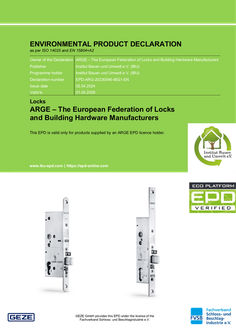
ENVIRONMENTAL PRODUCT DECLARATION as per ISO 14025 and EN 15804+A2 Owner of the Declaration ARGE – The European Federation of Locks and Building Hardware Manufacturers Publisher Institut Bauen und Umwelt e.V. (IBU) Programme holder Institut Bauen und Umwelt e.V. (IBU) Declaration number EPD-ARG-20230546-IBG1-EN Issue date … .2024 Valid to … .2029 Locks ARGE – The European Federation of Locks and Building Hardware Manufacturers This EPD is valid only for products supplied by an ARGE EPD licence holder. www.ibu-epd.com | https://epd-online.com GEZE GmbH provides this EPD under the license of the Fachverband Schloss- und Beschlagindustrie e.V. 1. General Information ARGE – The European Federation of Locks and Building Hardware Manufacturers Locks Programme holder Owner of the declaration IBU – Institut Bauen und Umwelt e.V. Hegelplatz … 10117 Berlin Germany Declaration number ARGE – The European Federation of Locks and Building Hardware Manufacturers Offerstraße 12 42551 Velbert Germany Declared product / declared unit EPD-ARG-20230546-IBG1-EN … kg of lock This declaration is based on the product category rules: Scope: Building Hardware products, … .2021 (PCR checked and approved by the SVR) This ARGE EPD covers locks used to secure doors, windows or shutters in buildings. The reference product used to calculate the impact this product group has on the environment is a high security night latch composed primarily of steel, Zamak and brass, and has been selected for the LCA (Life Cycle Assessment) because it is the product with the highest impact for … kg of product. A validity scope analysis has also been carried out to determine the limiting factors for locks covered by this EPD. In a preliminary study (simplified LCA), it has been confirmed that this EPD represents the worst-case condition and it can therefore be used to cover all locks manufactured in Europe by ARGE member companies. The owner of the declaration shall be liable for the underlying information and evidence; the IBU shall not be liable with respect to manufacturer information, life cycle assessment data and evidences. Issue date … .2024 Valid to … .2029 The EPD was created according to the specifications of EN 15804+A2. In the following, the standard will be simplified as EN 15804. Verification The standard EN 15804 serves as the core PCR Independent verification of the declaration and data according to ISO 14025:2011 Dipl.-Ing. Hans Peters (Chairman of Institut Bauen und Umwelt e.V.) Florian Pronold (Managing Director Institut Bauen und Umwelt e.V.) … internally X externally Dr. Matthew Fishwick, (Independent verifier) Environmental Product Declaration - ARGE – The European Federation of Locks and Building Hardware Manufacturers - Locks 2. Product … Product description/Product definition This EPD covers mechanical locks, latches and similar security devices, including locking plates, to be used in buildings. The sample group used to calculate the LCA data for this ARGE EPD includes sashlocks, multipoint locks and night latches. For certain products covered by this EPD the placing on the market in the European Union/European Free Trade Association (EU/EFTA) (with the exception of Switzerland) has to be compliant with Regulation (EU) No. 305/2011 (CPR). These products need a declaration of performance taking into consideration EN 12209:2003, Building hardware – Locks and latches – Mechanically operated locks, latches and locking plates – Requirements and test methods and the CE-marking. For the other products no legal provisions for harmonisation in the EU exist. They may be designed and manufactured according to EN 12209:2016, Building hardware – Mechanically operated locks and locking plates – Requirements and test methods or prEN 15685, Building hardware – Requirements and test methods – Multipoint locks, latches and locking plates – Characteristics and test methods. For the application and use the respective national provisions at the place of use apply. … Application These products are designed to be used in door, window and shutter assemblies consisting of various materials and used for various applications. Their purpose is to ensure the fastening of doors, windows or shutters in the closed position. In respect of doors, they can be used on either interior or exterior doors. … Technical Data Ideally, products should comply with a suitable technical specification. EN 12209 and prEN 15685 are examples of such a specification and some products will comply with them. The relevant grading structure according to EN 12209 is shown in the following table: Name Value Unit Category of use 1-3 Grade Durability A,B,C,L,M,R,S,W,X Grade Door mass and closing force 0-9 Grade Suitability for use in fire resisting 0,A,B,N Grade and/or smoke control door sets Safety … Grade Corrosion resistance 0,A,C,D,F,G Grade Security - burglar resistance 0-7 Grade Key identification of lever locks 0,A,B,C,D,E,F,G,H Grade The quoted standard defines the requirements of the product and the associated test methods. As construction hardware products are part of a set of a construction products (doorset, window, shutter), European application standards for locks themselves do not exist. If applicable, performance data of the product need to be in accordance with the declaration of performance with respect to its essential characteristics according to EN 12209:2003, Building hardware - Mechanically operated locks and locking plates - Requirements and test methods. … Delivery status The products are sold by unit. Deliveries of individual items are possible but are an exception. Standard deliveries comprise a … larger quantity of locks, as they are marketed as "B2B" products and not to end-users. … Base materials/Ancillary materials Composition of product analysed for this EPD: The values given are for the product analysed for this EPD. Ranges of values for other products covered by the validity scope analysis are shown in brackets. Name Value Unit Zamak (0% – 63,73%) 64 % Steel (20,96% – 91,25%) 21 % Brass (3,31% – 9,21%) … % Nickel silver (0% – 5,49%) … % Bronze (0% – 0,44%) … % Zamak is an alloy with a base metal of zinc and alloying elements of aluminium, magnesium, and copper. Components made of Zamak are die-cast. Steel is produced by combining iron with carbon as well as other elements depending on the desired characteristics. Components made of steel are formed by stamping or other types of mechanical processing. Brass is an alloy of zinc and copper. Components made of brass are made by extrusion, forging, die-casting or other types of mechanical processing. Nickel silver is an alloy of copper, nickel, and zinc. Components made of nickel silver are formed by stamping or other types of mechanical processing. Bronze is an alloy consisting primarily of copper, commonly with tin and often with the addition of other metals and sometimes non-metals. Components can be bronze-coated for decorative reasons and for providing sliding and dry running properties. 1) This product/article/at least one partial article contains substances listed in the ECHA candidate list (date: … .2023) exceeding … percentage by mass: Certain components may contain small amounts of lead (CAS no. 7439-92-1) as an alloying element. 2) This product/article/at least one partial article contains other cancerogenic, mutagenic, reprotoxic (CMR) substances in categories 1A or 1B which are not on the ECHA candidate list, exceeding … percentage by mass: no. 3) Biocide products were added to this construction product or it has been treated with biocide products (this then concerns a treated product as defined by the (EU) Ordinance on Biocide Products No. 528/2012): no. … Manufacture The manufacture of a lock usually follows a 3-step procedure: 1. Manufacture of the components: this step may include surface treatment in the factory or by external contractors. 2. Pre-assembly of modules (in the factory). 3. Final assembly (in the factory). … Environment and health during manufacturing Regular measurements of air quality and noise levels are carried out by the manufacturers, the ARGE member Environmental Product Declaration - ARGE – The European Federation of Locks and Building Hardware Manufacturers - Locks companies. The results shall be within the mandatory safety levels. In areas where employees are exposed to chemical products, the required protective clothing and technical protective devices shall be provided. Regular health checks are mandatory for employees in production facilities. … Product processing/Installation The installation of the product may vary depending on the type of door, window or shutter and the specific situation, but the products shall not require energy consumption for installation. … Packaging Normally, each individual product is packed in paper or cardboard. These individual products are then packed in a cardboard box and stacked on wooden pallets for transport to the customer. Waste from product packaging is collected separately for waste disposal (including recycling). … Condition of use Once installed, the products shall require no servicing during their expected service lives. There shall be no consumption of water or energy linked to their use, and they shall not cause any emissions. … Environment and health during use No environmental damage or health risks are to be expected during normal conditions of use. … Reference service life The reference service life is 30 years under normal working conditions. This corresponds to passing a mechanical endurance test of … cycles as specified in EN 12209. The reference service life is dependent on the actual frequency 3. LCA: Calculation rules … Declared Unit The declared unit for all products covered by ARGE EPD is … kg (of product). Since individual products will rarely weigh exactly … kg it is necessary to establish the exact weight of the product and then use this as a correction factor to determine the true values for … kg of product in the tables (Section 5). Declared unit Name Declared unit Mass of declared Product Raw density Value … Unit kg kg kg/m3 … System boundary Type of the EPD: "cradle to gate with options, with modules C1 – C4, and module D (A1-A3, C1-C3, D and additional modules)" The analysis of the product life cycle includes the production and transport of the raw materials, the manufacture of the product and the packaging materials which are declared in modules A1-A3. Losses during production are considered as waste and are sent for recycling. No recycling processes are taken into account except for transport and electricity consumption for grinding the metals. When recycled metals are used as raw material only their transformation process is taken into account and not the extraction of the raw material. A4 module represents the transport of the finished locks to the installation site. … of use and environmental conditions. It is required that installation as well as maintenance of the product are done in line with instructions provided by the manufacturer. … Extraordinary effects Fire Certain products are suitable for use on fire resisting and/or smoke control door/window sets according to one of the classes A,B,N in EN 12209. Water The declared product is intended to be used in a building under normal conditions (indoor and outdoor use). It shall not emit hazardous substances in the event of flooding. Mechanical destruction Mechanical destruction of the declared product shall not materially alter its composition or have any adverse effect on the environment. … Re-use phase Removal of locks (for re-use or recycling) shall have no adverse effect on the environment. … Disposal Locks should be recycled wherever possible, providing that there is no adverse effect on the environment. The waste code in accordance with the European Waste Code is 17 04 07. … Further information Details of all types and variants can be found on the manufacturers' websites. The respective website addresses are available at https://arge.org. There is no waste associated with the installation of the product. The A5 module therefore represents only the disposal of the product packaging. The End-of-Life (EoL) stages are also considered. The transportation to the EoL disposal site is taken into account in module C2. Module C4 covers the disposal of the locks. Module C3 covers the recycling of the individual elements according to European averages, with the remaining waste divided between incineration and landfill. Such a mixed scenario is declared due to the complex material mix of the product and the dependency of the EoL-route on the EoL route of the product the lock has been integrated into. In practice, the end of life has been modelled as follows: • when a material is sent for recycling, generic transport and electric consumption of a shredder is taken into account (corresponding to the process 'Grinding, metals'). Only then, is the material considered to have attained the 'end-of-waste' state. • each type of waste is modelled as a transport to the treatment site with a distance of 30 km. Parts sent for recycling include electricity consumption (grinding) and a flow ('Materials for recycling, unspecified'). … Estimates and assumptions The LCA data of the declared lock have been calculated using the production data of … ARGE member companies. These companies have been chosen by ARGE as being representative of their production processes and their market shares. The lock chosen as representative for this calculation follows the "worst-case" principle as explained under 6. LCA interpretation. Environmental Product Declaration - ARGE – The European Federation of Locks and Building Hardware Manufacturers - Locks … Cut-off criteria The cut-off criteria considered are 1% of renewable and nonrenewable primary energy usage and 1% of the total mass of that unit process. The total neglected input flows per module amount to a maximum of 5% of energy usage and mass. For this study, all input and output flows have been considered at 100%, including raw materials as per the product composition provided by the manufacturer and packaging of raw materials as well as the final product. Energy and water consumptions have also been considered at 100% according to the data provided. With the approach chosen, no significant environmental impacts are known to have been cut off. … Background data For the life cycle modelling of the considered product, all relevant background datasets are taken from ecoinvent v3.8 (system model: cut-off by classification). … Data quality The objective of this evaluation is to evaluate the environmental impacts generated by the products throughout their entire life cycles. To this end, ISO 14040, ISO 14044 and EN 15804 have been met regarding the quality of data on the following different criteria: Time: The life cycle inventory data used come from: • Data collected specifically for this study on the ARGE member companies' manufacturing sites. Datasets are based on 1-year averaged data (time period: January 2013 to December 2013 considered representative for 2022). • In the absence of collected data, generic data from the ecoinvent v3.8 database have been used. This is updated regularly and is representative of current processes (the entire database having been updated in 2021). Geography: Data come from production sites of the ARGE member companies. Generic data come from the ecoinvent database, representative for European production processes. Technology: Material shaping technologies are based on European technology in the case of the use of generic data. A total of … typical products (based on sales figures) have been evaluated, and the worst-case results are used in the tables. … Period under review The data of the LCA is based on the annual production data of an ARGE member from 2013, considered representative for the year 2022. … Geographic Representativeness Land or region, in which the declared product system is manufactured, used or handled at the end of the product´s lifespan: Europe … Allocation The products are produced in numerous production sites. All data were provided by the manufacturers of the products per unit, and then divided by the mass of the product to give a value per kg of product produced. The assumptions relating to the EoL of the product and waste during its life cycle are described in the section System Boundaries. Metal losses during production (stage A3) are considered as waste. … Comparability Basically, a comparison or an evaluation of EPD data is only possible if all the data sets to be compared were created according to EN 15804 and the building context, respectively the product-specific characteristics of performance, are taken into account. ecoinvent v3.8 (system model: cut-off by classification) has been used as the background database. 4. LCA: Scenarios and additional technical information Characteristic product properties of biogenic carbon Information on biogenic carbon content at factory gate Note: … kg of biogenic carbon is equivalent to 44/12 kg of CO2. Name Biogenic carbon content in product Biogenic carbon content in accompanying packaging Value Unit kg … C kg … C The following information is the basis of the declared modules within the LCA in this EPD. Transport to the building site (A4) Name Litres of fuel Transport distance Capacity utilisation (including empty runs) Installation into the building (A5) Value Unit … l/100km 3500 km 36 % Name Material loss Output substances following waste treatment on site Reference service life Name Reference service life Test cycles over RSL (EN 12209) End of life (C1-C4) Name Collected separately waste type Recycling Energy recovery Landfilling Value Unit kg … kg Value 30 100'000 Value … Unit a cycles Unit kg kg kg kg It is assumed that a 16–32-ton truck is used to transport the product: - Transport to shredding facility for metal recovery: 150 km - Transport to municipal waste incineration plant: 50 km - Transport to landfill: 30 km Reuse, recovery and/or recycling potentials (D), relevant scenario information … Environmental Product Declaration - ARGE – The European Federation of Locks and Building Hardware Manufacturers - Locks Module D contains the benefits and loads beyond the system boundary related to the recycling of metals, which result from the treatment of recycled materials from the point of end-ofwaste status to the point of substitution (as costs) and the substitution of primary resources (as benefits). According to EN 16710, clause … . … : 'In module D substitution effects are calculated only for the resulting net output flow. For building hardware, the following rules apply for the quantification of net output flows: - all production scrap and cuttings leave modules A1-B3 as sorted scrap without allocated burdens from primary production; the corresponding amounts are declared as material for recycling (MFR); … - net amounts of a metal leaving the product system are quantified as the material for recycling leaving modules A1-C4 minus the input of secondary scrap (secondary material, SM) to the product system; - in the case of brass and zinc alloys, which are composed of two different constituting metals, no difference shall be made between the input of secondary constituting metals (Cu and Zn; Cu and Sn) and its alloys (CuZn; CuSn). Negative net output flows have been considered in the quantification of module D. It also includes the benefits and loads related to 'exported energy electricity' and 'exported energy heat' resulting from the energy recovery from plastic wastes in a municipal waste incineration plant as modelled in Modules A3, A5 and C4. Environmental Product Declaration - ARGE – The European Federation of Locks and Building Hardware Manufacturers - Locks 5. LCA: Results Repair Replacement Refurbishment B2 MND B3 MNR B4 MNR B5 MNR B6 MND B7 MND C1 X C2 X C3 X C4 X RESULTS OF THE LCA - ENVIRONMENTAL IMPACT according to EN 15804+A2: … kg of locks Parameter Unit A1-A3 A4 A5 C1 C2 GWP-total kg CO2 eq GWP-fossil C3 C4 D … 1.51E-02 3.16E-03 1.1E-02 -2.02E+00 6.47E-01 2.94E-03 … 1.51E-02 3.15E-03 1.1E-02 -2.01E+00 … -2.03E-01 … 0 … 0 … 2.59E-04 9.01E-07 … 6.02E-06 7.85E-06 3.49E-06 -5.56E-03 3.55E-07 1.5E-07 4.59E-10 … 3.49E-09 1.6E-10 1.21E-09 -8.36E-08 1.32E-01 6.38E-04 9.62E-03 1.17E-01 1.84E-03 4.61E-06 3.65E-04 4.07E-03 2.15E-05 3.24E-08 9.22E-06 9.85E-05 … 0 … 0 4.28E-05 1.07E-07 8.5E-06 9.47E-05 1.62E-05 3.54E-07 2.08E-06 2.4E-05 3.12E-05 6.72E-08 1.09E-05 1.16E-04 -5.21E-02 -1.94E-04 -2.92E-03 -3.6E-02 3.46E-02 1.56E-03 2.54E-05 … 3.64E-05 6.57E-06 3.52E-05 -1.14E-02 2.62E-03 6.67E+01 2.29E-06 9.81E+00 8.64E-09 3.42E-02 … 0 5.34E-08 2.28E-01 7.63E-09 6.67E-02 1.39E-08 8.87E-02 -1.21E-03 -2.16E+01 3.14E+00 2.99E-02 3.34E-04 … 6.95E-04 7.45E-04 -9.63E-04 -8.41E-01 6.47E-01 kg CO2 eq 5.81E+00 GWP-biogenic kg CO2 eq -2.03E-01 GWP-luluc kg CO2 eq 1.48E-02 kg CFC11 eq mol H+ eq kg P eq kg N eq mol N eq kg NMVOC eq kg Sb eq MJ AP EP-freshwater EP-marine EP-terrestrial POCP ADPE ADPF WDP m3 world eq deprived D X -2.01E-01 5.62E+00 ODP ReuseRecoveryRecyclingpotential Maintenance B1 MND Disposal Use A5 X Waste processing Assembly A4 X Transport Transport from the gate to the site A3 X De-construction demolition Manufacturing A2 X Operational water use Transport A1 X Operational energy use Raw material supply In Table … "Description of the system boundary", the declared modules are indicated with an "X"; all modules that are not declared within the EPD but where additional data are available are indicated with "MND". Those data can also be used for building assessment scenarios. The values are declared with three valid digits in exponential form. The set of characterisation factors EF3.0 has been used for the life cycle assessment. DESCRIPTION OF THE SYSTEM BOUNDARY (X = INCLUDED IN LCA; MND = MODULE OR INDICATOR NOT DECLARED; MNR = MODULE NOT RELEVANT) Benefits and Construction loads beyond Product stage Use stage End of life stage process stage the system boundaries GWP = Global warming potential; ODP = Depletion potential of the stratospheric ozone layer; AP = Acidification potential of land and water; EP = Eutrophication potential; POCP = Formation potential of tropospheric ozone photochemical oxidants; ADPE = Abiotic depletion potential for non-fossil resources; ADPF = Abiotic depletion potential for fossil resources; WDP = Water (user) deprivation potential) RESULTS OF THE LCA - INDICATORS TO DESCRIBE RESOURCE USE according to EN 15804+A2: … kg of locks Parameter Unit A1-A3 A4 A5 C1 C2 C3 C4 D PERE PERM PERT PENRE PENRM PENRT SM RSF NRSF MJ MJ MJ MJ MJ MJ kg MJ MJ 1.15E+01 2.54E+00 1.4E+01 6.67E+01 1.62E-01 6.68E+01 1.08E-01 … 0 1.38E-01 … 1.38E-01 9.81E+00 … 9.81E+00 … 0 … -1.76E+00 1.37E+00 -3.93E-01 3.42E-02 … 3.42E-02 … 0 … 0 … 0 … 0 … 0 … 0 3.21E-03 … 3.21E-03 2.28E-01 … 2.28E-01 … 0 … 1.27E-02 … 1.27E-02 6.73E-02 … 6.73E-02 … 0 … 1.4E-03 … 1.4E-03 1.71E-01 -8.21E-02 8.87E-02 … 0 … -3.04E+00 … -3.04E+00 -2.17E+01 … -2.17E+01 … 0 … FW m3 8.58E-02 1.04E-03 8.72E-05 … 2.42E-05 4.3E-05 2.17E-04 -2.35E-02 PERE = Use of renewable primary energy excluding renewable primary energy resources used as raw materials; PERM = Use of renewable primary energy resources used as raw materials; PERT = Total use of renewable primary energy resources; PENRE = Use of non-renewable primary energy excluding non-renewable primary energy resources used as raw materials; PENRM = Use of non-renewable primary energy resources used as raw materials; PENRT = Total use of non-renewable primary energy resources; SM = Use of secondary material; RSF = Use of renewable secondary fuels; NRSF = Use of non-renewable secondary fuels; FW = Use of net fresh water RESULTS OF THE LCA – WASTE CATEGORIES AND OUTPUT FLOWS according to EN 15804+A2: … kg of locks Parameter Unit A1-A3 A4 A5 C1 C2 C3 HWD NHWD RWD CRU MFR MER … kg kg kg kg kg kg 4.69E-04 1.99E+00 3.67E-04 … 1.11E-01 … 2.56E-05 5.16E-01 1.42E-04 … 0 … 2.77E-07 2.91E-03 3.76E-07 … 2.38E-02 … 0 … 0 … 0 … 5.96E-07 1.2E-02 3.3E-06 … 0 … 2.37E-08 2.51E-04 8.97E-07 … 4.71E-01 … C4 D 1.71E-07 3.8E-01 1.14E-06 … 0 … -1.57E-04 -3.71E-01 -7.97E-05 … 0 … Environmental Product Declaration - ARGE – The European Federation of Locks and Building Hardware Manufacturers - Locks EEE EET MJ MJ 6.97E-04 4.62E-03 … 0 6.16E-02 4.08E-01 … 0 … 0 … 0 3.48E-03 2.3E-02 … 0 HWD = Hazardous waste disposed; NHWD = Non-hazardous waste disposed; RWD = Radioactive waste disposed; CRU = Components for re-use; MFR = Materials for recycling; MER = Materials for energy recovery; EEE = Exported electrical energy; EET = Exported thermal energy RESULTS OF THE LCA – additional impact categories according to EN 15804+A2-optional: … kg of locks Parameter Unit A1-A3 A4 A5 C1 C2 PM IR ETP-fw HTP-c HTP-nc SQP Disease incidence kBq U235 eq CTUe CTUh CTUh SQP C3 C4 D 5.57E-07 5.2E-08 3.02E-10 … 1.21E-09 4.33E-11 9.37E-10 -1.76E-07 1.96E-01 9.36E+02 3.53E-08 1.7E-06 7.05E+01 4.26E-02 7.7E+00 2.48E-10 7.78E-09 6.84E+00 1.18E-04 3.96E-02 4.66E-12 2.12E-10 1.91E-02 … 0 … 0 … 9.91E-04 1.79E-01 5.76E-12 1.81E-10 1.59E-01 6.07E-04 3.36E-02 8.97E-13 2.91E-11 1.03E-02 3.41E-04 2.12E-01 9.85E-12 9.49E-11 1.51E-01 -4.74E-02 -3.15E+02 -1.12E-08 -6.54E-07 -1.66E+01 PM = Potential incidence of disease due to PM emissions; IR = Potential Human exposure efficiency relative to U235; ETP-fw = Potential comparative Toxic Unit for ecosystems; HTP-c = Potential comparative Toxic Unit for humans (cancerogenic); HTP-nc = Potential comparative Toxic Unit for humans (not cancerogenic); SQP = Potential soil quality index Disclaimer … – for the indicator 'Potential Human exposure efficiency relative to U235'. This impact category deals mainly with the eventual impact of low-dose ionizing radiation on human health of the nuclear fuel cycle. It does not consider effects due to possible nuclear accidents, occupational exposure or radioactive waste disposal in underground facilities. Potential ionizing radiation from the soil, radon and from some construction materials is also not measured by this indicator. Disclaimer … – for the indicators 'abiotic depletion potential for non-fossil resources', 'abiotic depletion potential for fossil resources', 'water (user) deprivation potential, deprivation-weighted water consumption', 'potential comparative toxic unit for ecosystems', 'potential comparative toxic unit for humans – cancerogenic', 'Potential comparative toxic unit for humans - not cancerogenic', 'potential soil quality index'. The results of this environmental impact indicator shall be used with care as the uncertainties on these results are high as there is limited experience with the indicator. 6. LCA: Interpretation … Environmental Product Declaration - ARGE – The European Federation of Locks and Building Hardware Manufacturers - Locks The following figure illustrates the relative contributions of the different modules along the life cycle of the declared products: Figure 1: Environmental impacts of locks along its life cycle (impacts from production modules A1-A3 = 100 %) Benefits and burdens beyond the system boundary (module D) are in the order of 15 % to 30 % of the impacts over the product life cycle (modules A1-A3) and relate basically to the recycling of metals. The largest part of environmental impacts is caused during production (modules A1-A3); comparably small impacts are caused during the transport of the product to the construction site (via the manufacturer of the product, which the lock has been integrated into). All the other modules related to the product life cycle are not significant. A total of … typical products (based on sales figures) have been evaluated and the worst-case results are used in section … of this EPD. In chapter … , the tabulated range of relative weight per material ensures that the variability of results stays within +/- 40% of the declared values (assessed for the indicators GWP, PENRT, and non-hazardous waste). 7. Requisite evidence No testing results are required by the PCR part B. 8. References Product category rules of IBU IBU (2021) IBU (2021): General Instructions for the EPD Programme of the Institut Bauen und Umwelt e.V. (General Instructions for the IBU EPD Programme). Version … , Institut Bauen und Umwelt, Berlin. IBU (2021) IBU (2021): PCR Part A: Calculation rules for the life cycle assessment and requirements on the project report according to EN 15804+A2. Version … ., Institut Bauen und Umwelt, Berlin. IBU (2023) IBU (2023): PCR Part B: Requirements on the EPD for building hardware products, Institut Bauen und Umwelt, Berlin. Standards and legal documents EN 15804 EN 15804:2012+A2:2019+AC:2021, Sustainability of construction works - Environmental product declarations - Core rules for the product category construction products. EN 17610 … EN 17610:2022, Building hardware - Environmental product declarations - Product category rules complementary to EN 15804 for building hardware. ISO 14025 ISO 14025:2006-07, Environmental labels and declarations Type III Environmental declarations - Principles and procedures. ISO 14044 EN ISO 14044:2006-07, Environmental management - Life cycle assessment - Requirements and guidance (ISO 14044:2006). EN 12209 EN 12209:2003, Building hardware – Locks and latches – Mechanically operated locks, latches and locking plates – Requirements and test methods. (harmonised) EN 12209:2016, Building hardware – Mechanically operated locks and locking plates – Requirements and test methods. (not harmonised) prEN 15685 prEN 15685:2022, Building hardware – Requirements and test methods – Multipoint locks, latches and locking plates – Characteristics and test methods. Environmental Product Declaration - ARGE – The European Federation of Locks and Building Hardware Manufacturers - Locks EN 13501-1 EN 13501-1:2018, Fire classification of construction products and building elements - Part 1: Classification using data from reaction to fire tests. ISO 15686 ISO 15686:1, -2, -7 and -8. Service life planning (various parts). Regulation No. 305/2011 Regulation No. 305/2011 (Construction Products Regulation, or CPR) of the European Parliament and of the European Council is a regulation of … March 2011 that lays down harmonised conditions for the marketing of construction products and replaces Construction Products Directive (89/106/EEC). ECHA candidate list Candidate List of substances of very high concern for Authorisation, published in accordance with Article 59(10) of the REACH Regulation. European Chemicals Agency, Brussels. Ordinance on Biocide Products No. 528/2012 REGULATION (EU) No 528/2012 OF THE EUROPEAN … PARLIAMENT AND OF THE COUNCIL of 22 May 2012 concerning the making available on the market and use of biocidal products. European List of Waste Commission Decision of … May 2000 replacing Decision 94/3/EC establishing a list of wastes pursuant to Article 1(a) of Council Directive 75/442/EEC on waste and Council Decision 94/904/EC establishing a list of hazardous waste pursuant to Article 1(4) of Council Directive 91/689/EEC on hazardous waste (notified under document number C(2000) 1147). Additional references BBSR 2017 BBSR (2017): Nutzungsdauer von Bauteilen in Lebenszyklusanalysen nach Bewertungssystem Nachhaltiges Bauen (BNB). Version vom … .2017, Bundesinstitut für Bau-, Stadt- und Raumforschung, Berlin. ecoinvent v3.8 http://www.ecoinvent.org Environmental Product Declaration - ARGE – The European Federation of Locks and Building Hardware Manufacturers - Locks Publisher Institut Bauen und Umwelt e.V. Hegelplatz … 10117 Berlin Germany +49 (0)30 3087748- … info@ibu-epd.com www.ibu-epd.com Programme holder Institut Bauen und Umwelt e.V. Hegelplatz … 10117 Berlin Germany +49 (0)30 3087748- … info@ibu-epd.com www.ibu-epd.com Author of the Life Cycle Assessment Dr. Frank Werner - Umwelt & Entwicklung Kammelenbergstrasse 30 9011 St. Gallen Switzerland + 41 (0)44 241 39 06 frank@frankwerner.ch http://www.frankwerner.ch/ Owner of the Declaration ARGE – The European Federation of Locks and Building Hardware Manufacturers Offerstraße 12 42551 Velbert Germany 10 +49 (0)2051 9506 15 mail@arge.org www.arge.org Environmental Product Declaration - ARGE – The European Federation of Locks and Building Hardware Manufacturers - Locks
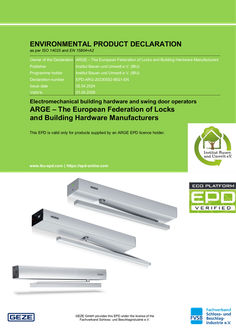
ENVIRONMENTAL PRODUCT DECLARATION as per ISO 14025 and EN 15804+A2 Owner of the Declaration ARGE – The European Federation of Locks and Building Hardware Manufacturers Publisher Institut Bauen und Umwelt e.V. (IBU) Programme holder Institut Bauen und Umwelt e.V. (IBU) Declaration number EPD-ARG-20230552-IBG1-EN Issue date … .2024 Valid to … .2029 Electromechanical building hardware and swing door operators ARGE – The European Federation of Locks and Building Hardware Manufacturers This EPD is valid only for products supplied by an ARGE EPD licence holder. www.ibu-epd.com | https://epd-online.com GEZE GmbH provides this EPD under the license of the Fachverband Schloss- und Beschlagindustrie e.V. 1. General Information ARGE – The European Federation of Locks and Building Hardware Manufacturers Electromechanical building hardware and swing door operators IBU – Institut Bauen und Umwelt e.V. Hegelplatz … 10117 Berlin Germany Declaration number ARGE – The European Federation of Locks and Building Hardware Manufacturers Offerstraße 12 42551 Velbert Germany Declared product / declared unit EPD-ARG-20230552-IBG1-EN … kg of electromechanical building hardware or swing door operator This declaration is based on the product category rules: Scope: Building Hardware products, … .2021 (PCR checked and approved by the SVR) This ARGE EPD covers electromechanical building hardware and swing door operators used to control access on doors or gates, or enable door or window opening and closing, as well as holding open of a door or window by means of electrical impulse. Several products of this product group have been assessed in separate LCA; from these LCA the worst values per indicator and module are declared as worst-case assumption. It can therefore be used to cover all electromechanical access control devices for doors and gates, as well as devices for opening, hold open and closing of doors, gates and windows manufactured in Europe by ARGE member companies. The owner of the declaration shall be liable for the underlying information and evidence; the IBU shall not be liable with respect to manufacturer information, life cycle assessment data and evidences. Programme holder Issue date … .2024 Valid to … .2029 Owner of the declaration The EPD was created according to the specifications of EN 15804+A2. In the following, the standard will be simplified as EN 15804. Verification The standard EN 15804 serves as the core PCR Independent verification of the declaration and data according to ISO 14025:2011 Dipl.-Ing. Hans Peters (Chairman of Institut Bauen und Umwelt e.V.) Florian Pronold (Managing Director Institut Bauen und Umwelt e.V.) … internally X externally Dr. Matthew Fishwick, (Independent verifier) Environmental Product Declaration - ARGE – The European Federation of Locks and Building Hardware Manufacturers - Electromechanical building hardware and swing door operators 2. Product … Product description/Product definition This ARGE EPD covers electromechanical building hardware and swing door operators used to control access on doors or gates, or enable opening, holding open and closing of a door or window, designed to potentially being integrated into access control systems, building security and/or automation systems, etc. There are … principal versions of such electromechanical hardware devices: - battery-powered - with external power supply For certain products covered by this EPD the placing on the market in the European Union/European Free Trade Association (EU/EFTA) (with the exception of Switzerland) has to be compliant with Regulation (EU) No. 305/2011 (CPR). These products need a declaration of performance taking into consideration EN 14846:2008 Building hardware – Locks and latches – Electromechanically operated locks and striking plates – Requirements and test methods and the CE-marking. In addition to such products requiring a CE-marking under EN 14846 all of the following products require a CE-marking as for placing in the European Union/European Free Trade Association (EU/EFTA) (with the exception of Switzerland) other legal provisions apply: • Electromechanically operated locks and striking plates, if no CE-marking is required under EN 14846:2008. • Mechatronic cylinders: EN 15684:2020, Building hardware - Mechatronic cylinders - Requirements and test methods. • Mechatronic padlocks: EN 16864:2017, Building hardware - Mechatronic padlocks - Requirements and test methods. • Mechatronic door furniture: EN 16867:2020+A1:2021, Building hardware - Mechatronic door furniture Requirements and test methods. • Electrically controlled exit systems for use on escape routes: EN 13637:2015, Building hardware - Electrically controlled exit systems for use on escape routes Requirements and test methods. • Electrically powered hold-open devices for swing doors: EN 1155:1997+A1:2002+AC:2006, Building hardware Electrically powered hold-open devices for swing doors Requirements and test methods. These other legal provisions which might apply for the electromechanical building hardware devices are: • Directive (EU) No. 2014/35 (Low Voltage Directive (LVD)) • Directive (EU) No. 2014/30 (Electromagnetic Compatibility (EMC) Directive) • Directive (EU) No. 2014/53 (Radio Equipment Directive (RED)) • Directive (EU) No. 2011/65 (Directive on the restriction of the use of certain hazardous substances in electrical and electronic equipment (RoHS Directive)) • Directive (EU) No. 2006/42 (Machinery Directive) The respective CE-marking takes into account the proof of conformity with the relevant harmonised standard(s) based on these legal provisions or with the legal provision itself. For the application and use the respective national provisions apply. These products are designed to be integrated into or installed on door, gate and window assemblies consisting of various materials and used for various applications. They may be used for either interior or exterior doors, gates or windows, in accordance with manufacturer's instructions. … Technical Data Ideally, products should comply with a suitable technical specification. EN 14846:2008, Building hardware – Locks and latches – Electromechanically operated locks and striking plates – Requirements and test methods is an example of such a specification and some products will comply with it. Performance data of such products in accordance with the declaration of performance with respect to its essential characteristics according to this standard. Performance data of other products in respect to its characteristics in accordance with the relevant technical provision (no CE-marking). … Delivery status The products are sold by unit. Deliveries of individual items are possible but are an exception. Standard deliveries comprise a larger quantity of electromechanical building hardware devices, as they are marketed as "B2B" products and not to end-users. … Base materials/Ancillary materials Composition of product analysed for this EPD: The values given in the table below are for the product analysed for this EPD: Name Value Steel … Stainless steel … Zamak … Motor … PCB … ABS … Acetal … Neodymium … Unit % % % % % % % % Steel is produced by combining iron with carbon as well as other elements depending on the desired characteristics. Components made of steel are formed by stamping or other types of mechanical processing. Stainless steel is produced by combining iron with chromium as well as other elements depending on the desired characteristics. Components made of steel are formed by stamping or other types of mechanical processing. Zamak is an alloy with a base metal of zinc and alloying elements of aluminium, magnesium, and copper. Components made of Zamak are die-cast. Motor, PCB are electronic components, which include copper wiring, etched copper sheets on non-conductive substrates, resistors, transistors, etc. ABS (acrylonitrile butadiene styrene) is a terpolymer polymer made by polymerizing styrene and acrylonitrile in the presence of polybutadiene. Components made of ABS are made by injection moulding or other thermal forming processes. Acetal, or polyoxymethylene (POM), is produced by polymerisation of anhydrous formaldehyde. Components made of Acetal are formed by injection moulding or other thermal … Application … Environmental Product Declaration - ARGE – The European Federation of Locks and Building Hardware Manufacturers - Electromechanical building hardware and swing door operators forming processes. disposal (including recycling). Neodymium is a chemical element and Neodymium alloys, used in high quality permanent magnets, consist of pure neodymium, iron, and boron. … Condition of use Once installed, the products shall require no servicing during their expected service lives. There shall be no consumption of water linked to their use, and they shall not cause any emissions. Battery (in case of battery-powered electromechanical devices): AA 1.5V Lithium or similar. 1) This product/article/at least one partial article contains substances listed in the ECHA candidate list (date: … .2023) exceeding … percentage by mass: Certain components may contain small amounts of lead (CAS no. 7439-92-1) as an alloying element. 2) This product/article/at least one partial article contains other cancerogenic, mutagenic, reprotoxic (CMR) substances in categories 1A or 1B which are not on the ECHA candidate list, exceeding … percentage by mass: no. 3) Biocide products were added to this construction product or it has been treated with biocide products (this then concerns a treated product as defined by the (EU) Ordinance on Biocide Products No. 528/2012): no. … Manufacture The manufacture of an electromechanical building hardware device usually follows a 3-step process: 1. Manufacture of the components: this step may include surface treatment in the factory or by external contractors. 2. Pre-assembly of modules (in the factory). 3. Final assembly (in the factory). … Environment and health during manufacturing Regular measurements of air quality and noise levels are carried out by the manufacturers, the ARGE member companies. The results shall be within the mandatory safety levels. In areas where employees are exposed to chemical products, the required protective clothing and technical protective devices shall be provided. Regular health checks are mandatory for employees in production facilities. … Product processing/Installation The installation of the product may vary depending on the type of door, gate or window and the specific situation, but the products shall not require energy consumption for installation. … Packaging Normally, each individual product is packed in paper or cardboard. These individual products are then packed in a cardboard box and stacked on wooden pallets for transport to the customer. … Environment and health during use No environmental damage or health risks are to be expected during normal conditions of use. … Reference service life A reference service life according to ISO 15686 cannot be declared. The typical service life is 10 years under normal working conditions. The service life is not limited due to mechanical obsolescence but due to outdated electronic components/software. It is required that installation, as well as maintenance of the product, must be done in line with instructions provided by the manufacturer. … Extraordinary effects Fire Certain products are suitable for use on fire resisting and/or smoke control door/window sets according to e.g., one of the classes A, B, N in EN 12209. Specific needs on fire resistance are addressed by individual manufacturers. Water The declared product is intended to be used in buildings under normal conditions (indoor or outdoor). It shall not emit hazardous substances in the event of flooding. Mechanical destruction Mechanical destruction of the declared product shall not materially alter its composition or have any adverse effect on the environment. … Re-use phase Removal of electromechanical building hardware (for re-use or recycling) shall have no adverse effect on the environment. … Disposal Electromechanical building hardware components should be recycled wherever possible, providing that there is no adverse effect on the environment. The waste code in accordance with the European Waste Code is 17 04 07. … Further information Details of all types and variants can be found on the manufacturers' websites. The respective website addresses are available at https://arge.org. Waste from product packaging is collected separately for waste 3. LCA: Calculation rules … Declared Unit The declared unit for all products covered by ARGE EPD is … kg (of product). Since individual products will rarely weigh exactly … kg it is necessary to establish the exact weight of the product then use this as a correction factor to determine the true values for … kg of product in the tables (Section 5). Declared unit Name Declared unit Mass of assessed products Raw density Value … - … Unit kg kg kg/m3 … System boundary Type of the EPD: "cradle to gate with options, with modules C1 – C4, and module D (A1-A3, C1-C3, D and additional modules)" The analysis of the product life cycle includes the production … Environmental Product Declaration - ARGE – The European Federation of Locks and Building Hardware Manufacturers - Electromechanical building hardware and swing door operators and transport of the raw materials, manufacture of the product and the packaging materials which are declared in modules A1A3. Losses during production are considered as waste and are sent for recycling. No recycling processes are taken into account except transport and electricity consumption for grinding the metals. When recycled metals are used as raw material only their transformation process is taken into account and not the extraction of the raw material. A4 module represents the transport of the finished electromechanical building hardware or swing door operator to the installation site. There is no waste associated with the installation of the product. The A5 module therefore represents only the disposal of the product packaging. Two alternatives are declared for the power supply: • B6_1: replacement of the battery every … years (for battery-powered devices) • B6_2: energy consumption from the grid (for gridconnected devices) The End-of-Life (EoL) stages are also considered. The transportation to the EoL disposal site is taken into account in module C2. Module C4 covers the disposal of the electromechanical building hardware or swing door operator. Module C3 covers the recycling of the individual elements according to European averages, with the remaining waste divided between incineration and landfill. Such a mixed scenario is declared due to the complex material mix of the product and the dependency of the EoL-route on the EoL-route of the product the electromechanical building hardware or swing door operator has been integrated into. In practice, the end of life has been modelled as follows: • when a material is sent for recycling, generic transport and electric consumption of a shredder is taken into account (corresponding to the process 'Grinding, metals'). Only then, is the material considered to have attained the 'end of waste' state. • each type of waste is modelled as a transport to the treatment site with a distance of 30 km. Parts sent for recycling include electricity consumption (grinding) and a flow ('Materials for recycling, unspecified'). … Estimates and assumptions The LCA data of the declared product had been calculated by the production data from one ARGE member company. This company had been chosen by ARGE as being representative by means of its production processes and its market share. The product is chosen to be as representative as possible. In addition, data were used from another manufacturer to consider battery-powered devices in order to complete the LCA results. … Cut-off criteria The cut-off criteria considered are 1% of renewable and nonrenewable primary energy usage and 1% of the total mass of that unit process. The total neglected input flows per module amount to a maximum of 5% of energy usage and mass. For this study, all input and output flows have been considered at 100%, including raw materials as per the product composition provided by the manufacturer and packaging of raw materials as well as the final product. Energy and water consumptions have also been considered at 100% according to the data provided. With the approach chosen, no significant environmental impacts are known to have been cut off. … Background data For life cycle modelling of the considered product, all relevant background datasets are taken from ecoinvent v3.8 (system model: cut-off by classification). … Data quality The objective of this evaluation is to evaluate the environmental impacts generated by the products throughout their entire life cycles. To this end, ISO 14040, ISO 14044 and EN 15804 have been met regarding the quality of data on the following different criteria: Time: The life cycle inventory data used come from: • Data collected specifically for this study on the ARGE member company's manufacturing site. Datasets are based on 1-year averaged data (time period: January 2013 to December 2013 considered representative for 2022). • In the absence of collected data, generic data from the ecoinvent v3.8 database have been used. This is updated regularly and is representative of current processes (the entire database having been updated in 2021). Geography: Data come from the production site of the ARGE member company. Generic data come from the ecoinvent database, representative for European production processes. Technology: Material shaping technologies are based on European technology in the case of use of generic data. Several products of this product group have been assessed in separate LCAs; from these LCA the worst values per indicator and module are declared as worst-case assumption. … Period under review The data of the LCA is based on the annual production data of an ARGE member from 2013, considered also representative for the year 2022. … Geographic Representativeness Land or region, in which the declared product system is manufactured, used or handled at the end of the product´s lifespan: Europe … Allocation The products covered by this EPD are produced in numerous sites. The product assessed for the calculation of this EPD is produced by one manufacturer on its own site. All data were provided by this manufacturer of the product per unit, and then divided by the mass of the product to give a value per kg of product produced. In addition, a battery-powered device was considered to complete the evaluation. The data were provided by another manufacturer. The assumptions relating to the EoL of the product are described in the section System Boundaries. … Comparability Basically, a comparison or an evaluation of EPD data is only possible if all the data sets to be compared were created according to EN 15804 and the building context, respectively the product-specific characteristics of performance, are taken into account. ecoinvent v3.8 (system model: cut-off by classification) has been used as the background database. Environmental Product Declaration - ARGE – The European Federation of Locks and Building Hardware Manufacturers - Electromechanical building hardware and swing door operators 4. LCA: Scenarios and additional technical information Characteristic product properties of biogenic carbon Information on the biogenic carbon content at factory gate Note: … kg of biogenic carbon is equivalent to 44/12 kg of CO2. Name Value Unit kg … C kg … C Biogenic carbon content in product Biogenic carbon content in accompanying packaging The following information is the basis of the declared modules within the LCA in this EPD. Transport to the building site (A4) Name Litres of fuel Transport distance Capacity utilisation (including empty runs) Installation into the building (A5) Name Material loss Value Unit … l/100km 3500 km 36 % Value … Reference service life Name Life Span according to the manufacturer Unit kg Value Unit 10 a The service life is not limited due to mechanical obsolescence but due to outdated electronic components/software. It is required that installation, as well as maintenance of the product, must be done in line with instructions provided by the manufacturer. Operational energy use (B6) Two alternatives are declared for the power supply: • B6_1: replacement of the battery every … years (for battery-powered devices) • B6_2: energy consumption from the grid (for gridconnected devices) When electromechanical hardware devices are batterypowered, the batteries are assumed to be replaced every … years which leads to … replacements of a set of … batteries over a service life of … years. The transport of the battery is assumed to be done by truck ( … tons) with a distance of 30 km. The following scenario has been taken into account for the gridconnected version: - … operative modes of the product: Active mode, standby and off - Time share in each mode (in %) - Average power for each mode (in Watts) The total energy consumption during the RSL has been calculated with the following formulas: Energy consumption mode (Wh) = Average power mode (W) * Time mode (%) * RSL * 365 * 24 … Energy consumption of the product (Wh) = Energy consumption active + Energy consumption standby + Energy consumption off It is assumed that, throughout its RSL (10 years), the product is active 1% of the time and is in stand-by or sleep-mode during 99 % of the time (data from companies). The average power during the active time is … W ( … Wh) and during stand-by is … W ( … Wh). A European electricity mix has been taken into account for the energy consumption. Name Value Unit Electricity consumption … kWh End of life (C1-C4) Name Collected separately waste type Recycling Energy recovery Landfilling Value … Unit kg kg kg kg It is assumed that a 16–32-ton truck is used to transport the product: - Transport to shredding facility for metal recovery: 150 km - Transport to municipal waste incineration plant: 50 km - Transport to landfill: 30 km Reuse, recovery and/or recycling potentials (D), relevant scenario information Module D contains the benefits and loads beyond the system boundary related to the recycling of metals, which result from the treatment of recycled materials from the point of end-ofwaste status to the point of substitution (as costs) and the substitution of primary resources (as benefits). According to EN 16710, clause … . … : 'In module D substitution effects are calculated only for the resulting net output flow. For building hardware, the following rules apply for the quantification of net output flows: - all production scrap and cuttings leave modules A1-B3 as sorted scrap without allocated burdens from primary production; the corresponding amounts are declared as material for recycling (MFR); - net amounts of a metal leaving the product system are quantified as the material for recycling leaving modules A1-C4 minus the input of secondary scrap (secondary material, SM) to the product system; - in the case of brass and zinc alloys, which are composed of two different constituting metals, no difference shall be made between the input of secondary constituting metals (Cu and Zn; Cu and Sn) and its alloys (CuZn; CuSn). Negative net output flows have been considered in the quantification of module D. It also includes the benefits and loads related to 'exported energy electricity' and 'exported energy heat' resulting from the energy recovery from plastic wastes in a municipal waste incineration plant as modelled in Modules A3, A5 and C4. Environmental Product Declaration - ARGE – The European Federation of Locks and Building Hardware Manufacturers - Electromechanical building hardware and swing door operators 5. LCA: Results Maintenance Repair Replacement Refurbishment B1 MND B2 MND B3 MNR B4 MNR B5 MNR B6 X B7 MND C1 X C2 X C3 X C4 X ReuseRecoveryRecyclingpotential Use A5 X Disposal Assembly A4 X Waste processing Transport from the gate to the site A3 X Transport Manufacturing A2 X De-construction demolition Transport A1 X Operational water use Raw material supply Operational energy use In Table … "Description of the system boundary", the declared modules are indicated with an "X"; all modules that are not declared within the EPD but where additional data are available are indicated with "MND". Those data can also be used for building assessment scenarios. The values are declared with three valid digits in exponential form. The set of characterisation factors EF3.0 has been used for the life cycle assessment. DESCRIPTION OF THE SYSTEM BOUNDARY (X = INCLUDED IN LCA; MND = MODULE OR INDICATOR NOT DECLARED; MNR = MODULE NOT RELEVANT) Benefits and Construction loads beyond Product stage Use stage End of life stage process stage the system boundaries D X RESULTS OF THE LCA - ENVIRONMENTAL IMPACT according to EN 15804+A2: … kg of electromechanical building hardware and swing door operators Parameter Unit A1-A3 A4 A5 B6/1 B6/2 C1 C2 C3 C4 D GWP-total kg CO2 eq 1.18E+01 6.75E-01 3.14E-01 1.48E+00 2.03E+02 … 1.86E-02 1.86E-02 4.93E-02 4.85E-01 GWP-fossil kg CO2 eq 1.2E+01 6.74E-01 2.26E-02 1.47E+00 2.03E+02 … 1.86E-02 1.85E-02 4.93E-02 4.84E-01 GWPbiogenic kg CO2 eq -2.69E-01 … 2.92E-01 … 0 … 0 … 0 … 7.47E-04 GWP-luluc ODP AP EPfreshwater EP-marine EP-terrestrial kg CO2 eq 2.82E-02 2.7E-04 1.8E-06 2.69E-03 5.07E-01 … 7.44E-06 3.14E-05 3.75E-06 kg CFC11 eq 6.48E-07 1.56E-07 1.02E-09 1.15E-07 1.05E-05 … 4.31E-09 8.96E-10 1.52E-09 3.2E-08 mol H+ eq 3.08E-01 1.91E-03 1.95E-05 3.07E-02 1.11E+00 … 5.28E-05 2.03E-04 4.35E-05 2.35E-02 kg P eq 1.87E-03 4.81E-06 3.74E-08 1.66E-04 2.27E-02 … 1.33E-07 1.06E-06 8.24E-08 7.47E-05 kg N eq mol N eq 3.85E-02 2.8E-01 3.81E-04 4.24E-03 6.46E-06 6.99E-05 2.35E-03 2.81E-02 1.38E-01 1.6E+00 … 0 1.05E-05 1.17E-04 1.67E-05 1.85E-04 1.76E-05 1.7E-04 1.02E-03 1.4E-02 kg NMVOC eq kg Sb eq MJ POCP ADPE ADPF m3 world eq deprived WDP 7.77E-02 1.63E-03 2.03E-05 8.53E-03 4.4E-01 … 4.5E-05 5.78E-05 4.98E-05 4.23E-03 4.07E-03 1.29E+02 2.39E-06 1.02E+01 1.62E-08 6.85E-02 5.7E-04 1.93E+01 1.97E-03 4.27E+03 … 0 6.59E-08 2.82E-01 7.78E-07 2.38E-01 2.26E-08 1.11E-01 5.66E-04 6.82E+00 5.06E+00 3.11E-02 3.36E-04 8.35E-01 5.07E+01 … 8.58E-04 9.87E-03 -3.16E-04 4.14E-01 GWP = Global warming potential; ODP = Depletion potential of the stratospheric ozone layer; AP = Acidification potential of land and water; EP = Eutrophication potential; POCP = Formation potential of tropospheric ozone photochemical oxidants; ADPE = Abiotic depletion potential for non-fossil resources; ADPF = Abiotic depletion potential for fossil resources; WDP = Water (user) deprivation potential) RESULTS OF THE LCA - INDICATORS TO DESCRIBE RESOURCE USE according to EN 15804+A2: … kg of electromechanical building hardware and swing door operators Parameter Unit A1-A3 A4 A5 B6/1 B6/2 C1 C2 C3 C4 D PERE PERM PERT PENRE PENRM PENRT SM RSF NRSF MJ MJ MJ MJ MJ MJ kg MJ MJ 2.15E+01 2.35E+00 2.38E+01 1.31E+02 1.43E+00 1.33E+02 4.47E-01 … 0 1.44E-01 … 1.44E-01 1.02E+01 … 1.02E+01 … 0 … -6.86E-01 -6.18E-01 -1.3E+00 2.17E-01 -1.48E-01 6.85E-02 … 0 … 2.56E+00 … 2.56E+00 1.93E+01 … 1.93E+01 … 0 … 9.42E+02 … 9.42E+02 4.32E+03 … 4.32E+03 … 0 … 0 … 0 … 0 … 0 … 0 3.96E-03 … 3.96E-03 2.82E-01 … 2.82E-01 … 0 … 9.18E-02 … 9.18E-02 2.39E-01 … 2.39E-01 … 0 … 6.71E-03 … 6.71E-03 1.11E-01 … 1.11E-01 … 0 … 1.33E+00 … 1.33E+00 6.85E+00 … 6.85E+00 … 0 … FW m3 1.62E-01 1.08E-03 5.13E-05 1.88E-02 2.84E+00 … 2.99E-05 2.75E-04 2.23E-04 6.66E-03 PERE = Use of renewable primary energy excluding renewable primary energy resources used as raw materials; PERM = Use of renewable primary energy resources used as raw materials; PERT = Total use of renewable primary energy resources; PENRE = Use of non-renewable primary energy excluding non-renewable primary energy resources used as raw materials; PENRM = Use of non-renewable primary energy resources used as raw materials; PENRT = Total use of non-renewable primary energy resources; SM = Use of secondary material; RSF = Use of renewable secondary fuels; NRSF = Use of non-renewable secondary fuels; FW = Use of net fresh water RESULTS OF THE LCA – WASTE CATEGORIES AND OUTPUT FLOWS according to EN 15804+A2: … kg of electromechanical building hardware and swing door operators Parameter Unit A1-A3 A4 A5 B6/1 B6/2 C1 C2 C3 HWD NHWD … kg kg 1.47E-03 4.71E+00 2.67E-05 5.38E-01 2.49E-07 4.05E-03 7.99E-04 5.53E-01 3.41E-03 1.72E+01 … 0 7.36E-07 1.48E-02 4.47E-07 1.37E-02 C4 D 2.15E-07 3.8E-01 1.92E-04 1.71E-01 Environmental Product Declaration - ARGE – The European Federation of Locks and Building Hardware Manufacturers - Electromechanical building hardware and swing door operators RWD CRU MFR MER EEE EET kg kg kg kg MJ MJ 2.12E-03 … 2.89E-01 … 0 … 1.48E-04 … 0 … 0 … 9.43E-07 … 1.61E-01 … 0 … 9.02E-05 … 0 … 0 … 5.73E-02 … 0 … 0 … 0 … 0 … 0 … 4.08E-06 … 0 … 0 … 1.95E-06 … 6.72E-01 … 0 … 1.41E-06 … 0 … 0 … 5.49E-05 … 0 … 0 … HWD = Hazardous waste disposed; NHWD = Non-hazardous waste disposed; RWD = Radioactive waste disposed; CRU = Components for re-use; MFR = Materials for recycling; MER = Materials for energy recovery; EEE = Exported electrical energy; EET = Exported thermal energy RESULTS OF THE LCA – additional impact categories according to EN 15804+A2-optional: … kg of electromechanical building hardware and swing door operators Parameter Unit A1-A3 A4 A5 B6/1 B6/2 C1 C2 PM IR ETP-fw HTP-c HTP-nc SQP Disease incidence kBq U235 eq CTUe CTUh CTUh SQP C3 C4 D 1.29E-06 5.42E-08 3.98E-10 1.34E-07 3.24E-06 … 1.49E-09 1.19E-09 1.05E-09 5.38E-08 7.95E-01 2.54E+03 6.79E-08 3.43E-06 1.14E+02 4.44E-02 8.02E+00 2.58E-10 8.11E-09 7.13E+00 2.85E-04 5.87E-02 3.64E-12 1.44E-10 4.58E-02 5.64E-02 2.18E+02 8.96E-09 3.53E-07 1.12E+01 3.89E+01 2.67E+03 8.58E-08 2.7E-06 8.22E+02 … 0 … 0 … 1.22E-03 2.21E-01 7.12E-12 2.24E-10 1.96E-01 1.32E-03 1.06E+00 2.13E-11 5.82E-10 7.52E-02 5.02E-04 5.48E+01 1.22E-11 3.96E-10 1.89E-01 3.51E-02 1.28E+02 5.6E-09 3.81E-07 8.77E+00 PM = Potential incidence of disease due to PM emissions; IR = Potential Human exposure efficiency relative to U235; ETP-fw = Potential comparative Toxic Unit for ecosystems; HTP-c = Potential comparative Toxic Unit for humans (cancerogenic); HTP-nc = Potential comparative Toxic Unit for humans (not cancerogenic); SQP = Potential soil quality index Disclaimer … – for the indicator 'Potential Human exposure efficiency relative to U235'. This impact category deals mainly with the eventual impact of low dose ionizing radiation on human health of the nuclear fuel cycle. It does not consider effects due to possible nuclear accidents, occupational exposure nor due to radioactive waste disposal in underground facilities. Potential ionizing radiation from the soil, from radon and from some construction materials is also not measured by this indicator. Disclaimer … – for the indicators 'abiotic depletion potential for non-fossil resources', 'abiotic depletion potential for fossil resources', 'water (user) deprivation potential, deprivation-weighted water consumption', 'potential comparative toxic unit for ecosystems', 'potential comparative toxic unit for humans – cancerogenic', 'Potential comparative toxic unit for humans - not cancerogenic', 'potential soil quality index'. The results of this environmental impact indicator shall be used with care as the uncertainties on these results are high or as there is limited experienced with the indicator. 6. LCA: Interpretation The following interpretation is based on the LCA scores of one of the assessed products, whereas two types of power supply have been analysed. Figure … illustrates the relative contributions of the different Figure 1: Environmental impacts of electromechanical building hardware and swing door operators with external power supply along their life cycle By far the largest part of environmental impact is caused by the … modules along the life cycle of the declared products, assuming power supply from the grid. electricity from the grid during standby. With the exception of the ADP elements, the production (modules A1-A3) of the electromechanical building hardware and swing door operators has negligible impacts. All the other modules related to the product life cycle and module D are not significant. Environmental Product Declaration - ARGE – The European Federation of Locks and Building Hardware Manufacturers - Electromechanical building hardware and swing door operators Figure … illustrates the relative contributions of the different modules along the life cycle of the battery-powered products. Figure 2: Environmental impacts of battery-powered electromechanical building hardware along its life cycle The largest part of environmental impacts is caused during production (modules A1-A3); comparably small impacts are caused during the transport of the product to the construction site (via the manufacturer of the product, which the electromechanical hardware has been integrated into). All the other modules related to the product life cycle are not significant. Benefits and burdens beyond the system boundary (module D) are in the order of +5 % to +15 % hence resulting in net burdens due to a negative net flow of recycled materials over the product life cycle. Several typical products (based on sales figures) have been evaluated and the worst-case results are used in section … of this EPD. In chapter … , the tabulated range of relative weight per material ensures that the variability of results stays within +/- 40% of the declared values (assessed for the indicators GWP, PENRT, and non-hazardous waste). 7. Requisite evidence … Environmental Product Declaration - ARGE – The European Federation of Locks and Building Hardware Manufacturers - Electromechanical building hardware and swing door operators No testing results are required by the PCR part B. 8. References Product category rules of IBU IBU (2021) IBU (2021): General Instructions for the EPD Programme of the Institut Bauen und Umwelt e.V. (General Instructions for the IBU EPD Programme). Version … , Institut Bauen und Umwelt, Berlin. IBU (2021) IBU (2021): PCR Part A: Calculation rules for the life cycle assessment and requirements on the project report according to EN 15804+A2. Version … ., Institut Bauen und Umwelt, Berlin. IBU (2023) IBU (2023): PCR Part B: Requirements on the EPD for building hardware products, Institut Bauen und Umwelt, Berlin. Standards and legal documents EN 15804 EN 15804:2012+A2:2019+AC:2021, Sustainability of construction works - Environmental product declarations - Core rules for the product category of construction products. EN 17610 EN 17610:2022, Building hardware - Environmental product declarations - Product category rules complementary to EN 15804 for building hardware. ISO 14025 ISO 14025:2006-07, Environmental labels and declarations Type III Environmental declarations - Principles and procedures. ISO 14044 EN ISO 14044:2006-07, Environmental management - Life cycle assessment - Requirements and guidance (ISO 14044:2006); German and English versions EN ISO 14044:2006. EN 15684 EN 15684:2020, Building hardware - Mechatronic cylinders Requirements and test methods. EN 16864 EN 16864:2017, Building hardware - Mechatronic padlocks Requirements and test methods. EN 16867 EN 16867:2020+A1:2021, Building hardware - Mechatronic door furniture - Requirements and test methods. EN 14846 EN 14846:2008, Building hardware - Locks and latches Electromechanically operated locks and striking plates Requirements and test methods. EN 1155 EN 1155:1997+A1:2002+AC:2006, Electrically powered holdopen devices for swing doors: Building hardware - Electrically powered hold-open devices for swing doors - Requirements and test methods. EN 13637 EN 13637:2015, Building hardware - Electrically controlled exit … systems for use on escape routes - Requirements and test methods. EN 13501-1 EN 13501-1:2018, Fire classification of construction products and building elements - Part 1: Classification using data from reaction to fire tests. ISO 15686 ISO 15686:1, -2, -7 and -8. Service life planning (various parts). Regulation No. 305/2011 Regulation No. 305/2011 (Construction Products Regulation, or CPR) of the European Parliament and of the European Council is a regulation of … March 2011 that lays down harmonised conditions for the marketing of construction products and replaces Construction Products Directive (89/106/EEC). Directive No. 2014/35 Directive No. 2014/35/EU (Low Voltage Directive, or LVD) of the European Parliament and of the Council of 26 February 2014 on the harmonisation of the laws of the Member States relating to the making available on the market of electrical equipment designed for use within certain voltage limits (recast). Directive No. 2014/30 Directive No. 2014/30 (Electromagnetic Compatibility Directive, or EMC) of the European Parliament and of the Council of 26 February 2014 on the harmonisation of the laws of the Member States relating to electromagnetic compatibility. Directive No. 2014/53 Directive No. 2014/53 (Radio Equipment Directive, or RED) of the European Parliament and of the Council of 16 April 2014 on the harmonisation of the laws of the Member States relating to the making available on the market of radio equipment and repealing Directive 1999/5. Directive No. 2011/65 Directive No. 2011/65 (RoHS) of the European Parliament and of the Council of … June 2011 on the restriction of the use of certain hazardous substances in electrical and electronic equipment. Directive No. 2006/42 Directive No. 2006/42 (Machinery Directive) of the European Parliament and of the Council of 17 May 2006 on machinery, and amending Directive 95/16/EC (recast). ECHA candidate list Candidate List of substances of very high concern for Authorisation, published in accordance with Article 59(10) of the REACH Regulation. European Chemicals Agency, Brussels. Ordinance on Biocide Products No. 528/2012 REGULATION (EU) No 528/2012 OF THE EUROPEAN PARLIAMENT AND OF THE COUNCIL of 22 May 2012 concerning the making available on the market and use of biocidal products. European List of Waste Commission Decision of … May 2000 replacing Decision 94/3/EC establishing a list of wastes pursuant to Article 1(a) of Council Directive 75/442/EEC on waste and Council Decision 94/904/EC establishing a list of hazardous waste pursuant to Article 1(4) of Council Directive 91/689/EEC on hazardous Environmental Product Declaration - ARGE – The European Federation of Locks and Building Hardware Manufacturers - Electromechanical building hardware and swing door operators Additional references Lebenszyklusanalysen nach Bewertungssystem Nachhaltiges Bauen (BNB). Version vom … .2017, Bundesinstitut für Bau-, Stadt- und Raumforschung, Berlin. BBSR 2017 BBSR (2017): Nutzungsdauer von Bauteilen in ecoinvent v3.8 http://www.ecoinvent.org waste (notified under document number C(2000) 1147). 10 Environmental Product Declaration - ARGE – The European Federation of Locks and Building Hardware Manufacturers - Electromechanical building hardware and swing door operators Publisher Institut Bauen und Umwelt e.V. Hegelplatz … 10117 Berlin Germany +49 (0)30 3087748- … info@ibu-epd.com www.ibu-epd.com Programme holder Institut Bauen und Umwelt e.V. Hegelplatz … 10117 Berlin Germany +49 (0)30 3087748- … info@ibu-epd.com www.ibu-epd.com Author of the Life Cycle Assessment Dr. Frank Werner - Umwelt & Entwicklung Kammelenbergstrasse 30 9011 St. Gallen Switzerland + 41 (0)44 241 39 06 frank@frankwerner.ch http://www.frankwerner.ch/ Owner of the Declaration ARGE – The European Federation of Locks and Building Hardware Manufacturers Offerstraße 12 42551 Velbert Germany 11 +49 (0)2051 9506 15 mail@arge.org www.arge.org Environmental Product Declaration - ARGE – The European Federation of Locks and Building Hardware Manufacturers - Electromechanical building hardware and swing door operators
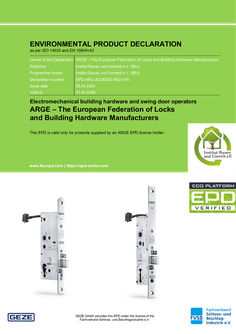
ENVIRONMENTAL PRODUCT DECLARATION as per ISO 14025 and EN 15804+A2 Owner of the Declaration ARGE – The European Federation of Locks and Building Hardware Manufacturers Publisher Institut Bauen und Umwelt e.V. (IBU) Programme holder Institut Bauen und Umwelt e.V. (IBU) Declaration number EPD-ARG-20230552-IBG1-EN Issue date … .2024 Valid to … .2029 Electromechanical building hardware and swing door operators ARGE – The European Federation of Locks and Building Hardware Manufacturers This EPD is valid only for products supplied by an ARGE EPD licence holder. www.ibu-epd.com | https://epd-online.com GEZE GmbH provides this EPD under the license of the Fachverband Schloss- und Beschlagindustrie e.V. 1. General Information ARGE – The European Federation of Locks and Building Hardware Manufacturers Electromechanical building hardware and swing door operators IBU – Institut Bauen und Umwelt e.V. Hegelplatz … 10117 Berlin Germany Declaration number ARGE – The European Federation of Locks and Building Hardware Manufacturers Offerstraße 12 42551 Velbert Germany Declared product / declared unit EPD-ARG-20230552-IBG1-EN … kg of electromechanical building hardware or swing door operator This declaration is based on the product category rules: Scope: Building Hardware products, … .2021 (PCR checked and approved by the SVR) This ARGE EPD covers electromechanical building hardware and swing door operators used to control access on doors or gates, or enable door or window opening and closing, as well as holding open of a door or window by means of electrical impulse. Several products of this product group have been assessed in separate LCA; from these LCA the worst values per indicator and module are declared as worst-case assumption. It can therefore be used to cover all electromechanical access control devices for doors and gates, as well as devices for opening, hold open and closing of doors, gates and windows manufactured in Europe by ARGE member companies. The owner of the declaration shall be liable for the underlying information and evidence; the IBU shall not be liable with respect to manufacturer information, life cycle assessment data and evidences. Programme holder Issue date … .2024 Valid to … .2029 Owner of the declaration The EPD was created according to the specifications of EN 15804+A2. In the following, the standard will be simplified as EN 15804. Verification The standard EN 15804 serves as the core PCR Independent verification of the declaration and data according to ISO 14025:2011 Dipl.-Ing. Hans Peters (Chairman of Institut Bauen und Umwelt e.V.) Florian Pronold (Managing Director Institut Bauen und Umwelt e.V.) … internally X externally Dr. Matthew Fishwick, (Independent verifier) Environmental Product Declaration - ARGE – The European Federation of Locks and Building Hardware Manufacturers - Electromechanical building hardware and swing door operators 2. Product … Product description/Product definition This ARGE EPD covers electromechanical building hardware and swing door operators used to control access on doors or gates, or enable opening, holding open and closing of a door or window, designed to potentially being integrated into access control systems, building security and/or automation systems, etc. There are … principal versions of such electromechanical hardware devices: - battery-powered - with external power supply For certain products covered by this EPD the placing on the market in the European Union/European Free Trade Association (EU/EFTA) (with the exception of Switzerland) has to be compliant with Regulation (EU) No. 305/2011 (CPR). These products need a declaration of performance taking into consideration EN 14846:2008 Building hardware – Locks and latches – Electromechanically operated locks and striking plates – Requirements and test methods and the CE-marking. In addition to such products requiring a CE-marking under EN 14846 all of the following products require a CE-marking as for placing in the European Union/European Free Trade Association (EU/EFTA) (with the exception of Switzerland) other legal provisions apply: • Electromechanically operated locks and striking plates, if no CE-marking is required under EN 14846:2008. • Mechatronic cylinders: EN 15684:2020, Building hardware - Mechatronic cylinders - Requirements and test methods. • Mechatronic padlocks: EN 16864:2017, Building hardware - Mechatronic padlocks - Requirements and test methods. • Mechatronic door furniture: EN 16867:2020+A1:2021, Building hardware - Mechatronic door furniture Requirements and test methods. • Electrically controlled exit systems for use on escape routes: EN 13637:2015, Building hardware - Electrically controlled exit systems for use on escape routes Requirements and test methods. • Electrically powered hold-open devices for swing doors: EN 1155:1997+A1:2002+AC:2006, Building hardware Electrically powered hold-open devices for swing doors Requirements and test methods. These other legal provisions which might apply for the electromechanical building hardware devices are: • Directive (EU) No. 2014/35 (Low Voltage Directive (LVD)) • Directive (EU) No. 2014/30 (Electromagnetic Compatibility (EMC) Directive) • Directive (EU) No. 2014/53 (Radio Equipment Directive (RED)) • Directive (EU) No. 2011/65 (Directive on the restriction of the use of certain hazardous substances in electrical and electronic equipment (RoHS Directive)) • Directive (EU) No. 2006/42 (Machinery Directive) The respective CE-marking takes into account the proof of conformity with the relevant harmonised standard(s) based on these legal provisions or with the legal provision itself. For the application and use the respective national provisions apply. These products are designed to be integrated into or installed on door, gate and window assemblies consisting of various materials and used for various applications. They may be used for either interior or exterior doors, gates or windows, in accordance with manufacturer's instructions. … Technical Data Ideally, products should comply with a suitable technical specification. EN 14846:2008, Building hardware – Locks and latches – Electromechanically operated locks and striking plates – Requirements and test methods is an example of such a specification and some products will comply with it. Performance data of such products in accordance with the declaration of performance with respect to its essential characteristics according to this standard. Performance data of other products in respect to its characteristics in accordance with the relevant technical provision (no CE-marking). … Delivery status The products are sold by unit. Deliveries of individual items are possible but are an exception. Standard deliveries comprise a larger quantity of electromechanical building hardware devices, as they are marketed as "B2B" products and not to end-users. … Base materials/Ancillary materials Composition of product analysed for this EPD: The values given in the table below are for the product analysed for this EPD: Name Value Steel … Stainless steel … Zamak … Motor … PCB … ABS … Acetal … Neodymium … Unit % % % % % % % % Steel is produced by combining iron with carbon as well as other elements depending on the desired characteristics. Components made of steel are formed by stamping or other types of mechanical processing. Stainless steel is produced by combining iron with chromium as well as other elements depending on the desired characteristics. Components made of steel are formed by stamping or other types of mechanical processing. Zamak is an alloy with a base metal of zinc and alloying elements of aluminium, magnesium, and copper. Components made of Zamak are die-cast. Motor, PCB are electronic components, which include copper wiring, etched copper sheets on non-conductive substrates, resistors, transistors, etc. ABS (acrylonitrile butadiene styrene) is a terpolymer polymer made by polymerizing styrene and acrylonitrile in the presence of polybutadiene. Components made of ABS are made by injection moulding or other thermal forming processes. Acetal, or polyoxymethylene (POM), is produced by polymerisation of anhydrous formaldehyde. Components made of Acetal are formed by injection moulding or other thermal … Application … Environmental Product Declaration - ARGE – The European Federation of Locks and Building Hardware Manufacturers - Electromechanical building hardware and swing door operators forming processes. disposal (including recycling). Neodymium is a chemical element and Neodymium alloys, used in high quality permanent magnets, consist of pure neodymium, iron, and boron. … Condition of use Once installed, the products shall require no servicing during their expected service lives. There shall be no consumption of water linked to their use, and they shall not cause any emissions. Battery (in case of battery-powered electromechanical devices): AA 1.5V Lithium or similar. 1) This product/article/at least one partial article contains substances listed in the ECHA candidate list (date: … .2023) exceeding … percentage by mass: Certain components may contain small amounts of lead (CAS no. 7439-92-1) as an alloying element. 2) This product/article/at least one partial article contains other cancerogenic, mutagenic, reprotoxic (CMR) substances in categories 1A or 1B which are not on the ECHA candidate list, exceeding … percentage by mass: no. 3) Biocide products were added to this construction product or it has been treated with biocide products (this then concerns a treated product as defined by the (EU) Ordinance on Biocide Products No. 528/2012): no. … Manufacture The manufacture of an electromechanical building hardware device usually follows a 3-step process: 1. Manufacture of the components: this step may include surface treatment in the factory or by external contractors. 2. Pre-assembly of modules (in the factory). 3. Final assembly (in the factory). … Environment and health during manufacturing Regular measurements of air quality and noise levels are carried out by the manufacturers, the ARGE member companies. The results shall be within the mandatory safety levels. In areas where employees are exposed to chemical products, the required protective clothing and technical protective devices shall be provided. Regular health checks are mandatory for employees in production facilities. … Product processing/Installation The installation of the product may vary depending on the type of door, gate or window and the specific situation, but the products shall not require energy consumption for installation. … Packaging Normally, each individual product is packed in paper or cardboard. These individual products are then packed in a cardboard box and stacked on wooden pallets for transport to the customer. … Environment and health during use No environmental damage or health risks are to be expected during normal conditions of use. … Reference service life A reference service life according to ISO 15686 cannot be declared. The typical service life is 10 years under normal working conditions. The service life is not limited due to mechanical obsolescence but due to outdated electronic components/software. It is required that installation, as well as maintenance of the product, must be done in line with instructions provided by the manufacturer. … Extraordinary effects Fire Certain products are suitable for use on fire resisting and/or smoke control door/window sets according to e.g., one of the classes A, B, N in EN 12209. Specific needs on fire resistance are addressed by individual manufacturers. Water The declared product is intended to be used in buildings under normal conditions (indoor or outdoor). It shall not emit hazardous substances in the event of flooding. Mechanical destruction Mechanical destruction of the declared product shall not materially alter its composition or have any adverse effect on the environment. … Re-use phase Removal of electromechanical building hardware (for re-use or recycling) shall have no adverse effect on the environment. … Disposal Electromechanical building hardware components should be recycled wherever possible, providing that there is no adverse effect on the environment. The waste code in accordance with the European Waste Code is 17 04 07. … Further information Details of all types and variants can be found on the manufacturers' websites. The respective website addresses are available at https://arge.org. Waste from product packaging is collected separately for waste 3. LCA: Calculation rules … Declared Unit The declared unit for all products covered by ARGE EPD is … kg (of product). Since individual products will rarely weigh exactly … kg it is necessary to establish the exact weight of the product then use this as a correction factor to determine the true values for … kg of product in the tables (Section 5). Declared unit Name Declared unit Mass of assessed products Raw density Value … - … Unit kg kg kg/m3 … System boundary Type of the EPD: "cradle to gate with options, with modules C1 – C4, and module D (A1-A3, C1-C3, D and additional modules)" The analysis of the product life cycle includes the production … Environmental Product Declaration - ARGE – The European Federation of Locks and Building Hardware Manufacturers - Electromechanical building hardware and swing door operators and transport of the raw materials, manufacture of the product and the packaging materials which are declared in modules A1A3. Losses during production are considered as waste and are sent for recycling. No recycling processes are taken into account except transport and electricity consumption for grinding the metals. When recycled metals are used as raw material only their transformation process is taken into account and not the extraction of the raw material. A4 module represents the transport of the finished electromechanical building hardware or swing door operator to the installation site. There is no waste associated with the installation of the product. The A5 module therefore represents only the disposal of the product packaging. Two alternatives are declared for the power supply: • B6_1: replacement of the battery every … years (for battery-powered devices) • B6_2: energy consumption from the grid (for gridconnected devices) The End-of-Life (EoL) stages are also considered. The transportation to the EoL disposal site is taken into account in module C2. Module C4 covers the disposal of the electromechanical building hardware or swing door operator. Module C3 covers the recycling of the individual elements according to European averages, with the remaining waste divided between incineration and landfill. Such a mixed scenario is declared due to the complex material mix of the product and the dependency of the EoL-route on the EoL-route of the product the electromechanical building hardware or swing door operator has been integrated into. In practice, the end of life has been modelled as follows: • when a material is sent for recycling, generic transport and electric consumption of a shredder is taken into account (corresponding to the process 'Grinding, metals'). Only then, is the material considered to have attained the 'end of waste' state. • each type of waste is modelled as a transport to the treatment site with a distance of 30 km. Parts sent for recycling include electricity consumption (grinding) and a flow ('Materials for recycling, unspecified'). … Estimates and assumptions The LCA data of the declared product had been calculated by the production data from one ARGE member company. This company had been chosen by ARGE as being representative by means of its production processes and its market share. The product is chosen to be as representative as possible. In addition, data were used from another manufacturer to consider battery-powered devices in order to complete the LCA results. … Cut-off criteria The cut-off criteria considered are 1% of renewable and nonrenewable primary energy usage and 1% of the total mass of that unit process. The total neglected input flows per module amount to a maximum of 5% of energy usage and mass. For this study, all input and output flows have been considered at 100%, including raw materials as per the product composition provided by the manufacturer and packaging of raw materials as well as the final product. Energy and water consumptions have also been considered at 100% according to the data provided. With the approach chosen, no significant environmental impacts are known to have been cut off. … Background data For life cycle modelling of the considered product, all relevant background datasets are taken from ecoinvent v3.8 (system model: cut-off by classification). … Data quality The objective of this evaluation is to evaluate the environmental impacts generated by the products throughout their entire life cycles. To this end, ISO 14040, ISO 14044 and EN 15804 have been met regarding the quality of data on the following different criteria: Time: The life cycle inventory data used come from: • Data collected specifically for this study on the ARGE member company's manufacturing site. Datasets are based on 1-year averaged data (time period: January 2013 to December 2013 considered representative for 2022). • In the absence of collected data, generic data from the ecoinvent v3.8 database have been used. This is updated regularly and is representative of current processes (the entire database having been updated in 2021). Geography: Data come from the production site of the ARGE member company. Generic data come from the ecoinvent database, representative for European production processes. Technology: Material shaping technologies are based on European technology in the case of use of generic data. Several products of this product group have been assessed in separate LCAs; from these LCA the worst values per indicator and module are declared as worst-case assumption. … Period under review The data of the LCA is based on the annual production data of an ARGE member from 2013, considered also representative for the year 2022. … Geographic Representativeness Land or region, in which the declared product system is manufactured, used or handled at the end of the product´s lifespan: Europe … Allocation The products covered by this EPD are produced in numerous sites. The product assessed for the calculation of this EPD is produced by one manufacturer on its own site. All data were provided by this manufacturer of the product per unit, and then divided by the mass of the product to give a value per kg of product produced. In addition, a battery-powered device was considered to complete the evaluation. The data were provided by another manufacturer. The assumptions relating to the EoL of the product are described in the section System Boundaries. … Comparability Basically, a comparison or an evaluation of EPD data is only possible if all the data sets to be compared were created according to EN 15804 and the building context, respectively the product-specific characteristics of performance, are taken into account. ecoinvent v3.8 (system model: cut-off by classification) has been used as the background database. Environmental Product Declaration - ARGE – The European Federation of Locks and Building Hardware Manufacturers - Electromechanical building hardware and swing door operators 4. LCA: Scenarios and additional technical information Characteristic product properties of biogenic carbon Information on the biogenic carbon content at factory gate Note: … kg of biogenic carbon is equivalent to 44/12 kg of CO2. Name Value Unit kg … C kg … C Biogenic carbon content in product Biogenic carbon content in accompanying packaging The following information is the basis of the declared modules within the LCA in this EPD. Transport to the building site (A4) Name Litres of fuel Transport distance Capacity utilisation (including empty runs) Installation into the building (A5) Name Material loss Value Unit … l/100km 3500 km 36 % Value … Reference service life Name Life Span according to the manufacturer Unit kg Value Unit 10 a The service life is not limited due to mechanical obsolescence but due to outdated electronic components/software. It is required that installation, as well as maintenance of the product, must be done in line with instructions provided by the manufacturer. Operational energy use (B6) Two alternatives are declared for the power supply: • B6_1: replacement of the battery every … years (for battery-powered devices) • B6_2: energy consumption from the grid (for gridconnected devices) When electromechanical hardware devices are batterypowered, the batteries are assumed to be replaced every … years which leads to … replacements of a set of … batteries over a service life of … years. The transport of the battery is assumed to be done by truck ( … tons) with a distance of 30 km. The following scenario has been taken into account for the gridconnected version: - … operative modes of the product: Active mode, standby and off - Time share in each mode (in %) - Average power for each mode (in Watts) The total energy consumption during the RSL has been calculated with the following formulas: Energy consumption mode (Wh) = Average power mode (W) * Time mode (%) * RSL * 365 * 24 … Energy consumption of the product (Wh) = Energy consumption active + Energy consumption standby + Energy consumption off It is assumed that, throughout its RSL (10 years), the product is active 1% of the time and is in stand-by or sleep-mode during 99 % of the time (data from companies). The average power during the active time is … W ( … Wh) and during stand-by is … W ( … Wh). A European electricity mix has been taken into account for the energy consumption. Name Value Unit Electricity consumption … kWh End of life (C1-C4) Name Collected separately waste type Recycling Energy recovery Landfilling Value … Unit kg kg kg kg It is assumed that a 16–32-ton truck is used to transport the product: - Transport to shredding facility for metal recovery: 150 km - Transport to municipal waste incineration plant: 50 km - Transport to landfill: 30 km Reuse, recovery and/or recycling potentials (D), relevant scenario information Module D contains the benefits and loads beyond the system boundary related to the recycling of metals, which result from the treatment of recycled materials from the point of end-ofwaste status to the point of substitution (as costs) and the substitution of primary resources (as benefits). According to EN 16710, clause … . … : 'In module D substitution effects are calculated only for the resulting net output flow. For building hardware, the following rules apply for the quantification of net output flows: - all production scrap and cuttings leave modules A1-B3 as sorted scrap without allocated burdens from primary production; the corresponding amounts are declared as material for recycling (MFR); - net amounts of a metal leaving the product system are quantified as the material for recycling leaving modules A1-C4 minus the input of secondary scrap (secondary material, SM) to the product system; - in the case of brass and zinc alloys, which are composed of two different constituting metals, no difference shall be made between the input of secondary constituting metals (Cu and Zn; Cu and Sn) and its alloys (CuZn; CuSn). Negative net output flows have been considered in the quantification of module D. It also includes the benefits and loads related to 'exported energy electricity' and 'exported energy heat' resulting from the energy recovery from plastic wastes in a municipal waste incineration plant as modelled in Modules A3, A5 and C4. Environmental Product Declaration - ARGE – The European Federation of Locks and Building Hardware Manufacturers - Electromechanical building hardware and swing door operators 5. LCA: Results Maintenance Repair Replacement Refurbishment B1 MND B2 MND B3 MNR B4 MNR B5 MNR B6 X B7 MND C1 X C2 X C3 X C4 X ReuseRecoveryRecyclingpotential Use A5 X Disposal Assembly A4 X Waste processing Transport from the gate to the site A3 X Transport Manufacturing A2 X De-construction demolition Transport A1 X Operational water use Raw material supply Operational energy use In Table … "Description of the system boundary", the declared modules are indicated with an "X"; all modules that are not declared within the EPD but where additional data are available are indicated with "MND". Those data can also be used for building assessment scenarios. The values are declared with three valid digits in exponential form. The set of characterisation factors EF3.0 has been used for the life cycle assessment. DESCRIPTION OF THE SYSTEM BOUNDARY (X = INCLUDED IN LCA; MND = MODULE OR INDICATOR NOT DECLARED; MNR = MODULE NOT RELEVANT) Benefits and Construction loads beyond Product stage Use stage End of life stage process stage the system boundaries D X RESULTS OF THE LCA - ENVIRONMENTAL IMPACT according to EN 15804+A2: … kg of electromechanical building hardware and swing door operators Parameter Unit A1-A3 A4 A5 B6/1 B6/2 C1 C2 C3 C4 D GWP-total kg CO2 eq 1.18E+01 6.75E-01 3.14E-01 1.48E+00 2.03E+02 … 1.86E-02 1.86E-02 4.93E-02 4.85E-01 GWP-fossil kg CO2 eq 1.2E+01 6.74E-01 2.26E-02 1.47E+00 2.03E+02 … 1.86E-02 1.85E-02 4.93E-02 4.84E-01 GWPbiogenic kg CO2 eq -2.69E-01 … 2.92E-01 … 0 … 0 … 0 … 7.47E-04 GWP-luluc ODP AP EPfreshwater EP-marine EP-terrestrial kg CO2 eq 2.82E-02 2.7E-04 1.8E-06 2.69E-03 5.07E-01 … 7.44E-06 3.14E-05 3.75E-06 kg CFC11 eq 6.48E-07 1.56E-07 1.02E-09 1.15E-07 1.05E-05 … 4.31E-09 8.96E-10 1.52E-09 3.2E-08 mol H+ eq 3.08E-01 1.91E-03 1.95E-05 3.07E-02 1.11E+00 … 5.28E-05 2.03E-04 4.35E-05 2.35E-02 kg P eq 1.87E-03 4.81E-06 3.74E-08 1.66E-04 2.27E-02 … 1.33E-07 1.06E-06 8.24E-08 7.47E-05 kg N eq mol N eq 3.85E-02 2.8E-01 3.81E-04 4.24E-03 6.46E-06 6.99E-05 2.35E-03 2.81E-02 1.38E-01 1.6E+00 … 0 1.05E-05 1.17E-04 1.67E-05 1.85E-04 1.76E-05 1.7E-04 1.02E-03 1.4E-02 kg NMVOC eq kg Sb eq MJ POCP ADPE ADPF m3 world eq deprived WDP 7.77E-02 1.63E-03 2.03E-05 8.53E-03 4.4E-01 … 4.5E-05 5.78E-05 4.98E-05 4.23E-03 4.07E-03 1.29E+02 2.39E-06 1.02E+01 1.62E-08 6.85E-02 5.7E-04 1.93E+01 1.97E-03 4.27E+03 … 0 6.59E-08 2.82E-01 7.78E-07 2.38E-01 2.26E-08 1.11E-01 5.66E-04 6.82E+00 5.06E+00 3.11E-02 3.36E-04 8.35E-01 5.07E+01 … 8.58E-04 9.87E-03 -3.16E-04 4.14E-01 GWP = Global warming potential; ODP = Depletion potential of the stratospheric ozone layer; AP = Acidification potential of land and water; EP = Eutrophication potential; POCP = Formation potential of tropospheric ozone photochemical oxidants; ADPE = Abiotic depletion potential for non-fossil resources; ADPF = Abiotic depletion potential for fossil resources; WDP = Water (user) deprivation potential) RESULTS OF THE LCA - INDICATORS TO DESCRIBE RESOURCE USE according to EN 15804+A2: … kg of electromechanical building hardware and swing door operators Parameter Unit A1-A3 A4 A5 B6/1 B6/2 C1 C2 C3 C4 D PERE PERM PERT PENRE PENRM PENRT SM RSF NRSF MJ MJ MJ MJ MJ MJ kg MJ MJ 2.15E+01 2.35E+00 2.38E+01 1.31E+02 1.43E+00 1.33E+02 4.47E-01 … 0 1.44E-01 … 1.44E-01 1.02E+01 … 1.02E+01 … 0 … -6.86E-01 -6.18E-01 -1.3E+00 2.17E-01 -1.48E-01 6.85E-02 … 0 … 2.56E+00 … 2.56E+00 1.93E+01 … 1.93E+01 … 0 … 9.42E+02 … 9.42E+02 4.32E+03 … 4.32E+03 … 0 … 0 … 0 … 0 … 0 … 0 3.96E-03 … 3.96E-03 2.82E-01 … 2.82E-01 … 0 … 9.18E-02 … 9.18E-02 2.39E-01 … 2.39E-01 … 0 … 6.71E-03 … 6.71E-03 1.11E-01 … 1.11E-01 … 0 … 1.33E+00 … 1.33E+00 6.85E+00 … 6.85E+00 … 0 … FW m3 1.62E-01 1.08E-03 5.13E-05 1.88E-02 2.84E+00 … 2.99E-05 2.75E-04 2.23E-04 6.66E-03 PERE = Use of renewable primary energy excluding renewable primary energy resources used as raw materials; PERM = Use of renewable primary energy resources used as raw materials; PERT = Total use of renewable primary energy resources; PENRE = Use of non-renewable primary energy excluding non-renewable primary energy resources used as raw materials; PENRM = Use of non-renewable primary energy resources used as raw materials; PENRT = Total use of non-renewable primary energy resources; SM = Use of secondary material; RSF = Use of renewable secondary fuels; NRSF = Use of non-renewable secondary fuels; FW = Use of net fresh water RESULTS OF THE LCA – WASTE CATEGORIES AND OUTPUT FLOWS according to EN 15804+A2: … kg of electromechanical building hardware and swing door operators Parameter Unit A1-A3 A4 A5 B6/1 B6/2 C1 C2 C3 HWD NHWD … kg kg 1.47E-03 4.71E+00 2.67E-05 5.38E-01 2.49E-07 4.05E-03 7.99E-04 5.53E-01 3.41E-03 1.72E+01 … 0 7.36E-07 1.48E-02 4.47E-07 1.37E-02 C4 D 2.15E-07 3.8E-01 1.92E-04 1.71E-01 Environmental Product Declaration - ARGE – The European Federation of Locks and Building Hardware Manufacturers - Electromechanical building hardware and swing door operators RWD CRU MFR MER EEE EET kg kg kg kg MJ MJ 2.12E-03 … 2.89E-01 … 0 … 1.48E-04 … 0 … 0 … 9.43E-07 … 1.61E-01 … 0 … 9.02E-05 … 0 … 0 … 5.73E-02 … 0 … 0 … 0 … 0 … 0 … 4.08E-06 … 0 … 0 … 1.95E-06 … 6.72E-01 … 0 … 1.41E-06 … 0 … 0 … 5.49E-05 … 0 … 0 … HWD = Hazardous waste disposed; NHWD = Non-hazardous waste disposed; RWD = Radioactive waste disposed; CRU = Components for re-use; MFR = Materials for recycling; MER = Materials for energy recovery; EEE = Exported electrical energy; EET = Exported thermal energy RESULTS OF THE LCA – additional impact categories according to EN 15804+A2-optional: … kg of electromechanical building hardware and swing door operators Parameter Unit A1-A3 A4 A5 B6/1 B6/2 C1 C2 PM IR ETP-fw HTP-c HTP-nc SQP Disease incidence kBq U235 eq CTUe CTUh CTUh SQP C3 C4 D 1.29E-06 5.42E-08 3.98E-10 1.34E-07 3.24E-06 … 1.49E-09 1.19E-09 1.05E-09 5.38E-08 7.95E-01 2.54E+03 6.79E-08 3.43E-06 1.14E+02 4.44E-02 8.02E+00 2.58E-10 8.11E-09 7.13E+00 2.85E-04 5.87E-02 3.64E-12 1.44E-10 4.58E-02 5.64E-02 2.18E+02 8.96E-09 3.53E-07 1.12E+01 3.89E+01 2.67E+03 8.58E-08 2.7E-06 8.22E+02 … 0 … 0 … 1.22E-03 2.21E-01 7.12E-12 2.24E-10 1.96E-01 1.32E-03 1.06E+00 2.13E-11 5.82E-10 7.52E-02 5.02E-04 5.48E+01 1.22E-11 3.96E-10 1.89E-01 3.51E-02 1.28E+02 5.6E-09 3.81E-07 8.77E+00 PM = Potential incidence of disease due to PM emissions; IR = Potential Human exposure efficiency relative to U235; ETP-fw = Potential comparative Toxic Unit for ecosystems; HTP-c = Potential comparative Toxic Unit for humans (cancerogenic); HTP-nc = Potential comparative Toxic Unit for humans (not cancerogenic); SQP = Potential soil quality index Disclaimer … – for the indicator 'Potential Human exposure efficiency relative to U235'. This impact category deals mainly with the eventual impact of low dose ionizing radiation on human health of the nuclear fuel cycle. It does not consider effects due to possible nuclear accidents, occupational exposure nor due to radioactive waste disposal in underground facilities. Potential ionizing radiation from the soil, from radon and from some construction materials is also not measured by this indicator. Disclaimer … – for the indicators 'abiotic depletion potential for non-fossil resources', 'abiotic depletion potential for fossil resources', 'water (user) deprivation potential, deprivation-weighted water consumption', 'potential comparative toxic unit for ecosystems', 'potential comparative toxic unit for humans – cancerogenic', 'Potential comparative toxic unit for humans - not cancerogenic', 'potential soil quality index'. The results of this environmental impact indicator shall be used with care as the uncertainties on these results are high or as there is limited experienced with the indicator. 6. LCA: Interpretation The following interpretation is based on the LCA scores of one of the assessed products, whereas two types of power supply have been analysed. Figure … illustrates the relative contributions of the different Figure 1: Environmental impacts of electromechanical building hardware and swing door operators with external power supply along their life cycle By far the largest part of environmental impact is caused by the … modules along the life cycle of the declared products, assuming power supply from the grid. electricity from the grid during standby. With the exception of the ADP elements, the production (modules A1-A3) of the electromechanical building hardware and swing door operators has negligible impacts. All the other modules related to the product life cycle and module D are not significant. Environmental Product Declaration - ARGE – The European Federation of Locks and Building Hardware Manufacturers - Electromechanical building hardware and swing door operators Figure … illustrates the relative contributions of the different modules along the life cycle of the battery-powered products. Figure 2: Environmental impacts of battery-powered electromechanical building hardware along its life cycle The largest part of environmental impacts is caused during production (modules A1-A3); comparably small impacts are caused during the transport of the product to the construction site (via the manufacturer of the product, which the electromechanical hardware has been integrated into). All the other modules related to the product life cycle are not significant. Benefits and burdens beyond the system boundary (module D) are in the order of +5 % to +15 % hence resulting in net burdens due to a negative net flow of recycled materials over the product life cycle. Several typical products (based on sales figures) have been evaluated and the worst-case results are used in section … of this EPD. In chapter … , the tabulated range of relative weight per material ensures that the variability of results stays within +/- 40% of the declared values (assessed for the indicators GWP, PENRT, and non-hazardous waste). 7. Requisite evidence … Environmental Product Declaration - ARGE – The European Federation of Locks and Building Hardware Manufacturers - Electromechanical building hardware and swing door operators No testing results are required by the PCR part B. 8. References Product category rules of IBU IBU (2021) IBU (2021): General Instructions for the EPD Programme of the Institut Bauen und Umwelt e.V. (General Instructions for the IBU EPD Programme). Version … , Institut Bauen und Umwelt, Berlin. IBU (2021) IBU (2021): PCR Part A: Calculation rules for the life cycle assessment and requirements on the project report according to EN 15804+A2. Version … ., Institut Bauen und Umwelt, Berlin. IBU (2023) IBU (2023): PCR Part B: Requirements on the EPD for building hardware products, Institut Bauen und Umwelt, Berlin. Standards and legal documents EN 15804 EN 15804:2012+A2:2019+AC:2021, Sustainability of construction works - Environmental product declarations - Core rules for the product category of construction products. EN 17610 EN 17610:2022, Building hardware - Environmental product declarations - Product category rules complementary to EN 15804 for building hardware. ISO 14025 ISO 14025:2006-07, Environmental labels and declarations Type III Environmental declarations - Principles and procedures. ISO 14044 EN ISO 14044:2006-07, Environmental management - Life cycle assessment - Requirements and guidance (ISO 14044:2006); German and English versions EN ISO 14044:2006. EN 15684 EN 15684:2020, Building hardware - Mechatronic cylinders Requirements and test methods. EN 16864 EN 16864:2017, Building hardware - Mechatronic padlocks Requirements and test methods. EN 16867 EN 16867:2020+A1:2021, Building hardware - Mechatronic door furniture - Requirements and test methods. EN 14846 EN 14846:2008, Building hardware - Locks and latches Electromechanically operated locks and striking plates Requirements and test methods. EN 1155 EN 1155:1997+A1:2002+AC:2006, Electrically powered holdopen devices for swing doors: Building hardware - Electrically powered hold-open devices for swing doors - Requirements and test methods. EN 13637 EN 13637:2015, Building hardware - Electrically controlled exit … systems for use on escape routes - Requirements and test methods. EN 13501-1 EN 13501-1:2018, Fire classification of construction products and building elements - Part 1: Classification using data from reaction to fire tests. ISO 15686 ISO 15686:1, -2, -7 and -8. Service life planning (various parts). Regulation No. 305/2011 Regulation No. 305/2011 (Construction Products Regulation, or CPR) of the European Parliament and of the European Council is a regulation of … March 2011 that lays down harmonised conditions for the marketing of construction products and replaces Construction Products Directive (89/106/EEC). Directive No. 2014/35 Directive No. 2014/35/EU (Low Voltage Directive, or LVD) of the European Parliament and of the Council of 26 February 2014 on the harmonisation of the laws of the Member States relating to the making available on the market of electrical equipment designed for use within certain voltage limits (recast). Directive No. 2014/30 Directive No. 2014/30 (Electromagnetic Compatibility Directive, or EMC) of the European Parliament and of the Council of 26 February 2014 on the harmonisation of the laws of the Member States relating to electromagnetic compatibility. Directive No. 2014/53 Directive No. 2014/53 (Radio Equipment Directive, or RED) of the European Parliament and of the Council of 16 April 2014 on the harmonisation of the laws of the Member States relating to the making available on the market of radio equipment and repealing Directive 1999/5. Directive No. 2011/65 Directive No. 2011/65 (RoHS) of the European Parliament and of the Council of … June 2011 on the restriction of the use of certain hazardous substances in electrical and electronic equipment. Directive No. 2006/42 Directive No. 2006/42 (Machinery Directive) of the European Parliament and of the Council of 17 May 2006 on machinery, and amending Directive 95/16/EC (recast). ECHA candidate list Candidate List of substances of very high concern for Authorisation, published in accordance with Article 59(10) of the REACH Regulation. European Chemicals Agency, Brussels. Ordinance on Biocide Products No. 528/2012 REGULATION (EU) No 528/2012 OF THE EUROPEAN PARLIAMENT AND OF THE COUNCIL of 22 May 2012 concerning the making available on the market and use of biocidal products. European List of Waste Commission Decision of … May 2000 replacing Decision 94/3/EC establishing a list of wastes pursuant to Article 1(a) of Council Directive 75/442/EEC on waste and Council Decision 94/904/EC establishing a list of hazardous waste pursuant to Article 1(4) of Council Directive 91/689/EEC on hazardous Environmental Product Declaration - ARGE – The European Federation of Locks and Building Hardware Manufacturers - Electromechanical building hardware and swing door operators Additional references Lebenszyklusanalysen nach Bewertungssystem Nachhaltiges Bauen (BNB). Version vom … .2017, Bundesinstitut für Bau-, Stadt- und Raumforschung, Berlin. BBSR 2017 BBSR (2017): Nutzungsdauer von Bauteilen in ecoinvent v3.8 http://www.ecoinvent.org waste (notified under document number C(2000) 1147). 10 Environmental Product Declaration - ARGE – The European Federation of Locks and Building Hardware Manufacturers - Electromechanical building hardware and swing door operators Publisher Institut Bauen und Umwelt e.V. Hegelplatz … 10117 Berlin Germany +49 (0)30 3087748- … info@ibu-epd.com www.ibu-epd.com Programme holder Institut Bauen und Umwelt e.V. Hegelplatz … 10117 Berlin Germany +49 (0)30 3087748- … info@ibu-epd.com www.ibu-epd.com Author of the Life Cycle Assessment Dr. Frank Werner - Umwelt & Entwicklung Kammelenbergstrasse 30 9011 St. Gallen Switzerland + 41 (0)44 241 39 06 frank@frankwerner.ch http://www.frankwerner.ch/ Owner of the Declaration ARGE – The European Federation of Locks and Building Hardware Manufacturers Offerstraße 12 42551 Velbert Germany 11 +49 (0)2051 9506 15 mail@arge.org www.arge.org Environmental Product Declaration - ARGE – The European Federation of Locks and Building Hardware Manufacturers - Electromechanical building hardware and swing door operators
ENVIRONMENTAL PRODUCT DECLARATION as per ISO 14025 and EN 15804 Owner of the Declaration Programme holder ARGE; European Federation of Associations of Lock and Builders Hardware Manufacturers Institut Bauen und Umwelt e.V. (IBU) Publisher Institut Bauen und Umwelt e.V. (IBU) Declaration number EPD-ARG-20160185-IBG1-EN ECO EPD Ref. No. ECO-00000447 Issue date … .2016 Valid to … .2021 Glass door gear ARGE; European Federation of Associations of Lock and Builders Hardware Manufacturers (This EPD is valid only for products supplied by an ARGE EPD licence holder) www.bau-umwelt.com / https://epd-online.com GEZE GmbH provides this EPD under the licence of the Fachverband Schloss- und Beschlagindustrie e.V. Umwelt Produktdeklaration Name des Herstellers – Name des Produkts 1. General Information ARGE Glass door gear Programme holder IBU - Institut Bauen und Umwelt e.V. Panoramastr. … 10178 Berlin Germany Owner of the Declaration ARGE; European Federation of Associations of Lock and Builders Hardware Manufacturers Offerstraße 12, 42551 Velbert Germany Declaration number EPD-ARG-20160185-IBG1-EN Declared product / Declared unit … kg of glass door gear This Declaration is based on the Product Category Rules: Building Hardware products, … (PCR tested and approved by the SVR) Scope: Issue date … .2016 Valid to … .2021 This ARGE EPD covers glass door mechanisms used to support glass doors and allow their opening and closing by means of a sliding action. The reference product used to calculate the impact this product group has on the environment is a mechanism composed of aluminium, steel and zinc-based alloy. It is the only one assessed for this EPD and serves as a reference to cover all products within this family. This product has been determined in accordance with ARGE and its market share as being the most representative product of the family. The owner of the declaration shall be liable for the underlying information and evidence, but the ARGE programme holder (IBU) cannot be held responsible for manufacturer’s information, life cycle assessment data or evidence. Verification The CEN Norm /EN 15804/ serves as the core PCR Independent verification of the declaration according to /ISO 14025/ Prof. Dr.-Ing. Horst J. Bossenmayer (President of Institut Bauen und Umwelt e.V.) internally x externally Dr. Frank Werner (Independent verifier appointed by SVR) Dr. Burkhart Lehmann (Managing Director IBU) 2. Product … Product description This EPD covers glass door gear used to support glass doors and allow their opening and closing. … Application These products are designed to be integrated into door assemblies made of glass. Their purpose is to ensure the opening and closing of a door. They may be used for either interior or exterior doors in accordance with manufacturer’s instructions. … Technical Data Ideally, products should comply with a suitable technical specification. /EN 1527:2013/ is an example of such a specification and some products will comply with this. The relevant grading structure is shown in the following table Name Value Category of use Durability Door mass Fire resistance Safety 1-6 1-4 … 2 Unit corrosion resistance Security - Burglar resistance Category of door 0-5 1, 2, … Placing on the market / Application rules Since /EN 1527:2013/ and /CEN-TS 13126/ are no harmonized standards, it is not subject to the terms of the CPR and compliance with the standard is purely voluntary. National provisions however (e.g. Building Regulations) may still apply. … Delivery status The products are sold by unit. Deliveries of a single unit might be possible but will be an exception. Regular deliveries will cover a larger amount of glass door gear as they are put on the market as "B2B" products and not for the final customer. … Base materials / Ancillary materials Composition of product analysed for this EPD: Environmental Product Declaration ARGE – Glass door gear The values given in the table below are for the product analysed for this EPD : Name Aluminium Steel Zinc-based alloy Stainless steel Acetal Polypropylene PVC POM PEHD Value Unit … % % % % % % % % % The product does not contain substances cited on the REACH list of hazardous substances. Aluminium is a non-ferrous metal produced from bauxite by the Bayer process. Subcomponents made of aluminium are made by extrusion. Steel is produced by combining iron with carbon as well as other elements depending on the desired characteristics. The subcomponents made of steel are formed by stamping. Zinc-based alloy is an alloy of four separate metals: zinc, aluminium, magnesium and copper. Subcomponents of the glass door gear, which are made from zinc-based alloy, are diecast. Stainless steel is produced by combining iron with chromium as well as other elements depending on the desired characteristics. The subcomponents made of steel are formed by stamping. Acetal, or polyoxymethylene, is produced via polymerisation of anhydrous formaldehyde. Subcomponents made of acetal are also formed by injection moulding. Polypropylene is a thermoplastic polymer produced from propylene via a polymerisation process. Subcomponents made of PP are made by injection moulding. PVC is a thermoplastic polymer produced via polymerisation of vinyl chloride. Subcomponents made of PVC are made by injection moulding. … Manufacture Production of glass door gear hardware normally follows a … step procedure: 1. Prefabrication of the semi-finished products This step might include a surface treatment on the factory site or by external manufacturers. 2. Preassembly of assembly modules (onsite factory) 3. Final assembly (onsite factory) … Environment and health during manufacturing Regular measurements of air quality and noise levels are performed by ARGE member manufacturers. The results shall be within compulsory safety levels. In areas where employees are exposed to chemical products, prescribed safety clothes and technical safety devices shall be provided. Regular health checks are mandatory for employees on production sites. … Product processing/Installation The installation of the product could vary depending on the type of door and the specific situation but products shall not require energy consumption for installation. … Packaging The product assessed for this EPD is packaged in paper. The product is then packed by batch in a cardboard box and stacked on wooden pallets for transport to the customer. Waste from product packaging is collected separately for waste disposal (including recycling). … Condition of use Once installed, the products shall require no servicing during their expected service lives. There shall be no consumption of water or energy linked to their use, and they shall not cause any emissions. … Environment and health during use No environmental damage or health risks are to be expected during normal conditions of use. … Reference service life The Reference Service Life is 30 years under normal working conditions. This corresponds to passing a mechanical endurance test of … cycles as specified in the /EN 1527/. The Reference Service Life is dependent on the actual frequency of use and environmental conditions. It is required that installation, as well as maintenance of the product, must be done in line with instructions provided by the manufacturer. … Extraordinary effects Fire There are no specific fire resistance requirements. Water The declared product is intended to be used in buildings under normal conditions (indoor or outdoor use). It shall not emit hazardous substances in the event of flooding. Mechanical destruction Mechanical destruction of the declared product shall not materially alter its composition or have any adverse effect on the environment. … Re-use phase Removal of glass door gear (for re-use or re-cycling) shall have no adverse effect on the environment. … Disposal Glass door gear should be re-cycled wherever possible, providing that there is no adverse effect on the environment. The waste code in accordance with the /European Waste Code/ is 17 04 07. … Further information Details of all types and variants to be shown on the manufacturers' websites listed on http://arge.org/members/members-directory.htm 3. LCA: Calculation rules … Environmental Product Declaration ARGE – Glass door gear … Declared Unit The declared unit for all products covered by ARGE EPD is … kg (of product). Since individual products will rarely weigh exactly … kg it is necessary to establish the exact weight of the product then use this as a correction factor to determine the true values for … kg of product in the tables (Section 5. Correction factor Name Value Declared unit mass Mass of declared product Correction factor … kg … Kg Divide by … Unit … System boundary This type of EPD covers “cradle-to-grave" requirements. The analysis of the product life cycle includes the production and transport of the raw materials, manufacture of the product and the packaging materials, which are declared in modules A1-A3. Losses during production are considered as waste and are sent for recycling. No recycling processes are taken into account except transport and an electricity consumption for grinding the metals. When recycled metals are used as raw material, only their transformation process is taken into account and not the extraction of the raw material. A4 module represents the transport of the finished product to the installation site. There is no waste associated with the installation of the product. The A5 module therefore represents only the disposal of the product packaging. For the RSL considered for this study, there are no inputs or outputs for the stages B1-B7. The End-of-Life (EoL) stages are also considered. The transportation to the EoL disposal site is taken into account in module C2. Module C4 covers the disposal of the glass door gear. Module C3 covers the recycling of the individual elements according to European averages, with the remaining waste divided between incineration and landfill. The same assumption as for waste to recycling in A3 is used here. For end-of-life modules (C1 to C4) the system boundaries from the XP P01-064/CN standard have been followed, see annex H.2 and H.6 of this document for figures and further details. In practice, the end-of-life has been modelled as follows: - When a material is sent to recycling generic transport and electric consumption of a shredder is taken into account (corresponding to the process “Grinding, metals”). Only then is the material considered to have attained the “end-of-waste” state. - Each type of waste is modelled as transport to the treatment site over a distance of 30 km (source: FD P01-015). Parts sent for recycling include an electricity consumption (grinding) and a flow (“Materials for recycling, unspecified”). Four scenarios for the end-of-life of the products have been declared for this EPD: 1. 100% of the product going to landfill 2. 100% of the product going to incineration 3. 100% of the product going to recycling 4. Mixed scenario consisting of the previous three scenarios, with values depending on the amount of waste going for recycling. Module D has not been declared. … Estimates and assumptions The LCA data of the declared product has been calculated from the production data of one ARGE member company. This company had been chosen by ARGE as being representative by virtue of its production processes and market share. The chosen product follows the "worst-case" principle as explained in Section … - LCA interpretation . … Cut-off criteria The cut -off criteria considered are 1% of renewable and non-renewable primary energy usage and 1% of the total mass of that unit process. The total neglected input flows per module shall be at a maximum of 5% of energy usage and mass. For this study, all input and output flows have been considered at 100%, including raw materials as per the product composition provided by the manufacturer and packaging of raw materials as well as the final product. Energy and water consumption have also been considered at 100% according to the data provided. With the approach chosen, no significant environmental impacts are known to have been cut-off. … Background data For life cycle modelling of the considered product, all relevant background datasets are taken from the ecoinvent … – Alloc Rec database. The life cycle analysis software used is SimaPro (V8. … ), developed by PRé Consulting. … Data quality The time factor, the life cycle inventory data used comes from: Data collected specifically for this study on the ARGE manufacturer’s site. Data sets are based on 1- year averaged data (time period: January 2013 to December 2013). In the absence of collected data, generic data from the ecoinvent V3 database was used. It is updated regularly and is representative of current processes (the entire database having been updated in 2014). … Period under review The LCA data is based on the annual production data of an ARGE member company from 2013. Other values, e.g. for the processing of the base materials, are taken from the ecoinvent v3.1 Alloc Rec where the dataset age varies for each dataset, see ecoinvent documentation for more information. … Allocation The product assessed for the calculation of this EPD is produced by one manufacturer on one site. All data was provided by this manufacturer of the products by unit, and then divided by the mass of the product to give a value per kg of product produced The assumptions relating to the EoL of the product are described in the section System Boundaries. … Comparability Basically, a comparison or an evaluation of EPD data is only possible if all the data sets to be compared are created according to /EN 15804/ and the building context, respectively the product-specific characteristics of performance, are taken into account. Environmental Product Declaration ARGE – Glass door gear 4. LCA: Scenarios and additional technical information The following technical information is a basis for the declared modules or can be used for developing specific scenarios in the context of a building assessment for Modules Not Declared (MND). Transport to the building site (A4) Name Value Unit Litres of fuel Transport distance Capacity utilisation (including empty runs) … 3500 l/100km km 36 % Name Value Unit Material loss … kg Value Unit 30 a Value Unit … kg … kg kg kg … kg … kg … kg Installation into the building (A5) Reference service life Name Reference service life (condition of use: see § … ) End of life (C1-C4) Name Collected separately (Mixed scenario) Recycling (Mixed scenario) Energy recovery (Mixed scenario) Landfilling (Mixed scenario) Incineration (100% incineration scenario) Scenario … Landfilling (Landfill scenario) Scenario … Recycling (100% recycling scenario) Scenario … It is assumed that a 16-32 ton truck is used to transport the product over the (up to) 30 km distance between the dismantling site and the next treatment site. (source: FD P01-015). Reuse, recovery and/or recycling potentials (D), relevant scenario information As Module D has not been declared, materials destined for recycling have been accounted for in the indicator “Materials for recycling” however, no benefit has been allocated. Name … Value Unit Environmental Product Declaration ARGE – Glass door gear 5. LCA: Results In Table … "Description of the system boundary", the declared modules are indicated with an "X"; all modules that are not declared within the EPD but where additional data are available are indicated with "MND". Those data can also be used for building assessment scenarios. The values are declared with three valid digits in exponential form. DESCRIPTION OF THE SYSTEM BOUNDARY (X = INCLUDED IN LCA; MND = MODULE NOT DECLARED) BENEFITS AND LOADS BEYOND THE SYSTEM BOUNDARIES Replacement Refurbishment Operational energy use B1 B2 B3 B4 B5 B6 X X X X X ReuseRecoveryRecyclingpotential Repair A5 Disposal Maintenance A4 Waste processing Use A3 Transport Assembly A2 De-construction demolition Transport from the gate to the site A1 Operational water use Manufacturing END OF LIFE STAGE Transport USE STAGE Raw material supply PRODUCT STAGE CONSTRUCTI ON PROCESS STAGE B7 C1 C2 C3 C4 D X X X X MND MND MND MND MND MND MND MND RESULTS OF THE LCA - ENVIRONMENTAL IMPACT: … kg of glass door gear Param eter Unit A1-A3 A4 A5 C1 C2 C2/1 C2/2 C2/3 C3 C3/1 C3/2 C3/3 C4 C4/1 C4/2 C4/3 7.96E+ 0.00E+ 0.00E+ 0.00E+ 0.00E+ GWP [kg CO2-Eq.] 5.89E-1 8.64E-3 5.05E-3 5.05E-3 5.05E-3 5.05E-3 5.03E-3 8.66E-3 3.98E-3 5.23E-1 4.97E-1 … 0 … 0 … 2.06E- 0.00E+ 9.26E- 9.26E- 9.26E- 9.26E- 5.40E- 0.00E+ 0.00E+ 9.30E- 2.90E0.00E+ ODP [kg CFC11-Eq.] 6.66E-7 1.08E-7 4.02E-9 3.43E-9 10 … 10 10 10 10 10 … 0 10 11 … 0.00E+ 0.00E+ 0.00E+ 0.00E+ AP [kg SO2-Eq.] 6.66E-2 2.39E-3 7.06E-6 2.05E-5 2.05E-5 2.05E-5 2.05E-5 2.09E-5 3.60E-5 1.46E-6 2.58E-4 1.24E-4 … 0 … 0 0.00E+ 0.00E+ 0.00E+ 0.00E+ EP [kg (PO4)3--Eq.] 4.86E-3 4.06E-4 3.99E-6 3.48E-6 3.48E-6 3.48E-6 3.48E-6 2.35E-6 4.04E-6 2.78E-6 7.52E-5 5.94E-4 … 0 … 0 0.00E+ 0.00E+ 0.00E+ 0.00E+ POCP [kg ethene-Eq.] 5.42E-3 2.68E-4 1.85E-6 2.30E-6 2.30E-6 2.30E-6 2.30E-6 1.15E-6 1.98E-6 6.51E-7 1.60E-5 1.41E-4 … 0 … 0 0.00E+ 0.00E+ 0.00E+ 2.73E0.00E+ ADPE [kg Sb-Eq.] 5.13E-4 1.95E-6 2.30E-9 1.67E-8 1.67E-8 1.67E-8 1.67E-8 2.05E-9 3.53E-9 4.69E-8 2.47E-8 … 0 … 10 … 9.48E+ 8.97E+ 0.00E+ 0.00E+ 0.00E+ 0.00E+ ADPF [MJ] 1.91E-2 7.69E-2 7.69E-2 7.69E-2 7.69E-2 7.72E-2 1.33E-1 2.52E-3 3.73E-1 2.80E-1 … 0 … 0 … 0 GWP = Global warming potential; ODP = Depletion potential of the stratospheric ozone layer; AP = Acidification potential of land and water; EP = Caption Eutrophication potential; POCP = Formation potential of tropospheric ozone photochemical oxidants; ADPE = Abiotic depletion potential for nonfossil resources; ADPF = Abiotic depletion potential for fossil resources RESULTS OF THE LCA - RESOURCE USE: … kg of glass door gear Parameter Unit PERE [MJ] A1-A3 A4 A5 C1 C2 C2/1 C2/2 C2/3 C3 C3/1 C3/2 C3/3 C4 C4/1 C4/2 C4/3 3.59E+1 1.12E-1 1.42E-3 0.00E+0 9.61E-4 9.61E-4 9.61E-4 9.61E-4 9.98E-3 0.00E+0 0.00E+0 1.72E-2 1.30E-4 1.14E-2 2.11E-2 0.00E+0 PERM [MJ] 1.26E+0 0.00E+0 0.00E+0 0.00E+0 0.00E+0 0.00E+0 0.00E+0 0.00E+0 0.00E+0 0.00E+0 0.00E+0 0.00E+0 0.00E+0 0.00E+0 0.00E+0 1.10E+0 PERT [MJ] 3.71E+1 1.12E-1 0.00E+0 9.61E-4 9.61E-4 9.61E-4 9.61E-4 9.98E-3 0.00E+0 0.00E+0 1.72E-2 1.30E-4 1.14E-2 2.11E-2 0.00E+0 1.10E+0 PENRE [MJ] 1.13E+2 9.13E+0 2.38E-2 0.00E+0 7.82E-2 7.82E-2 7.82E-2 7.82E-2 1.13E-1 0.00E+0 0.00E+0 1.95E-1 2.88E-3 3.86E-1 3.53E-1 0.00E+0 PENRM [MJ] 3.14E-1 0.00E+0 -3.90E-2 0.00E+0 0.00E+0 0.00E+0 0.00E+0 0.00E+0 0.00E+0 0.00E+0 0.00E+0 0.00E+0 0.00E+0 0.00E+0 0.00E+0 0.00E+0 PENRT [MJ] 1.13E+2 9.13E+0 -1.53E-2 0.00E+0 7.82E-2 7.82E-2 7.82E-2 7.82E-2 1.13E-1 0.00E+0 0.00E+0 1.95E-1 2.88E-3 3.86E-1 3.53E-1 0.00E+0 SM [kg] 4.20E-1 0.00E+0 0.00E+0 0.00E+0 0.00E+0 0.00E+0 0.00E+0 0.00E+0 0.00E+0 0.00E+0 0.00E+0 0.00E+0 0.00E+0 0.00E+0 0.00E+0 0.00E+0 RSF [MJ] 0.00E+0 0.00E+0 0.00E+0 0.00E+0 0.00E+0 0.00E+0 0.00E+0 0.00E+0 0.00E+0 0.00E+0 0.00E+0 0.00E+0 0.00E+0 0.00E+0 0.00E+0 0.00E+0 NRSF [MJ] 0.00E+0 0.00E+0 0.00E+0 0.00E+0 0.00E+0 0.00E+0 0.00E+0 0.00E+0 0.00E+0 0.00E+0 0.00E+0 0.00E+0 0.00E+0 0.00E+0 0.00E+0 0.00E+0 FW [m³] 1.49E-1 1.72E-3 1.24E-5 0.00E+0 1.48E-5 1.48E-5 1.48E-5 1.48E-5 3.80E-5 0.00E+0 0.00E+0 6.54E-5 5.65E-6 1.17E-3 3.42E-4 0.00E+0 PERE = Use of renewable primary energy excluding renewable primary energy resources used as raw materials; PERM = Use of renewable primary energy resources used as raw materials; PERT = Total use of renewable primary energy resources; PENRE = Use of non-renewable primary energy excluding non-renewable primary energy resources used as raw materials; PENRM = Use of nonCaption renewable primary energy resources used as raw materials; PENRT = Total use of non-renewable primary energy resources; SM = Use of secondary material; RSF = Use of renewable secondary fuels; NRSF = Use of non-renewable secondary fuels; FW = Use of net fresh water RESULTS OF THE LCA – OUTPUT FLOWS AND WASTE CATEGORIES: … kg of glass door gear Parameter Unit A1-A3 A4 A5 C1 C2 C2/1 C2/2 C2/3 C3 C3/1 C3/2 C3/3 C4 C4/1 C4/2 C4/3 HWD NHWD RWD CRU MFR MER EEE EET [kg] 2.12E+0 5.64E-3 1.43E-4 0.00E+0 4.83E-5 4.83E-5 4.83E-5 4.83E-5 3.56E-4 0.00E+0 0.00E+0 6.14E-4 9.61E-4 2.66E-1 1.24E-3 0.00E+0 [kg] 3.24E+0 4.68E-1 7.35E-3 0.00E+0 4.01E-3 4.01E-3 4.01E-3 4.01E-3 1.61E-3 0.00E+0 0.00E+0 2.77E-3 4.30E-3 1.45E-2 1.00E+0 0.00E+0 [kg] 4.61E-4 6.13E-5 1.37E-7 0.00E+0 5.25E-7 5.25E-7 5.25E-7 5.25E-7 6.11E-7 0.00E+0 0.00E+0 1.05E-6 1.60E-8 1.35E-6 2.65E-6 0.00E+0 [kg] 0.00E+0 0.00E+0 0.00E+0 0.00E+0 0.00E+0 0.00E+0 0.00E+0 0.00E+0 0.00E+0 0.00E+0 0.00E+0 0.00E+0 0.00E+0 0.00E+0 0.00E+0 0.00E+0 [kg] 1.95E-1 0.00E+0 7.64E-2 0.00E+0 0.00E+0 0.00E+0 0.00E+0 0.00E+0 5.80E-1 0.00E+0 0.00E+0 1.00E+0 0.00E+0 0.00E+0 0.00E+0 0.00E+0 [kg] 0.00E+0 0.00E+0 0.00E+0 0.00E+0 0.00E+0 0.00E+0 0.00E+0 0.00E+0 0.00E+0 0.00E+0 0.00E+0 0.00E+0 0.00E+0 0.00E+0 0.00E+0 0.00E+0 [MJ] 1.31E-3 0.00E+0 1.09E-2 0.00E+0 0.00E+0 0.00E+0 0.00E+0 0.00E+0 0.00E+0 0.00E+0 0.00E+0 0.00E+0 5.00E-3 1.39E+0 0.00E+0 0.00E+0 [MJ] 2.68E-3 0.00E+0 2.26E-2 0.00E+0 0.00E+0 0.00E+0 0.00E+0 0.00E+0 0.00E+0 0.00E+0 0.00E+0 0.00E+0 1.03E-2 2.85E+0 0.00E+0 0.00E+0 HWD = Hazardous waste disposed; NHWD = Non-hazardous waste disposed; RWD = Radioactive waste disposed; CRU = Components Caption for re-use; MFR = Materials for recycling; MER = Materials for energy recovery; EEE = Exported electrical energy; EEE = Exported thermal energy Other end of life scenarios have been calculated in order to build specific end of life scenario at the building level: … Environmental Product Declaration ARGE – Glass door gear - scenario 1: the product is considered to be 100% incinerated - scenario 2: the product is considered to be 100% landfilled - scenario 3: the product is considered to be 100% recycled 6. LCA: Interpretation This chapter contains an interpretation of the Life Cycle Impact Assessment categories. When expressed as a percentage, the impact refers to its magnitude expressed as a percentage of total product impact across all modules, with the exception of module D. The majority of the product’s impacts are due to the extraction and supply of raw materials (A1). The manufacturing stage (A3) represents a significant percentage of the impacts, as does the transportation of the finished product (A4), especially for the indicator concerning ozone depletion. 7. Requisite evidence No testing results are required by the PCR part B. 8. References ISO 14040 ISO 14040:2006-10, Environmental management – Life cycle assessment – Principles and framework (ISO 14040:2006).” German and English version EN ISO 14040:2006 DIN EN ISO 14044 DIN EN ISO 14044:2006-10, Environmental Management — Life Cycle Assessment Requirements and Instructions (ISO 14044:2006); German and English version EN ISO 14044:2000 CEN/TR 15941 CEN/TR 15941:2010-03, Sustainability of construction works —Environmental Product Declarations — Methodology for selection and use of generic data; German version CEN/TR 15941:2010 … EN 1527 EN 1527:2013, Hardware for sliding doors and folding doors – Requirements and test methods FD P01-015 FD P01-015:2006, Environmental quality of construction products - Energy and transport data sheet European Waste Code epa - European Waste Catalogue and Hazardous Waste List - 01-2002. Ecoinvent … Ecoinvent … - Allocation Recycling database. IBU PCR part A Environmental Product Declaration ARGE – Glass door gear Part A: Calculation Rules for the Life Cycle Assessment and Requirements on the Project report IBU PCR part B Part B: Requirements on the EPD for Locks and fittings Institut Bauen und Umwelt Institut Bauen und Umwelt e.V., Berlin(pub.): Generation of Environmental Product Declarations (EPDs); ISO 14025 DIN EN ISO 14025:2011-10: Environmental labels and declarations — Type III environmental declarations — Principles and procedures EN 15804 EN 15804:2012-04+A1 2013: Sustainability of construction works — Environmental Product Declarations — Core rules for the product category of construction products General principles for the EPD range of Institut Bauen und Umwelt e.V. (IBU), 2013/04 www.bau-umwelt.de … Environmental Product Declaration ARGE – Glass door gear Publisher Institut Bauen und Umwelt e.V. Panoramastr. … 10178 Berlin Germany Tel Fax Mail Web +49 (0)30 3087748- … +49 (0)30 3087748- 29 info@bau-umwelt.com www.bau-umwelt.com Programme holder Institut Bauen und Umwelt e.V. Panoramastr … 10178 Berlin Germany Tel Fax Mail Web +49 (0)30 - 3087748- … +49 (0)30 – 3087748 - 29 info@bau-umwelt.com www.bau-umwelt.com Author of the Life Cycle Assessment CETIM rue de la Presse … 42952 Saint-Etienne Cedex … France Tel Fax Mail Web 0033477794042 0033477794107 sqr@cetim.fr www.cetim.fr Tel Fax Mail Web +49 (0)2051 9506 36 +49 (0)2051 9506 25 info@arge.org www.arge.org Owner of the Declaration ARGE; European Federation of Associations of Lock and Builders Hardware Manufacturers Offerstraße 12 42551 Velbert Germany
ENVIRONMENTAL PRODUCT DECLARATION as per ISO 14025 and EN 15804+A2 Owner of the Declaration ARGE – The European Federation of Locks and Building Hardware Manufacturers Publisher Institut Bauen und Umwelt e.V. (IBU) Programme holder Institut Bauen und Umwelt e.V. (IBU) Declaration number EPD-ARG-20230548-IBG1-EN Issue date … .2024 Valid to … .2029 Glass door hardware ARGE – The European Federation of Locks and Building Hardware Manufacturers This EPD is valid only for products supplied by an ARGE EPD licence holder. www.ibu-epd.com | https://epd-online.com GEZE GmbH provides this EPD under the license of the Fachverband Schloss- und Beschlagindustrie e.V. 1. General Information ARGE – The European Federation of Locks and Building Hardware Manufacturers Glass door hardware Programme holder Owner of the declaration IBU – Institut Bauen und Umwelt e.V. Hegelplatz … 10117 Berlin Germany Declaration number ARGE – The European Federation of Locks and Building Hardware Manufacturers Offerstraße 12 42551 Velbert Germany Declared product / declared unit EPD-ARG-20230548-IBG1-EN … kg of glass door hardware This declaration is based on the product category rules: Scope: Building Hardware products, … .2021 (PCR checked and approved by the SVR) This ARGE EPD covers glass door mechanisms used to support glass doors and allow their opening and closing by means of a sliding action. The reference product used to calculate the impact this product group has on the environment is a mechanism composed of aluminium, steel and Zamak. It is the only one assessed for this EPD and serves as a reference to cover all products within this family. This product has been determined in accordance with ARGE and its market share as being the most representative product of the family. The owner of the declaration shall be liable for the underlying information and evidence; the IBU shall not be liable with respect to manufacturer information, life cycle assessment data and evidences. Issue date … .2024 Valid to … .2029 The EPD was created according to the specifications of EN 15804+A2. In the following, the standard will be simplified as EN 15804. Verification The standard EN 15804 serves as the core PCR Independent verification of the declaration and data according to ISO 14025:2011 internally X externally Dipl.-Ing. Hans Peters (Chairman of Institut Bauen und Umwelt e.V.) Florian Pronold (Managing Director Institut Bauen und Umwelt e.V.) … Dr. Matthew Fishwick, (Independent verifier) Environmental Product Declaration - ARGE – The European Federation of Locks and Building Hardware Manufacturers - Glass door hardware 2. Product … Product description/Product definition This EPD covers glass door hardware used to support glass doors and allow their opening and closing. For the application and use the respective national provisions at the place of use apply. … Application These products are designed to be integrated into door assemblies made of glass. Their purpose is to ensure the opening and closing of a door. They may be used for either interior or exterior doors in accordance with manufacturer's instructions. … Delivery status The products are sold by unit. Deliveries of individual items are possible but are an exception. Standard deliveries comprise a larger quantity of glass door hardware as it is marketed as "B2B" product and not to end-users. PP (polypropylene) is a thermoplastic polymer produced from propylene by a polymerisation process. Components made of PP are formed by injection moulding or other thermal forming processes. PVC (polyvinyl chloride) is a thermoplastic polymer produced via polymerisation of vinyl chloride. Components made of PVC are formed by injection moulding or other thermal forming processes. PEHD (polyethylene high-density) is a thermoplastic polymer produced from the monomer ethylene. Components made of PEHD are formed by injection moulding or other thermal forming processes. 1) This product/article/at least one partial article contains substances listed in the ECHA candidate list (date: … .2023) exceeding … percentage by mass: Certain components may contain small amounts of lead (CAS no. 7439-92-1) as an alloying element. 2) This product/article/at least one partial article contains other cancerogenic, mutagenic, reprotoxic (CMR) substances in categories 1A or 1B which are not on the ECHA candidate list, exceeding … percentage by mass: no. 3) Biocide products were added to this construction product or it has been treated with biocide products (this then concerns a treated product as defined by the (EU) Ordinance on Biocide Products No. 528/2012): no. … Base materials/Ancillary materials Composition of product analysed for this EPD: Unit % % % % % % % % Aluminium is a non-ferrous metal produced from bauxite by the Bayer process. Components made of aluminium are manufactured by extrusion or other types of mechanical processing. Steel is produced by combining iron with carbon as well as other elements depending on the desired characteristics. Components made of steel are formed by stamping or other types of mechanical processing. Zamak is an alloy with a base metal of zinc and alloying elements of aluminium, magnesium, and copper. Components … Stainless steel is produced by combining iron with chromium as well as other elements depending on the desired characteristics. Components made of steel are formed by stamping or other types of mechanical processing. Acetal, or polyoxymethylene (POM), is produced by polymerisation of anhydrous formaldehyde. Components made of Acetal are formed by injection moulding or other thermal forming processes. … Technical Data Ideally, products should comply with a suitable technical specification. EN 1527:2019+A1:2022, Building hardware – Hardware for sliding doors and folding doors – Requirements and test methods is an example of such a specification and some products will comply with this. The relevant grading structure is shown in the following table: Name Value Unit Category of use Durability 1-6 Door mass 1-4 Fire resistance Safety … Corrosion resistance 0-5 Security - Burglar resistance Category of door 1, 2, … The values given in the table below are for the product analysed for this EPD: Name Value Aluminium … Steel … Zamak … Stainless steel … Acetal … PP (polypropylene) … PVC (polyvinyl chloride) … PEHD (polyethylene high-density) … made of Zamak are die-cast. … Manufacture Manufacture of glass door hardware normally follows a 3-step procedure: 1. Manufacture of the components: this step may include surface treatment in the factory or by external contractors. 2. Pre-assembly of modules (in the factory). 3. Final assembly (in the factory). … Environment and health during manufacturing Regular measurements of air quality and noise levels are carried out by the manufacturers, the ARGE member companies. The results shall be within the mandatory safety levels. In areas where employees are exposed to chemical products, the required protective clothing and technical protective devices shall be provided. Regular health checks are mandatory for employees in production facilities. … Product processing/Installation The installation of the product may vary depending on the type of door and the specific situation, but the products shall not require energy consumption for installation. … Packaging Environmental Product Declaration - ARGE – The European Federation of Locks and Building Hardware Manufacturers - Glass door hardware Normally, each individual product is packed in paper or cardboard. These individual products are then packed in a cardboard box and stacked on wooden pallets for transport to the customer. Waste from product packaging is collected separately for waste disposal (including recycling). … Condition of use Once installed, the products shall require no servicing during their expected service lives. There shall be no consumption of water or energy linked to their use, and they shall not cause any emissions. … Environment and health during use No environmental damage or health risks are to be expected during normal conditions of use. … Reference service life The reference service life is 30 years under normal working conditions. This corresponds to passing a mechanical endurance test of … cycles as specified in the EN 1527. The reference service life is dependent on the actual frequency of use and environmental conditions. It is required that installation, as well as maintenance of the product, must be done in line with instructions provided by the manufacturer. … Extraordinary effects 3. LCA: Calculation rules … Declared Unit The declared unit for all products covered by ARGE EPD is … kg (of product). Since individual products will rarely weigh exactly … kg it is necessary to establish the exact weight of the product and then use this as a correction factor to determine the true values for … kg of product in the tables (Section 5). Declared unit Name Declared unit Mass of declared product Raw density Value … Unit kg kg kg/m3 … System boundary Type of the EPD: "cradle to gate with options, with modules C1 – C4, and module D (A1-A3, C1-C3, D and additional modules)" The analysis of the product life cycle includes the production and transport of the raw materials, the manufacture of the product and the packaging materials which are declared in modules A1-A3. Losses during production are considered as waste and are sent for recycling. No recycling processes are taken into account except for transport and electricity consumption for grinding the metals. When recycled metals are used as raw material only their transformation process is taken into account and not the extraction of the raw material. A4 module represents the transport of the finished glass door gear to the installation site. There is no waste associated with the installation of the product. The A5 module therefore represents only the disposal of the product packaging. The End-of-Life (EoL) stages are also considered. The transportation to the EoL disposal site is taken into account in module C2. Module C4 covers the disposal of the locks. Module C3 covers the recycling of the individual elements … Fire There are no specific fire resistance requirements. Water The declared product is intended to be used in buildings under normal conditions (indoor or outdoor use). It shall not emit hazardous substances in the event of flooding. Mechanical destruction Mechanical destruction of the declared product shall not materially alter its composition or have any adverse effect on the environment. … Re-use phase Removal of glass door hardware (for re-use or recycling) shall have no adverse effect on the environment. … Disposal Glass door hardware should be re-cycled wherever possible, providing that there is no adverse effect on the environment. The waste code in accordance with the European Waste Code is 17 04 07. … Further information Details of all types and variants can be found on the manufacturers' websites. The respective website addresses are available at https://arge.org. according to European averages, with the remaining waste divided between incineration and landfill. Such a mixed scenario is declared due to the complex material mix of the product and the dependency of the EoL-route on the EoL-route of the product the glass door hardware has been integrated into. In practice, the end of life has been modelled as follows: • when a material is sent for recycling, generic transport and electric consumption of a shredder is taken into account (corresponding to the process 'Grinding, metals'). Only then, is the material considered to have attained the 'end-of-waste' state. • each type of waste is modelled as a transport to the treatment site with a distance of 30 km. Parts sent for recycling include electricity consumption (grinding) and a flow ('Materials for recycling, unspecified'). … Estimates and assumptions The LCA data of the declared product had been calculated from the production data of one ARGE member company. This company had been chosen by ARGE as being representative by virtue of its production processes and market share. The chosen product follows the "worst-case" principle as explained in Section … - LCA interpretation. … Cut-off criteria The cut-off criteria considered are 1% of renewable and nonrenewable primary energy usage and 1% of the total mass of that unit process. The total neglected input flows per module shall be at a maximum of 5% of energy usage and mass. For this study, all input and output flows have been considered at 100%, including raw materials as per the product composition provided by the manufacturer and packaging of raw materials as well as the final product. Energy and water consumption have also been considered at 100% according to the data provided. With the approach chosen, no significant environmental Environmental Product Declaration - ARGE – The European Federation of Locks and Building Hardware Manufacturers - Glass door hardware In this EPD, a representative product has been selected to represent the product group, considering the most common material types of the products covered in this product group. impacts are known to have been cut off. … Background data For the life cycle modelling of the considered product, all relevant background datasets are taken from ecoinvent v3.8 (system model: cut-off by classification). … Data quality The objective of this evaluation is to evaluate the environmental impacts generated by the products throughout their entire life cycles. To this end, ISO 14040, ISO 14044 and EN 15804 have been met regarding the quality of data on the following different criteria: Time: The life cycle inventory data used come from: • Data collected specifically for this study on the ARGE member company's manufacturing site. Datasets are based on 1-year averaged data (time period: January 2013 to December 2013 considered representative for 2022). • In the absence of collected data, generic data from the ecoinvent v3.8 database have been used. This is updated regularly and is representative of current processes (the entire database having been updated in 2021). Geography: Data on the composition of products, process technologies, wastage, etc. come from production site of the ARGE member company. Generic data on processing processes come from the ecoinvent database, representative for European production processes. Technology: Material shaping technologies are based on European technology in the case of the use of generic data. … Period under review The data of the LCA is based on the annual production data of an ARGE member from 2013, considered also representative for the year 2022. … Geographic Representativeness Land or region, in which the declared product system is manufactured, used or handled at the end of the product´s lifespan: Europe … Allocation The product assessed for the calculation of this EPD is produced by one manufacturer on one site. All data were provided by this manufacturer of the products by unit, and then divided by the mass of the product to give a value per kg of product produced. The assumptions relating to the EoL of the product are described in the section System Boundaries. … Comparability Basically, a comparison or an evaluation of EPD data is only possible if all the data sets to be compared were created according to EN 15804 and the building context, respectively the product-specific characteristics of performance, are taken into account. ecoinvent v3.8 (system model: cut-off by classification) has been used as the background database. 4. LCA: Scenarios and additional technical information Characteristic product properties of biogenic carbon Note: … kg of biogenic carbon is equivalent to 44/12 kg of CO2. Information on the biogenic carbon content at factory gate Name Value Unit kg Biogenic carbon content in product … C Biogenic carbon content in accompanying kg … packaging C The following information is the basis of the declared modules within the LCA in this EPD. Transport to the building site (A4) Name Litres of fuel Transport distance Capacity utilisation (including empty runs) Installation into the building (A5) Name Material loss Value … Reference service life Name Reference service life (condition of use: see § … ) Test cycles over RSL (EN 1527) … Value Unit … l/100km 3500 km 36 % Unit kg End of life (C1-C4) Name Collected separately waste type Recycling Energy recovery Landfilling Value … Unit kg kg kg kg It is assumed that a 16-32-ton truck is used to transport the product: - Transport to shredding facility for metal recovery: 150 km - Transport to municipal waste incineration plant: 50 km - Transport to landfill: 30 km Reuse, recovery and/or recycling potentials (D), relevant scenario information Module D contains the benefits and loads beyond the system boundary related to the recycling of metals, which result from the treatment of recycled materials from the point of end-ofwaste status to the point of substitution (as costs) and the substitution of primary resources (as benefits). According to EN 16710, clause … . … : 'In module D substitution effects are calculated only for the resulting net output flow. Value Unit 30 a 100'000 cycles For building hardware, the following rules apply for the quantification of net output flows: - all production scrap and cuttings leave modules A1-B3 as sorted scrap without allocated burdens from primary production; the corresponding amounts are declared as material for recycling (MFR); Environmental Product Declaration - ARGE – The European Federation of Locks and Building Hardware Manufacturers - Glass door hardware - net amounts of a metal leaving the product system are quantified as the material for recycling leaving modules A1-C4 minus the input of secondary scrap (secondary material, SM) to the product system; - in the case of brass and zinc alloys, which are composed of two different constituting metals, no difference shall be made between the input of secondary constituting metals (Cu and Zn; Cu and Sn) and its alloys (CuZn; CuSn). … Negative net output flows have been considered in the quantification of module D. It also includes the benefits and loads related to 'exported energy electricity' and 'exported energy heat' resulting from the energy recovery from plastic wastes in a municipal waste incineration plant as modelled in Modules A3, A5 and C4. Environmental Product Declaration - ARGE – The European Federation of Locks and Building Hardware Manufacturers - Glass door hardware 5. LCA: Results Repair Replacement Refurbishment B2 MND B3 MNR B4 MNR B5 MNR B6 MND B7 MND C1 X C2 X C3 X C4 X RESULTS OF THE LCA - ENVIRONMENTAL IMPACT according to EN 15804+A2: … kg of glass door gear Parameter Unit A1-A3 A4 A5 C1 C2 C3 ReuseRecoveryRecyclingpotential Maintenance B1 MND Disposal Use A5 X Waste processing Assembly A4 X Transport Transport from the gate to the site A3 X De-construction demolition Manufacturing A2 X Operational water use Transport A1 X Operational energy use Raw material supply In Table … "Description of the system boundary", the declared modules are indicated with an "X"; all modules that are not declared within the EPD but where additional data are available are indicated with "MND". Those data can also be used for building assessment scenarios. The values are declared with three valid digits in exponential form. The set of characterisation factors EF3.0 has been used for the life cycle assessment. DESCRIPTION OF THE SYSTEM BOUNDARY (X = INCLUDED IN LCA; MND = MODULE OR INDICATOR NOT DECLARED; MNR = MODULE NOT RELEVANT) Benefits and Construction loads beyond Product stage Use stage End of life stage process stage the system boundaries D X C4 D 1.65E+01 6.52E-01 2.32E-01 … 1.67E-02 3.78E-03 1.44E-02 -7.72E+00 kg CO2 eq 1.66E+01 6.52E-01 2.33E-02 … 1.67E-02 3.77E-03 1.44E-02 -7.69E+00 GWP-biogenic kg CO2 eq -2.09E-01 … 2.09E-01 … 0 … 0 … GWP-luluc kg CO2 eq 4.53E-02 2.61E-04 1.24E-06 … 6.69E-06 9.41E-06 3.03E-06 -2.84E-02 kg CFC11 eq 6.44E-07 1.51E-07 6.91E-10 … 3.88E-09 1.91E-10 1.4E-09 -2.57E-07 mol H+ eq kg P eq kg N eq mol N eq kg NMVOC eq kg Sb eq MJ 1.12E-01 5.56E-04 1.73E-02 1.91E-01 1.85E-03 4.65E-06 3.68E-04 4.1E-03 1.72E-05 2.96E-08 6.11E-06 6.6E-05 … 0 … 0 4.75E-05 1.19E-07 9.44E-06 1.05E-04 1.94E-05 4.24E-07 2.49E-06 2.88E-05 3.92E-05 7.41E-08 1.42E-05 1.55E-04 -5.03E-02 -2.82E-04 -7.46E-03 -8.21E-02 5.51E-02 1.58E-03 1.85E-05 … 4.04E-05 7.88E-06 4.56E-05 -2.45E-02 2.07E-04 1.59E+02 2.31E-06 9.89E+00 1.14E-08 4.76E-02 … 0 5.93E-08 2.54E-01 9.14E-09 7.99E-02 2.34E-08 1.11E-01 1.54E-05 -6.94E+01 2.51E+00 3.01E-02 3E-04 … 7.72E-04 8.93E-04 -1.21E-03 -1.07E+00 GWP-total kg CO2 eq GWP-fossil ODP AP EP-freshwater EP-marine EP-terrestrial POCP ADPE ADPF WDP m3 world eq deprived GWP = Global warming potential; ODP = Depletion potential of the stratospheric ozone layer; AP = Acidification potential of land and water; EP = Eutrophication potential; POCP = Formation potential of tropospheric ozone photochemical oxidants; ADPE = Abiotic depletion potential for non-fossil resources; ADPF = Abiotic depletion potential for fossil resources; WDP = Water (user) deprivation potential) RESULTS OF THE LCA - INDICATORS TO DESCRIBE RESOURCE USE according to EN 15804+A2: … kg of glass door gear Parameter Unit A1-A3 A4 A5 C1 C2 C3 C4 D PERE PERM PERT PENRE PENRM PENRT SM RSF NRSF MJ MJ MJ MJ MJ MJ kg MJ MJ 1.68E+01 1.78E+00 1.86E+01 1.58E+02 4.61E-01 1.59E+02 4.24E-01 … 0 1.39E-01 … 1.39E-01 9.89E+00 … 9.89E+00 … 0 … -7.08E-01 -2.15E-01 -9.23E-01 3.38E-01 -2.9E-01 4.76E-02 … 0 … 0 … 0 … 0 … 0 … 0 3.56E-03 … 3.56E-03 2.54E-01 … 2.54E-01 … 0 … 1.52E-02 … 1.52E-02 8.07E-02 … 8.07E-02 … 0 … 1.13E-02 … 1.13E-02 2.18E-01 -1.07E-01 1.11E-01 … 0 … -9.25E+00 … -9.25E+00 -6.95E+01 … -6.95E+01 … 0 … FW m3 1.03E-01 1.05E-03 5.19E-05 … 2.69E-05 5.15E-05 2.06E-04 -5.16E-02 PERE = Use of renewable primary energy excluding renewable primary energy resources used as raw materials; PERM = Use of renewable primary energy resources used as raw materials; PERT = Total use of renewable primary energy resources; PENRE = Use of non-renewable primary energy excluding non-renewable primary energy resources used as raw materials; PENRM = Use of non-renewable primary energy resources used as raw materials; PENRT = Total use of non-renewable primary energy resources; SM = Use of secondary material; RSF = Use of renewable secondary fuels; NRSF = Use of non-renewable secondary fuels; FW = Use of net fresh water RESULTS OF THE LCA – WASTE CATEGORIES AND OUTPUT FLOWS according to EN 15804+A2: … kg of glass door gear Parameter Unit A1-A3 A4 A5 C1 C2 C3 HWD NHWD RWD CRU MFR MER … kg kg kg kg kg kg 1.39E-03 4.68E+00 5.39E-04 … 3.21E-01 … 2.58E-05 5.2E-01 1.43E-04 … 0 … 2.15E-07 3.19E-03 6.17E-07 … 9.3E-02 … 0 … 0 … 0 … 6.62E-07 1.33E-02 3.67E-06 … 0 … 2.84E-08 3.01E-04 1.08E-06 … 5.65E-01 … C4 D 1.84E-07 3.42E-01 1.47E-06 … 0 … 9.86E-04 -1.9E+00 -2.13E-04 … 0 … Environmental Product Declaration - ARGE – The European Federation of Locks and Building Hardware Manufacturers - Glass door hardware EEE EET MJ MJ 2.63E-03 1.74E-02 … 0 3.71E-02 2.45E-01 … 0 … 0 … 0 4.55E-03 3.01E-02 … 0 HWD = Hazardous waste disposed; NHWD = Non-hazardous waste disposed; RWD = Radioactive waste disposed; CRU = Components for re-use; MFR = Materials for recycling; MER = Materials for energy recovery; EEE = Exported electrical energy; EET = Exported thermal energy RESULTS OF THE LCA – additional impact categories according to EN 15804+A2-optional: … kg of glass door gear Parameter Unit A1-A3 A4 A5 C1 C2 PM IR ETP-fw HTP-c HTP-nc SQP Disease incidence kBq U235 eq CTUe CTUh CTUh SQP C3 C4 D 1.38E-06 5.24E-08 3E-10 … 1.34E-09 5.19E-11 1.03E-09 -6.49E-07 2.31E-01 4.73E+02 2.65E-08 4.88E-07 5.25E+01 4.29E-02 7.76E+00 2.5E-10 7.84E-09 6.89E+00 1.88E-04 4.49E-02 3.37E-12 1.37E-10 3.03E-02 … 0 … 0 … 1.1E-03 1.99E-01 6.4E-12 2.01E-10 1.77E-01 7.28E-04 4.02E-02 1.08E-12 3.49E-11 1.23E-02 5.85E-04 1.14E+02 1.19E-11 1.95E-10 1.99E-01 -8.02E-02 -1.68E+02 -8.83E-09 -1.47E-07 -1.1E+01 PM = Potential incidence of disease due to PM emissions; IR = Potential Human exposure efficiency relative to U235; ETP-fw = Potential comparative Toxic Unit for ecosystems; HTP-c = Potential comparative Toxic Unit for humans (cancerogenic); HTP-nc = Potential comparative Toxic Unit for humans (not cancerogenic); SQP = Potential soil quality index Disclaimer … – for the indicator 'Potential Human exposure efficiency relative to U235'. This impact category deals mainly with the eventual impact of low-dose ionizing radiation on human health of the nuclear fuel cycle. It does not consider effects due to possible nuclear accidents, occupational exposure or radioactive waste disposal in underground facilities. Potential ionizing radiation from the soil, radon and from some construction materials is also not measured by this indicator. Disclaimer … – for the indicators 'abiotic depletion potential for non-fossil resources', 'abiotic depletion potential for fossil resources', 'water (user) deprivation potential, deprivation-weighted water consumption', 'potential comparative toxic unit for ecosystems', 'potential comparative toxic unit for humans – cancerogenic', 'Potential comparative toxic unit for humans - not cancerogenic', 'potential soil quality index'. The results of this environmental impact indicator shall be used with care as the uncertainties on these results are high as there is limited experience with the indicator. 6. LCA: Interpretation … Environmental Product Declaration - ARGE – The European Federation of Locks and Building Hardware Manufacturers - Glass door hardware Figure … illustrates the relative contributions of the different Figure 1: Environmental impacts of glass door hardware along its life cycle The largest part of environmental impacts is caused during production (modules A1-A3); comparably small impacts are caused during the transport of the product to the construction site (via the manufacturer of the product, which the glass door gear has been integrated into). All the other modules related to the product life cycle are not significant. Benefits and burdens beyond the system boundary (module D) modules along the life cycle of the declared products. are in the order of 25 % to 30 % of the impacts over the product life cycle (modules A1-A3) and relate basically to the recycling of metals; module. Only for ADP elements, the negative net amount of zinc leaving the product system leads to additional burdens in module D from the compensation of material losses with primary production of zinc. In this EPD, a representative product has been selected to represent the product group, considering the most common materialisation of the products covered in this product group. This has been done based on the knowledge of ARGE members on the composition of the declared products. In indepth analysis of variability has not been conducted for this product group. 7. Requisite evidence No testing results are required by the PCR part B. 8. References Product category rules of IBU rules for the product category of construction products. IBU (2021) IBU (2021): General Instructions for the EPD Programme of the Institut Bauen und Umwelt e.V. (General Instructions for the IBU EPD Programme). Version … , Institut Bauen und Umwelt, Berlin. EN 17610 EN 17610:2022, Building hardware - Environmental product declarations - Product category rules complementary to EN 15804 for building hardware. IBU (2021) IBU (2021): PCR Part A: Calculation rules for the life cycle assessment and requirements on the project report according to EN 15804+A2. Version … ., Institut Bauen und Umwelt, Berlin. IBU (2023) IBU (2023): P): PCR Part B: Requirements on the EPD for building hardware products. Version 2023/04, Institut Bauen und Umwelt, Berlin. Standards and legal documents EN 15804 EN 15804:2012+A2:2019+AC:2021, Sustainability of construction works - Environmental product declarations - Core … ISO 14025 ISO 14025:2006-07, Environmental labels and declarations Type III Environmental declarations - Principles and procedures. ISO 14044 EN ISO 14044:2006-07, Environmental management - Life cycle assessment - Requirements and guidance (ISO 14044:2006). EN 1527 EN 1527:2019+A1:2021, Building hardware - Hardware for sliding doors and folding doors - Requirements and test methods. ISO 15686 ISO 15686:1,-2, -7 and -8. Service life planning (various parts). Environmental Product Declaration - ARGE – The European Federation of Locks and Building Hardware Manufacturers - Glass door hardware ECHA candidate list Candidate List of substances of very high concern for Authorisation, published in accordance with Article 59(10) of the REACH Regulation. European Chemicals Agency, Brussels. Ordinance on Biocide Products No. 528/2012 REGULATION (EU) No 528/2012 OF THE EUROPEAN PARLIAMENT AND OF THE COUNCIL of 22 May 2012 concerning the making available on the market and use of biocidal products. European List of Waste Commission Decision of … May 2000 replacing Decision 94/3/EC establishing a list of wastes pursuant to Article 1(a) of … Council Directive 75/442/EEC on waste and Council Decision 94/904/EC establishing a list of hazardous waste pursuant to Article 1(4) of Council Directive 91/689/EEC on hazardous waste (notified under document number C(2000) 1147). Additional references BBSR 2017 BBSR (2017): Nutzungsdauer von Bauteilen in Lebenszyklusanalysen nach Bewertungssystem Nachhaltiges Bauen (BNB). Version vom … .2017, Bundesinstitut für Bau-, Stadt- und Raumforschung, Berlin. ecoinvent v3.8 http://www.ecoinvent.org Environmental Product Declaration - ARGE – The European Federation of Locks and Building Hardware Manufacturers - Glass door hardware Publisher Institut Bauen und Umwelt e.V. Hegelplatz … 10117 Berlin Germany +49 (0)30 3087748- … info@ibu-epd.com www.ibu-epd.com Programme holder Institut Bauen und Umwelt e.V. Hegelplatz … 10117 Berlin Germany +49 (0)30 3087748- … info@ibu-epd.com www.ibu-epd.com Author of the Life Cycle Assessment Dr. Frank Werner - Umwelt & Entwicklung Kammelenbergstrasse 30 9011 St. Gallen Switzerland + 41 (0)44 241 39 06 frank@frankwerner.ch http://www.frankwerner.ch/ Owner of the Declaration ARGE – The European Federation of Locks and Building Hardware Manufacturers Offerstraße 12 42551 Velbert Germany 10 +49 (0)2051 9506 15 mail@arge.org www.arge.org Environmental Product Declaration - ARGE – The European Federation of Locks and Building Hardware Manufacturers - Glass door hardware
ENVIRONMENTAL PRODUCT DECLARATION as per ISO 14025 and EN 15804 Owner of the Declaration Programme holder ARGE; European Federation of Associations of Lock and Builders Hardware Manufacturers Institut Bauen und Umwelt e.V. (IBU) Publisher Institut Bauen und Umwelt e.V. (IBU) Declaration number EPD-ARG-20160184-IBG1-EN ECO EPD Ref. No. ECO-00000408 Issue date … .2016 Valid to … .2021 Sliding door gear ARGE, European lock and builders hardware federation (This EPD is valid only for products supplied by an ARGE EPD licence holder) www.ibu-epd.com / https://epd-online.com GEZE GmbH provides this EPD under the licence of the Fachverband Schloss- und Beschlagindustrie e.V. Umwelt Produktdeklaration Name des Herstellers – Name des Produkts 1. General Information ARGE Sliding door gear Programme holder IBU - Institut Bauen und Umwelt e.V. Panoramastr. … 10178 Berlin Germany Owner of the Declaration ARGE; European Federation of Associations of Lock and Builders Hardware Manufacturers Offerstraße 12 42551 Velbert Germany Declaration number EPD-ARG-20160184-IBG1-EN Declared product / Declared unit … unit of sliding door gear. This Declaration is based on the Product Category Rules: Building Hardware products, … (PCR tested and approved by the SVR) Scope: Issue date … .2016 Valid to … .2021 This ARGE EPD covers hardware systems for sliding doors, sliding corner doors, sliding folding doors, sliding gates used for buildings, mechanisms used to support doors of varying materials and allow their opening and closing via a sliding action. It does not include sliding folding windows or door height windows. The reference product used to calculate the impact this product group has on the environment is an item of sliding door gear composed primarily of aluminium and has been selected for the LCA (Life Cycle Assessment) because it is the product with the highest impact for … kg of product. A validity scope analysis has also been carried out to determine the limiting factors for sliding door gear covered by this EPD. In a preliminary study (simplified LCA), it has been confirmed that this EPD represents the worst case condition and it can therefore be used to cover all sliding door gear manufactured in Europe by ARGE member companies. The owner of the declaration shall be liable for the underlying information and evidence, but the ARGE programme holder (IBU) cannot be held responsible for manufacturer’s information, life cycle assessment data or evidence. Verification The CEN Norm /EN 15804/ serves as the core PCR Independent verification of the declaration according to /ISO 14025/ Prof. Dr.-Ing. Horst J. Bossenmayer (President of Institut Bauen und Umwelt e.V.) Dr. Burkhart Lehmann (Managing Director IBU) internally x externally Dr. Frank Werner (Independent verifier appointed by SVR) 2. Product … Product description This EPD refers to sliding door gear intended to be used in buildings. The sample group used to calculate the LCA data for this Association EPD includes all functional gear necessary to move safely a sliding door … Application These products are designed to be integrated into door assemblies of varying materials and applications. . Their purpose is to ensure the fastening of the door, window or shutter, and to open and close it safely. They may be used for either interior or exterior doors. … Technical Data Ideally, products should comply with a suitable technical specification. /EN 1527 is an example of such a specification and some products will comply with this. The relevant grading structure is shown in the following table Sliding door gear according to the classification in EN 1527 and EN 13126-15 Name Value Unit Category of use Durability Door mass Fire resistance Safety 1-6 1-4 … Grade Grade Grade Grade Grade Environmental Product Declaration ARGE – Sliding door gear Corrosion resistance Security – burglar resistance Category of door 0-5 1, 2, … Grade Grade Grade … Application rules Since /EN 1527/ is not a harmonized standard, it is not subject to the terms of the CPR and compliance with the standard is purely voluntary. National provisions however (e.g. Building Regulations) may still apply. … Delivery status The products are sold by unit. Deliveries of a single unit might be possible but will be an exception. Regular deliveries will cover a larger amount of sliding door gear as they are put on the market as "B2B" product and not for a single customer. … Base materials / Ancillary materials Composition of product analysed for this EPD: The values given are for the product analysed for this EPD. Ranges of the values for other products covered by the validity scope analysis are given in brackets. Name Value Unit Aluminium ( … % – … %) Nylon ( … % – … %) Steel ( … % – … %) … % % % The product does not contain substances cited on the REACH list of hazardous substances. Aluminium is a non-ferrous metal produced from bauxite by the Bayer process. Aluminium components are made by extrusion. Nylon is a polyamide produced by ring-opening polymerization of hexamethylenediamine and adipic acid in equal parts. This can then be combined with glass fibres to improve its mechanical properties. Subcomponents made of nylon are formed by injection moulding. Steel is produced by combining iron with carbon as well as other elements depending on the desired characteristics. Steel components are made by pressing and/or forming. … Manufacture The production of a sliding door gear normally follows a … step procedure: 1. Preparation of semi-finished components, this step might include a surface treatment on factory site or by external manufacturers. 2. Preassembly of assembly modules (onsite factory) 3. Final assembly (onsite factory) … Environment and health during manufacturing Regular measurements of air quality and noise levels are performed by ARGE member manufacturers. Resulting levels shall be within compulsory safety limits. In areas where employees are exposed to chemical products, prescribed safety clothes and technical safety devices shall be provided. Regular health checks are mandatory for employees of production sites. … Product processing/Installation The installation of the product could vary depending on the type of door and the specific situation but products shall not require energy consumption for installation. … Packaging Normally each single product is packaged in paper. The products are then packed by product batch in a paperboard box and then stacked on wooden pallets for transport to the customer (Door or window fabricant). Waste from product packaging is collected separately for waste disposal including recycling. … Condition of use Once installed, the products shall require no servicing during their expected service lives. There shall be no consumption of water or energy linked to their use, and they shall not cause any emissions. … Environment and health during use No environmental damage or health risks are to be expected during normal conditions of use. … Reference service life The Reference Service Life is 30 years under normal working conditions. This corresponds to passing a mechanical endurance test of … cycles as specified in the /EN 1527/. The Reference Service Life is dependent on the actual frequency of use and environmental conditions. It is required that installation, as well as maintenance of the product, must be done in line with instructions provided by the manufacturer. … Extraordinary effects Fire There are no specific fire resistance requirements Water The declared product is intended to be used in a building under normal conditions (indoor or outdoor use) It shall not emit hazardous substances in the event of flooding. Mechanical destruction Mechanical destruction of the declared product shall not materially alter its composition or have any adverse effectt on the environment … Re-use phase Removal of sliding door gear (for re-use or re-cycling) shall have no adverse effect on the environment … Disposal Sliding door gear should be re-cycled wherever possible, providing that there is no adverse effect on the environment . The waste code in accordance with the /European Waste Code/ is 17 04 07. … Further information Details of all types and variants to be shown on the manufacturers’ websites listed on http://arge.org/members/members-directory.htm 3. LCA: Calculation rules … Environmental Product Declaration ARGE – Sliding door gear … Declared Unit The declared unit for all products covered by ARGE EPD is … kg (of product). Since individual products will rarely weigh exactly … kg it is necessary to establish the exact weight of the product then use this as a correction factor to determine the true values for … kg of product in the tables (Section 5). A total of six typical products (based on sales figures) have been evaluated, and the worst case results are used in the tables. Correction factor Name Value Declared unit mass Mass of declared product Correction factor … kg … Kg Divide by … Unit … System boundary The type of the EPD covers “cradle to grave” requirements. The analysis of the product life cycle includes the production and transport of the raw materials, manufacture of the product and the packaging materials, which are declared in modules A1-A3. Losses during production are considered as waste and are sent for recycling. No recycling processes are taken into account except transport and electricity consumption for grinding the metals. When recycled metals are used as raw material, only their transformation process is taken into account and not the extraction of the raw material. A4 module represents the transport of the finished product to the installation site. There is no waste associated with the installation of the product. The A5 module therefore represents only the disposal of the product packaging. For the RSL considered for this study, there are no inputs or outputs for the stages B1-B7. The End-of-Life (EoL) stages are also considered. The transportation to the EoL disposal site is taken into account in module C2. Module C4 covers the disposal of the sliding door gear. Module C3 covers the recycling of the individual elements according to European averages, with the remaining waste divided between incineration and landfill. The same assumption as for waste to recycling in A3 is used here. For end of life modules (C1 to C4) the system boundaries from the XP P01-064/CN standard have been followed, see annex H.2 and H.6 of this document for figures and further details. In practice, the end of life has been modelled as follows: - When a material is sent for recycling generic transport and electric consumption of a shredder is taken into account (corresponding to the process “Grinding, metals”). Only then, is the material considered to have attained the “end of waste” state. - Each type of waste is modelled as a transport to the treatment site with a distance of 30 km (source: FD P01-015). Parts sent for recycling include an electricity consumption (grinding) and a flow (“Materials for recycling, unspecified”). Four scenarios for the end of life of the products have been declared for this EPD: 1. 100% of the product going in landfill 2. 100% of the product going in incineration … 3. 100% of the product going in recycling 4. Mixed scenario consisting of the previous three scenarios, values depending of the amount of waste going to recycling. Module D has not been declared. … Estimates and assumptions The LCA data of the declared product had been calculated using the production data of an ARGE member company that manufactures … different products. The company had been chosen by ARGE as being representative by virtue of their production processes and market share. The sliding door gear chosen as representative for this calculation follows the "worst case" principle as explained under … LCA interpretation. … Cut-off criteria The cut -off criteria considered are 1% of renewable and non-renewable primary energy usage and 1% of the total mass of that unit process. The total neglected input flows per module shall be a maximum of 5% of energy usage and mass. For this study, all input and output flows have been considered at 100%, including raw materials as per the product composition provided by the manufacturer and packaging of raw materials as well as the final product. Energy and water consumptions have also been considered at 100% according to the data provided. With the approach chosen, no significant environmental impacts are known to have been cut-off. … Background data For life cycle modeling of the considered product, all relevant background datasets are taken from the ecoinvent … – Alloc Rec database. The life cycle analysis software used is SimaPro (V8. … ), developed by PRé Consulting. … Data quality The time factor and life cycle inventory data used comes from: Data collected specifically for this study on the ARGE manufacturer’s site. Data sets are based on 1-year averaged data (time period: January 2013 to December 2013). In the absence of collected data, generic data from the ecoinvent V3 database. This is updated regularly and is representative of current processes (the entire database having been updated in 2014). … Period under review The data of the LCA is based on the annual production data of an ARGE member company from 2013. Other values, e.g. for the processing of the base materials, are taken from the ecoinvent v3.1 Alloc Rec where dataset age varies for each dataset, see ecoinvent documentation for more information. … Allocation The products are produced in one production site. All data was provided by the manufacturer of the products per unit and then divided by the mass of the product to give a value per kg of product produced. The assumptions relating to the EoL of the product are described in the section System Boundaries. … Comparability Basically, a comparison or an evaluation of EPD data is only possible if all the data sets to be compared are Environmental Product Declaration ARGE – Sliding door gear created according to /EN 15804/ and the building context, and the product-specific characteristics of performance, are taken into account. The used background database has to be mentioned. 4. LCA: Scenarios and additional technical information The following technical information is a basis for the declared modules or can be used for developing specific scenarios in the context of a building assessment if modules are not declared (MND). Transport to the building site (A4) Name Litres of fuel Transport distance Value Unit … l/100km 3500 km Installation into the building (A5) Name Value Unit Material loss … kg Value Unit 30 a Reference service life Name Reference service life (condition of use: see § … ) End of life (C1-C4) Name Value Unit Collected separately (All scenarii) … kg Recycling (Mixed scenario) … kg Energy recovery (Mixed scenario) … kg Landfilling (Mixed scenario) … kg Incineration (100% incineration … kg scenario) Scenario … Landfilling (Landfill scenario) … kg Scenario … Recycling (100% recycling … kg scenario) Scenario … it is assumed thtaa 16-32 ton truck is used to transport the product over the (up to?) 30 km distance between the dismantling site and the next treatment site (source: FD P01-015). Reuse, recovery and/or recycling potentials (D), relevant scenario information As Module D has not been declared, materials destined for recycling have been accounted for in the indicator “Materials for recycling” however no benefit has been allocated. … Environmental Product Declaration ARGE – Sliding door gear 5. LCA: Results In Table … "Description of the system boundary", the declared modules are indicated with an "X"; all modules that are not declared within the EPD but where additional data are available are indicated with "MND". Those data can also be used for building assessment scenarios. The values are declared with three valid digits in exponential form. DESCRIPTION OF THE SYSTEM BOUNDARY (X = INCLUDED IN LCA; MND = MODULE NOT DECLARED) BENEFITS AND LOADS BEYOND THE SYSTEM BOUNDARIES Replacement Refurbishment Operational energy use B1 B2 B3 B4 B5 B6 X X X X X ReuseRecoveryRecyclingpotential Repair A5 Disposal Maintenance A4 Waste processing Use A3 Transport Assembly A2 De-construction demolition Transport from the gate to the site A1 Operational water use Manufacturing END OF LIFE STAGE Transport USE STAGE Raw material supply PRODUCT STAGE CONSTRUCTI ON PROCESS STAGE B7 C1 C2 C3 C4 D X X X X MND MND MND MND MND MND MND MND RESULTS OF THE LCA - ENVIRONMENTAL IMPACT/ sliding door gear unit Param eter Unit A1-A3 A4 A5 C1 C2 C2/1 C2/2 C2/3 C3 C3/1 C3/2 C3/3 C4 C4/1 C4/2 C4/3 9.01E+ 0.00E+ 0.00E+ 0.00E+ 0.00E+ GWP [kg CO2-Eq.] 5.89E-1 1.36E-2 5.05E-3 5.05E-3 5.05E-3 5.05E-3 4.85E-3 8.66E-3 1.27E-2 5.23E-1 4.97E-1 … 0 … 0 … 3.60E- 0.00E+ 9.26E- 9.26E- 9.26E- 9.26E- 5.20E- 0.00E+ 0.00E+ 9.30E- 9.25E0.00E+ ODP [kg CFC11-Eq.] 7.27E-7 1.08E-7 4.02E-9 3.43E-9 10 … 10 10 10 10 10 … 0 10 11 … 0.00E+ 0.00E+ 0.00E+ 0.00E+ AP [kg SO2-Eq.] 7.50E-2 2.39E-3 1.41E-5 2.05E-5 2.05E-5 2.05E-5 2.05E-5 2.01E-5 3.60E-5 4.65E-6 2.58E-4 1.24E-4 … 0 … 0 0.00E+ 0.00E+ 0.00E+ 0.00E+ EP [kg (PO4)3--Eq.] 5.01E-3 4.06E-4 6.29E-6 3.48E-6 3.48E-6 3.48E-6 3.48E-6 2.26E-6 4.04E-6 8.87E-6 7.52E-5 5.94E-4 … 0 … 0 0.00E+ 0.00E+ 0.00E+ 0.00E+ POCP [kg ethene-Eq.] 6.30E-3 2.68E-4 3.22E-6 2.30E-6 2.30E-6 2.30E-6 2.30E-6 1.11E-6 1.98E-6 2.08E-6 1.60E-5 1.41E-4 … 0 … 0 0.00E+ 0.00E+ 0.00E+ 8.73E0.00E+ ADPE [kg Sb-Eq.] 2.24E-5 1.95E-6 4.10E-9 1.67E-8 1.67E-8 1.67E-8 1.67E-8 1.97E-9 3.53E-9 4.69E-8 2.47E-8 … 0 … 10 … 1.02E+ 8.97E+ 0.00E+ 0.00E+ 0.00E+ 0.00E+ ADPF [MJ] 3.31E-2 7.69E-2 7.69E-2 7.69E-2 7.69E-2 7.44E-2 1.33E-1 8.06E-3 3.73E-1 2.80E-1 … 0 … 0 … 0 GWP = Global warming potential; ODP = Depletion potential of the stratospheric ozone layer; AP = Acidification potential of land and water; EP = Caption Eutrophication potential; POCP = Formation potential of tropospheric ozone photochemical oxidants; ADPE = Abiotic depletion potential for nonfossil resources; ADPF = Abiotic depletion potential for fossil resources RESULTS OF THE LCA - RESOURCE USE/ sliding door gear unit Parameter Unit PERE [MJ] A1-A3 A4 A5 C1 C2 C2/1 C2/2 C2/3 C3 C3/1 C3/2 C3/3 C4 C4/1 C4/2 C4/3 4.58E+1 1.12E-1 2.06E-3 0.00E+0 9.61E-4 9.61E-4 9.61E-4 9.61E-4 9.61E-3 0.00E+0 0.00E+0 1.72E-2 4.15E-4 1.14E-2 2.11E-2 0.00E+0 PERM [MJ] 2.21E+0 0.00E+0 0.00E+0 0.00E+0 0.00E+0 0.00E+0 0.00E+0 0.00E+0 0.00E+0 0.00E+0 0.00E+0 0.00E+0 0.00E+0 0.00E+0 0.00E+0 1.40E+0 PERT [MJ] 4.80E+1 1.12E-1 0.00E+0 9.61E-4 9.61E-4 9.61E-4 9.61E-4 9.61E-3 0.00E+0 0.00E+0 1.72E-2 4.15E-4 1.14E-2 2.11E-2 0.00E+0 1.40E+0 PENRE [MJ] 1.20E+2 9.13E+0 3.95E-2 0.00E+0 7.82E-2 7.82E-2 7.82E-2 7.82E-2 1.09E-1 0.00E+0 0.00E+0 1.95E-1 9.20E-3 3.86E-1 3.53E-1 0.00E+0 PENRM [MJ] 9.94E-1 0.00E+0 -6.97E-2 0.00E+0 0.00E+0 0.00E+0 0.00E+0 0.00E+0 0.00E+0 0.00E+0 0.00E+0 0.00E+0 0.00E+0 0.00E+0 0.00E+0 0.00E+0 PENRT [MJ] 1.21E+2 9.13E+0 -3.02E-2 0.00E+0 7.82E-2 7.82E-2 7.82E-2 7.82E-2 1.09E-1 0.00E+0 0.00E+0 1.95E-1 9.20E-3 3.86E-1 3.53E-1 0.00E+0 SM [kg] 4.55E-1 0.00E+0 0.00E+0 0.00E+0 0.00E+0 0.00E+0 0.00E+0 0.00E+0 0.00E+0 0.00E+0 0.00E+0 0.00E+0 0.00E+0 0.00E+0 0.00E+0 0.00E+0 RSF [MJ] 0.00E+0 0.00E+0 0.00E+0 0.00E+0 0.00E+0 0.00E+0 0.00E+0 0.00E+0 0.00E+0 0.00E+0 0.00E+0 0.00E+0 0.00E+0 0.00E+0 0.00E+0 0.00E+0 NRSF [MJ] 0.00E+0 0.00E+0 0.00E+0 0.00E+0 0.00E+0 0.00E+0 0.00E+0 0.00E+0 0.00E+0 0.00E+0 0.00E+0 0.00E+0 0.00E+0 0.00E+0 0.00E+0 0.00E+0 FW [m³] 1.81E-1 1.72E-3 2.77E-5 0.00E+0 1.48E-5 1.48E-5 1.48E-5 1.48E-5 3.66E-5 0.00E+0 0.00E+0 6.54E-5 1.80E-5 1.17E-3 3.42E-4 0.00E+0 PERE = Use of renewable primary energy excluding renewable primary energy resources used as raw materials; PERM = Use of renewable primary energy resources used as raw materials; PERT = Total use of renewable primary energy resources; PENRE = Use of non-renewable primary energy excluding non-renewable primary energy resources used as raw materials; PENRM = Use of nonCaption renewable primary energy resources used as raw materials; PENRT = Total use of non-renewable primary energy resources; SM = Use of secondary material; RSF = Use of renewable secondary fuels; NRSF = Use of non-renewable secondary fuels; FW = Use of net fresh water RESULTS OF THE LCA – OUTPUT FLOWS AND WASTE CATEGORIES: / sliding door gear unit Parameter Unit A1-A3 A4 A5 C1 C2 C2/1 C2/2 C2/3 C3 C3/1 C3/2 C3/3 C4 C4/1 C4/2 C4/3 HWD NHWD RWD CRU MFR MER EEE EET [kg] 2.53E+0 5.64E-3 3.13E-4 0.00E+0 4.83E-5 4.83E-5 4.83E-5 4.83E-5 3.43E-4 0.00E+0 0.00E+0 6.14E-4 3.07E-3 2.66E-1 1.24E-3 0.00E+0 [kg] 3.14E+0 4.68E-1 2.54E-2 0.00E+0 4.01E-3 4.01E-3 4.01E-3 4.01E-3 1.55E-3 0.00E+0 0.00E+0 2.77E-3 1.37E-2 1.45E-2 1.00E+0 0.00E+0 [kg] 4.98E-4 6.13E-5 2.23E-7 0.00E+0 5.25E-7 5.25E-7 5.25E-7 5.25E-7 5.89E-7 0.00E+0 0.00E+0 1.05E-6 5.12E-8 1.35E-6 2.65E-6 0.00E+0 [kg] 0.00E+0 0.00E+0 0.00E+0 0.00E+0 0.00E+0 0.00E+0 0.00E+0 0.00E+0 0.00E+0 0.00E+0 0.00E+0 0.00E+0 0.00E+0 0.00E+0 0.00E+0 0.00E+0 [kg] 3.21E-1 0.00E+0 9.94E-2 0.00E+0 0.00E+0 0.00E+0 0.00E+0 0.00E+0 5.59E-1 0.00E+0 0.00E+0 1.00E+0 0.00E+0 0.00E+0 0.00E+0 0.00E+0 [kg] 0.00E+0 0.00E+0 0.00E+0 0.00E+0 0.00E+0 0.00E+0 0.00E+0 0.00E+0 0.00E+0 0.00E+0 0.00E+0 0.00E+0 0.00E+0 0.00E+0 0.00E+0 0.00E+0 [MJ] 6.57E-3 0.00E+0 3.28E-2 0.00E+0 0.00E+0 0.00E+0 0.00E+0 0.00E+0 0.00E+0 0.00E+0 0.00E+0 0.00E+0 1.60E-2 1.39E+0 0.00E+0 0.00E+0 [MJ] 1.33E-2 0.00E+0 6.82E-2 0.00E+0 0.00E+0 0.00E+0 0.00E+0 0.00E+0 0.00E+0 0.00E+0 0.00E+0 0.00E+0 3.27E-2 2.85E+0 0.00E+0 0.00E+0 HWD = Hazardous waste disposed; NHWD = Non-hazardous waste disposed; RWD = Radioactive waste disposed; CRU = Components Caption for re-use; MFR = Materials for recycling; MER = Materials for energy recovery; EEE = Exported electrical energy; EEE = Exported thermal energy … Environmental Product Declaration ARGE – Sliding door gear Other end of life scenarios have been calculated in order to build specific end of life scenario at the building level: - scenario 1: the product is considered to be 100% incinerated - scenario 2: the product is considered to be 100% landfilled - scenario 3: the product is considered to be 100% recycled 6. LCA: Interpretation This chapter contains an interpretation of the Life Cycle Impact Assessment categories. When expressed as a percentage, the impact refers to its magnitude expressed as a percentage of total product impact across all modules, with the exception of module D. The majority of the product’s impacts are due to the extraction and supply of raw materials (A1). The manufacturing stage (A3) represents a significant percentage of the impacts –notably for the depletion of non-fossil abiotic resources due to the zinc coating process and the wasted aluminium - as does the transportation of the finished product (A4), especially for the indicator concerning ozone depletion. The results are conservative as complying with the composition given in section … . 7. Requisite evidence No testing results are required by the PCR part B. 8. References ISO 14040 ISO 14040:2006-10, Environmental management – Life cycle assessment – Principles and framework (ISO 14040:2006).” German and English version EN ISO 14040:2006 FD P01-015 FD P01-015: 2006, Environmental quality of construction products - Energy and transport data sheet DIN EN ISO 14044 DIN EN ISO 14044:2006-10, Environmental Management — Life Cycle Assessment Requirements and Instructions (ISO 14044:2006); German and English version EN ISO 14044:2006 European Waste Code epa - European Waste Catalogue and Hazardous Waste List - 01-2002. CEN/TR 15941 CEN/TR 15941:2010-03, Sustainability of construction works —Environmental Product Declarations — Methodology for selection and use of generic data; German version CEN/TR 15941:2010 IBU PCR part A Part A: Calculation Rules for the Life Cycle Assessment and Requirements on the Project report, 2016-08. EN 1527 EN 1527:2013, Hardware for sliding doors and folding doors – Requirements and test methods … Ecoinvent … Ecoinvent … - Allocation Recycling database. IBU PCR part B Part B: Requirements on the EPD for Building Hardware products, 2016-02. Environmental Product Declaration ARGE – Sliding door gear Institut Bauen und Umwelt Institut Bauen und Umwelt e.V., Berlin(pub.): Generation of Environmental Product Declarations (EPDs); www.ibu-epd.de EN 15804 EN 15804:2012-04+A1 2013: Sustainability of construction works — Environmental Product Declarations — Core rules for the product category of construction products ISO 14025 DIN EN ISO 14025:2011-10: Environmental labels and declarations — Type III environmental declarations — Principles and procedures … Environmental Product Declaration ARGE – Sliding door gear Publisher Institut Bauen und Umwelt e.V. Panoramastr. … 10178 Berlin Germany Tel Fax Mail Web +49 (0)30 3087748- … +49 (0)30 3087748- 29 info@ibu-epd.com www.ibu-epd.com Programme holder Institut Bauen und Umwelt e.V. Panoramastr … 10178 Berlin Germany Tel Fax Mail Web +49 (0)30 - 3087748- … +49 (0)30 – 3087748 - 29 info@ibu-epd.com www.ibu-epd.com Author of the Life Cycle Assessment CETIM rue de la Presse … 42952 Saint-Etienne Cedex … France Tel Fax Mail Web 0033477794042 0033477794107 sqr@cetim.fr www.cetim.fr Owner of the Declaration ARGE Offerstraße 12 42551 Velbert Germany Tel Fax Mail Web +492051950636 +492051950613 j.kieker@arge.org www.arge.org